How Many Bags of Pellets per Day? Real Numbers + Math
Every September the same question shows up: how many bags of pellets will I actually go through? Usually because there’s a pallet decision attached to it — buy two tons now at the pre-season price, or wait and pay more later.
The internet’s answer is maddening: “a bag lasts anywhere from 8 to 40 hours.” True, and useless — that range is so wide it can’t help you order fuel. So let’s do it properly: the short answer, the actual math, an estimate table by home size, and — the part that matters most — how to measure your own stove in three days so next year you’re working from data, not guesses.
The short answer
For a stove run as a home’s main heat through a real winter, plan on roughly ½ to 2 forty-pound bags per day, swinging with the weather. Shoulder-season days in October might sip half a bag; a brutal January cold snap can push past two. Over a season that lands most households in the 2 to 5 ton range (a ton is a 50-bag pallet).
Those are the numbers owners consistently report, and they line up with the math below. But “½ to 2” is a planning range, not a promise — where you land depends on things no article can see from here, which is the whole point of the last section.
The math: pounds per hour × hours
A pellet stove’s appetite isn’t mysterious. It feeds a measured amount of fuel per hour, and the Harman manuals print that number outright (not every manufacturer does, which is half of why the internet’s answers are so vague):
- A Harman P43 feeds roughly 0.75 to 5.5 lb per hour across its range (per the owner’s manual — 5.5 lb/hr is its maximum input).
- A Harman P61, a bigger stove, runs 0.75 to 7.5 lb per hour.
That spread — from under a pound an hour on low to several pounds on high — is the entire story of “8 to 40 hours a bag.” Do the arithmetic on a 40-lb bag:
- On low (~1 lb/hr): a bag lasts ~40 hours. Run the stove 12 hours a day at this setting and one bag covers three-plus days — well under half a bag daily.
- On medium (~2.5 lb/hr): ~16 hours a bag. Running 16 hours a day, that’s about one bag per day.
- On high (~5 lb/hr): ~8 hours a bag. A cold day with the stove working hard can burn two-plus bags.
So the honest formula is just:
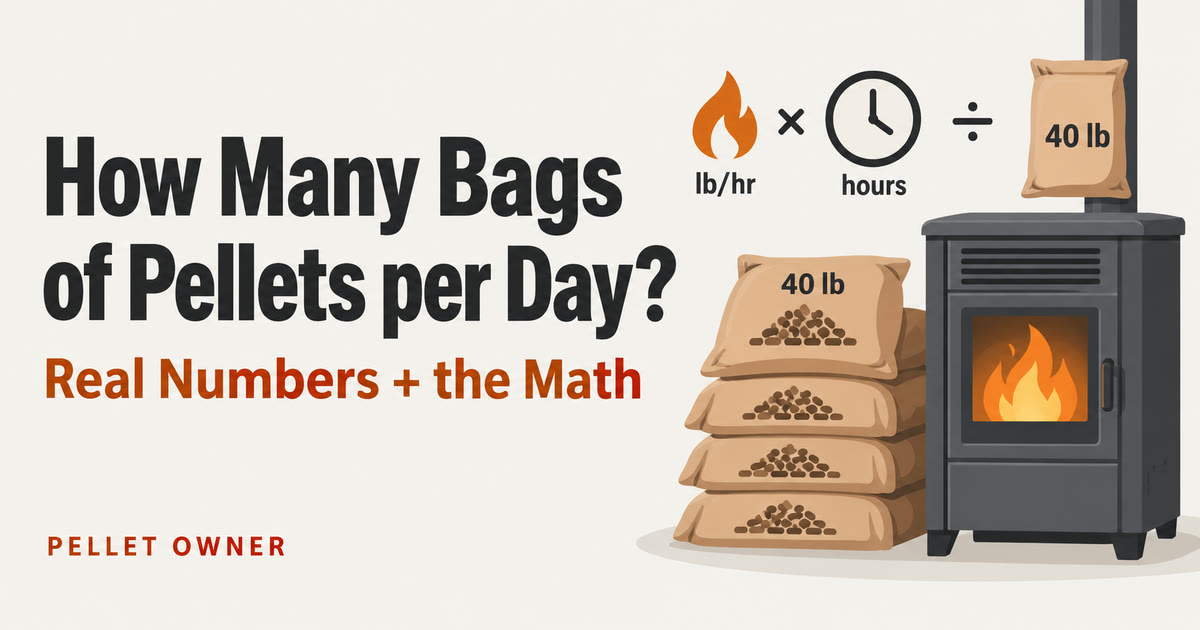
bags per day ≈ (your feed rate in lb/hr × hours you run) ÷ 40
Everything else — house size, climate, insulation — matters only because it decides which feed rate you spend your day at. A tight house in a mild spell idles on low; a leaky house in a cold snap lives on high.
(If you want to sanity-check against heat output rather than weight: pellet fuel runs around 8,000 BTU per pound as a rough industry figure, and stoves publish their BTU range — a PelPro PP130, for instance, lists roughly 9,600–40,700 BTU/hr output. But for ordering fuel, weight × hours is the number you can actually count.)
Bags per day by home size and climate (estimates)
The table below is an estimate, not a measurement. It’s built from the feed-rate math above plus what owners commonly report, and it assumes a stove used as the primary heat, average insulation, and a whole-home layout that the stove can actually reach. Your real numbers will differ — treat this as a starting point for ordering, then correct it with the three-day test in the next section.
Assumptions: 40-lb bags · stove run ~16 hrs/day in cold weather · average insulation · pellet ~8,000 BTU/lb.
| Home size (heated area) | Mild day (~45 °F) | Cold day (~25 °F) | Deep cold (~5 °F) |
|---|---|---|---|
| Small (~800 sq ft / one zone) | ⅓–½ bag | ½–1 bag | 1–1½ bags |
| Medium (~1,500 sq ft) | ½–1 bag | 1–1½ bags | 1½–2 bags |
| Large (~2,200+ sq ft) | 1 bag | 1½–2 bags | 2–3 bags |
Read it as ranges, not targets — a drafty large home in deep cold sits at the top of its cell, a well-sealed one at the bottom. Colder climates simply spend more days in the right-hand columns, which is why a Vermont season burns more tons than a Virginia one for the same house.
Tons per season: how much to order
Owners buy by the ton for a reason — it’s cheaper per bag and it’s one delivery. The community rule of thumb, worth exactly what a rule of thumb is worth: about one ton per month of real winter. A household running the stove hard from December through February often lands around 3 tons; add shoulder months or a colder climate and 4–5 is common.
A few practical notes owners learn the hard way:
- A ton is a 50-bag pallet (50 × 40 lb = 2,000 lb). Order in whole tons to get pallet pricing.
- Buy early. Pre-season prices climb once it gets cold and pallets get scarce in a hard winter — the reason you’re reading this in September.
- Store dry. Pellets are compressed sawdust; they drink humidity and swell, which turns a smooth-feeding auger into a jammed one. Keep pallets off a damp floor and covered.
Measure your own burn rate in three days
Here’s the honest truth every table on the internet dances around: year one is an estimate; year two should be data. Your house, your climate, your thermostat habits, and your pellets combine into a number only your stove knows — so measure it.
- Fill the hopper and note the date, the setting you actually run, and the rough outdoor temperature.
- Count bags as you add them over three representative days (not the mildest of the season, not the single coldest).
- Divide: bags ÷ days = your real bags-per-day at that weather. Multiply out a month and you’ve got your ordering number — far better than any table, because it already includes everything your house does that a stranger’s spreadsheet can’t.
Do this once in early winter and you’ll never over- or under-order a pallet again. That’s the payoff: not a number I can hand you, but a five-minute habit that hands you your own.
Why your neighbor burns half what you do
Same stove, same town, wildly different pellet bills — it happens constantly, and it’s not mysterious:
- Insulation and air-sealing. The single biggest lever. A tight house holds the stove’s heat; a leaky one pours it outside and keeps the stove on high.
- Setting and run-time habits. A stove idling on low all day sips; one cycling to high burns.
- Layout. A stove heating an open floor plan does more with less than one fighting a hallway.
- Pellets. Species and quality shift BTU per pound and how cleanly it burns — enough to matter over a season (a topic for its own guide).
None of that changes the math — it just changes which feed rate you spend your winter at, and therefore how many bags a day you go through.
FAQ
How long does one 40-lb bag of pellets last? Anywhere from about 8 hours (running hard on high) to 40 hours (idling on low), because feed rate ranges from roughly 1 to 5+ lb/hr depending on setting. For a stove used as primary heat, one bag a day is a common average, more in deep cold.
How many tons of pellets do I need for the winter? A rough planning figure is one ton per month of real winter — often 3 tons for a Dec–Feb heating season, 4–5 with shoulder months or a cold climate. Measure your own bags-per-day early in the season to firm it up before ordering.
How many bags of pellets per day in cold weather? On a genuinely cold day with the stove working, one to two-plus 40-lb bags is typical, versus a half bag or less on a mild shoulder-season day. Home size and insulation set where in that range you land.

Walt Hensley — Walt Hensley is the pen name of Pellet Owner’s editor. I’m not an NFI-certified technician, and I don’t sell stoves, pellets, or parts. Every guide here starts from the manufacturers’ owner’s and service manuals, is cross-checked against what owners consistently report, and says which is which — including what you can safely check yourself and when it’s time to call a certified technician.