Pellet Stove Burn Pot Overflowing? Causes and the Safe Fix
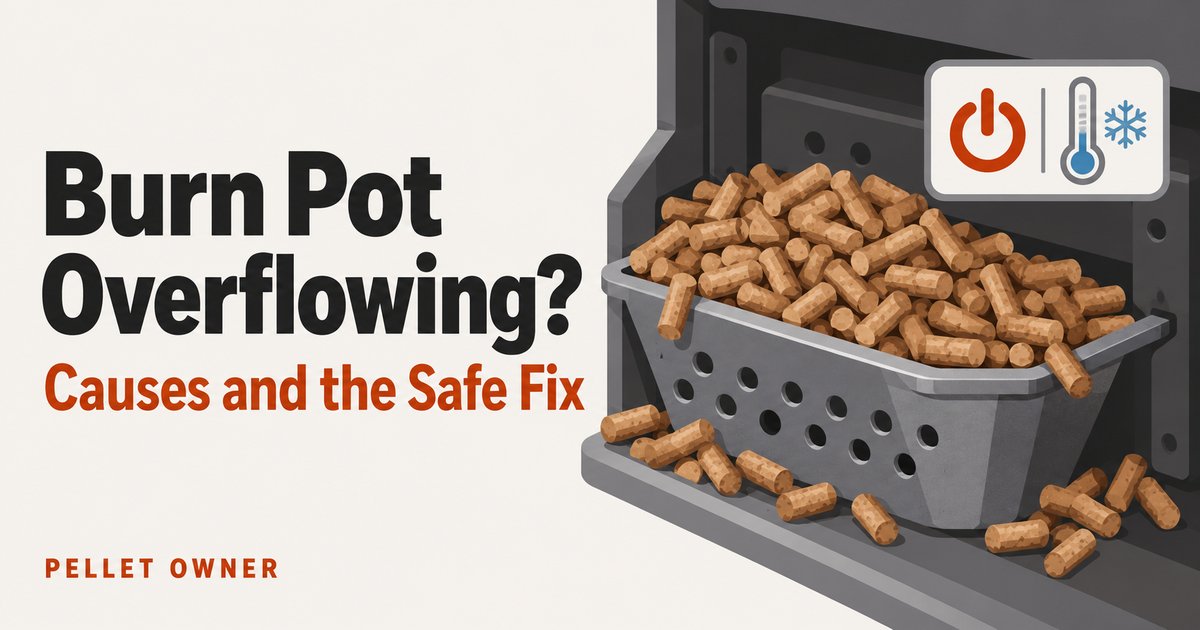
An overflowing burn pot means fuel is arriving faster than the fire burns it. Three different problems do that: a burning stove fed more than its air can handle (dirty pot or vent, leaky gasket, damp pellets, feed set high), a failed start that left a pot of unlit pellets, or a feed that won’t stop. Turn the stove OFF with its controls, let it go cold and empty the pot before any restart.
Smoke or a CO alarm comes first. If smoke is filling the room, a CO alarm sounds, or anyone feels unwell: turn the stove OFF at its controls on your way out (don’t unplug it), get everyone outside, and call 911 from there. For lighter smoke, each brand has its own rules, in the safe order below; they come before you open the stove.
Which kind of overflow do you have?
The manuals answer two different questions here: how to tune a stove that’s overfeeding, and what to do with a pot that never lit. Mix them up and you relight on top of a heap. Start with what you see:
| What you see | What it points to | First move |
|---|---|---|
| The fire is burning, but the pot piles up or unburned pellets drop into the ash pan | Feed outrunning air: dirty pot or vent, leaky gasket, damp pellets, feed set high | Clean it cold, then turn the feed down |
| A pot full of pellets that never lit (Harman 5 blinks, PelPro red 4, Englander E-2) | A failed start: the stove fed pellets during its ignition cycle | The safe order below, then the ignition cause |
| Pellets keep coming, or fuel spills over the pot with an oversized flame | A fault; PelPro calls it “Feed Motor locked on” | OFF at the controls, then a technician |
| A smoky start-up or puffs of smoke | Harman’s -C manual: “Either the burnpot is dirty or there is too much fuel at start-up and not enough air” | Smoke in the room: the box above. Before the next start, a clean, empty pot |
Not a fault: a big flame at start-up. Harman’s -C manual calls it normal (“Flame will settle down once the fire is established”), and Englander’s SBI manual says “Variation in the flame height is normal.”
Is an overflowing burn pot dangerous?
It depends which one you have. Harman’s -C owner’s manual, on a burning stove with the feed turned up, says: “The unit’s maximum burn rate should not create less than 1” of ash on the burn pot front edge. Overfeeding is not a safety concern, but fuel may be wasted if unburned pellets fall into the ash pan.” That covers a stove burning with its feed a notch high. It doesn’t cover a pot of pellets that never lit, or a feed motor stuck on.
What does make it a safety problem, per the manuals:
- Starting on top of too much fuel: the -C’s smoky start-up answer above, and the P43’s warning that TEST “again and again may purge too much fuel into the burn pot causing excessive smoke on start-up.”
- Unburned fuel in the ash pan at lighting: “This will cause smoke and soot and other unwanted results” (P43; the -C and P61 carry the same rule).
- Ash build-up: Englander says too much ash “hampers airflow… and can cause smoke-back.”
- A feed that won’t stop, PelPro’s “Feed Motor locked on.”
No manual in my set documents this, but owners on hearth.com describe start-ups where the firebox filled with smoke and then lit all at once, with a bang (a Harman P61 thread from 2009; a P52i owner in 2018 reported “a lot of smoke before the pellets ignited”). The suspects those threads name are a dirty or overloaded pot, ash on the igniter and damp pellets. Individual reports, not statistics, and they point where the manuals do.
What should you do with a burn pot full of pellets?
Warnings first, then hands.
- Turn it OFF with its controls, never by pulling the plug. Every manual in my set says not to unplug a hot stove; the ones that say why point to smoke in the room.
- Handle smoke your brand’s way before you open anything.
- Any brand, heavy smoke, a CO alarm or anyone unwell: the box above.
- Englander: if it failed to start or didn’t finish shutting down, “open the closest outside door and a window… BEFORE opening the stove’s door or hopper lid.” Smoke in the room: its smoke-back steps (don’t open the hopper or door, “DO NOT UNPLUG UNIT!!”, press OFF, air the room for at least an hour, call support before restarting; after a power failure, the manual’s own restart steps).
- Harman: the -C and P61 manuals warn that with smoke in the firebox, opening the load door lets it escape. Keep it shut until it clears.
- PelPro PP130-C: “let Stove completely cool and exhaust blower must be off” before unplugging, because “Smoke spillage into room can occur if Stove is not cool before unplugging.”
- Airing the room makes sense with any brand; only Englander prints it as a step.
- Let it finish shutting down and go completely cold. Harman’s -C: “Never attempt to manually light a stove or insert that has been operated recently and is not at room temperature”; after an automatic attempt, at least 30 minutes. Englander: firebox metal “can remain HOT… EVEN after the Shut-Down cycle is complete.”
- Then unplug it before your hands go in, cold and with the exhaust blower stopped. PelPro: “Disconnect Stove from power supply before servicing.”
- Empty the pot. That’s the site’s rule for every brand; here’s how each
manual backs it:
- Englander requires it before every press of ON: with the unit cool, remove the wear plate and dump the ashes, “burnt or partially burnt.”
- PelPro, if the stove doesn’t ignite “on the initial burn,” starts with “Turn the dial control to off, remove and clean the fire pot.” For a later red 4, the alarm table’s fix for a dirty pot is “Clean the Fire Pot,” with the stove “turned off and cold.”
- Harman prints no emptying step after a failed start. It asks for no unburned fuel in the ash pan before lighting, and its line that a small amount of new fuel “is not a problem” belongs to the weekly scraping routine, not to a full load that never caught. Emptying it cold is good practice, the way owners do it.
- The scraping itself, brand by brand and hot or cold, is in how to clean a pellet stove burn pot.
- Bin it like ash: a metal container with a tight-fitting lid, on a noncombustible floor or the ground (P43, PP130 and Englander manuals). Vacuum only when it’s all cold; PelPro says to be sure “embers are thoroughly cooled to prevent a fire in the vacuum.” My rule: whatever comes out of the pot doesn’t go back into the hopper.
- Fix the cause, then use your manual’s normal start. Englander: ON once. PelPro: priming “is only required the first time your Stove is lit, or after a FUEL FEED ALARM.” Harman: one 60-second TEST cycle, only if the hopper ran empty; the Harman case in detail is in the Harman 5 blinks guide.
Why is my burn pot filling up?
The stove is burning, but fuel lands faster than it burns. The manuals list the same suspects:
- Harman, “PARTIALLY BURNED PELLETS”: “1. Feed rate too high. 2. Poor air to fuel mixture. (Check burn pot clean-out cover and air intake). 3. Burn pot or heat exchanger tubes may need to be cleaned” (P43 and -C). The P61’s list has “Draft too low. (Check burn pot clean-out slide and door gasket)” instead of the air-to-fuel line.
- PelPro PP130-C, “Large, lazy flame, orange color. Black ash on glass”: a dirty stove, high-ash fuel (“Try a different brand of pellets”), the trim, or a feed motor locked on.
- Englander, “Lazy fire”: board settings, a bad exhaust blower, pellet moisture (“Keep pellets inside”), excessive ash (“Remove baffles; Clean unit”) and low-quality pellets.
- Fuel: Harman caps moisture at 8%; PelPro says “Damp pellet fuel can clog the feed system”; and Englander’s SBI manual says wet or high-ash pellets make the pot “fill with ash at a more rapid pace.”
Most owners advise checking airflow before blaming the auger: the hearth.com threads that ended in a fix found a vent elbow nearly packed with soot, or smoke passages left uncleaned for years. Some owners blame the vacuum switch for overfeeding, but in the manuals that switch does the opposite: on the P43, “Poor draft will result in an interruption of power to the feeder and the igniter”; on an Englander, it “will either stop the top (feed) auger or shut the unit off”; on the PP130-C, the feed motor runs only with the vacuum switch closed. A tall flame can mean low air or an overfed pot, with opposite fixes; reading the flame tells them apart.
How do you turn the feed down on your stove?
One change at a time, and give the fire time to settle.
| Stove | What you adjust | The manual’s reference |
|---|---|---|
| Harman P43 (classic) | Feed Adjuster: 4 for most premium pellets, 5 or 6 for higher-ash fuel | At maximum, about 1” of ash on the front of the pot; less, turn it down. Not a hard line: if 1” isn’t obtainable at #6, “it is not a problem” |
| Harman -C (P43-C, P61-C, P68-C) | Feed Limit, factory set at #4 | Adjust after 15 minutes of burning, then allow 15 minutes. “Black sooty tips,” orange and lazy, or “rolling against the top of the firebox”: reduce. Never less than 1” of ash at the front edge at maximum |
| Harman P61 (classic) | Feed Adjuster | About 1” of ash in front of the fire at maximum; “too high of a feed rate will waste fuel” |
| PelPro PP130-C | No feed knob; the Trim dial, 1 to 9, factory 5 | Too large, lazy or sooty: one step counterclockwise, wait 15 minutes. Normal feed: “on between 1 and 4 seconds out of every 7” |
| Englander 25-PDV / 25-PDVC | The Heat Range only | It sets the top-auger feed; the lower buttons are factory presets, and the SBI board “automatically adjusts the air to fuel ratio.” High consumption: premium pellets, then support |
Pot full of pellets that never lit: a failed start
The codes name it: Harman’s 5 blinks (the stove “failed to light within the 36 minute start cycle,” Igniter AUTO only), PelPro’s red 4 (a missed ignition after one automatic retry, with causes that include a fire pot “Dirty so fuel is not near ignition hole”) and Englander’s E-2, “Fail to Start.” The P43 adds that after a power outage, in its Manual setting, the feeder may restart on a dead fire. Empty the pot the safe way first, then chase the ignition cause in why a pellet stove won’t ignite.
Lighting by hand: only your own manual’s procedure. The -C allows it only as an emergency, cold, with the pot “only half way. (Do Not Over Fill)”; the P43 fills “only level with front edge”; on the classic P61, always lit by hand, “just short of overflowing” is the normal start. Englander says to “first clean any pellets out of the burn pot (to prevent over-feeding),” and PelPro has no manual-lighting procedure at all.
Don’t stack starts. Repeated TEST on a P43 means too much fuel; a second ON restarts an Englander’s start-up; and during a PelPro start, “DO NOT: Try to restart, manually add pellets or use any type of accelerant.”
What if pellets keep coming, or fuel spills over the pot?
That’s a fault, not a setting. PelPro lists “Excessive fuel spilling over the fire pot into the ash wells and/or excessive flame” under “Feed Motor locked on” and sends you to its feed-motor fix: a short circuit, board and component replacement, technician work. Its first step, opening the hopper to stop the motor, is a PP130-C instruction for that one fault, never with smoke or fire in the hopper; the limits are in pellet stove won’t turn off. On an Englander in Shut-Down the bottom auger keeps turning by design, but the top auger stops at once, so fresh pellets still dropping after OFF mean a call to support. Harman’s manuals have no entry for it; in one forum thread, a P43 that kept feeding without lighting came down to the igniter circuit or the board. Either way, a technician.
What not to do
- Don’t light by hand on top of a loaded pot or a stove that’s still warm, and don’t add pellets or accelerants.
- Don’t unplug a hot stove, or open the door or hopper while there’s smoke.
- Don’t press ON over and over or repeat TEST.
- Don’t jumper switches or change an Englander’s lower buttons.
- Don’t modify the pot (“no additional grates or other fire elevators,” says Englander’s SBI manual) or run with the pot floor open (PelPro, Harman -C).
FAQ
Is it normal to find unburned pellets in the ash pan? On a burning Harman -C with the feed set high, the manual calls it wasted fuel, not a safety issue. Either way, clear them before the next light: unburned fuel in the ash pan at lighting “will cause smoke and soot,” says the P43.
Can I relight a pellet stove with pellets still in the burn pot? Not on top of a load that failed to catch. Harman’s “small amount of new fuel” line is about the weekly scrape, and Englander wants the pot cleared before every ON. Empty it cold, then start normally.
How full should a pellet stove burn pot be? No manual gives a fill level for normal running. The levels you’ll read (P43 “level with front edge,” -C “half way,” P61 “just short of overflowing”) are for lighting those models by hand. In operation, the Harman check is the ash at the pot’s front edge at maximum.
Can wet pellets make the burn pot overflow? They can make it worse: the manuals say damp pellets clog the feed, burn poorly and fill the pot with ash faster. Store them dry.
Does a bad vacuum switch cause overfeeding? Not according to the manuals. Low draft makes the switch cut or stop the feed; it doesn’t add pellets. Look at the air path and the feed setting instead.

Walt Hensley — Walt Hensley is the pen name of Pellet Owner’s editor. I’m not an NFI-certified technician, and I don’t sell stoves, pellets, or parts. Every guide here starts from the manufacturers’ owner’s and service manuals, is cross-checked against what owners consistently report, and says which is which — including what you can safely check yourself and when it’s time to call a certified technician.