Pellet Stove Igniter Replacement: Test It Before You Buy It
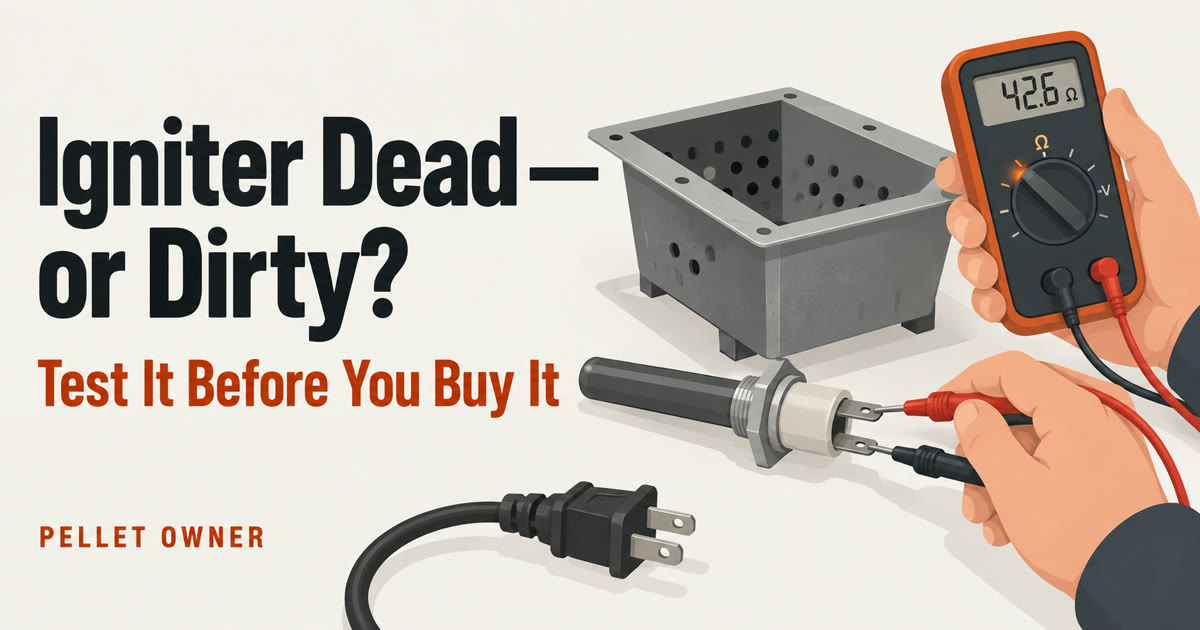
Don’t buy the igniter yet. Owners often find that a “bad igniter” is really an ash-choked burn pot, starved airflow, or a mispositioned element — all free fixes. A truly dead igniter shows two things: no glow at all during a start cycle, and an open circuit (infinite ohms) on a multimeter test done with the stove cold and unplugged. Confirm both first. If it’s truly dead, check your manual: some, like PelPro’s PP130, print the replacement steps; if yours doesn’t, ask your dealer.
That’s the whole article in one paragraph. Now let me talk you out of the parts order for a few minutes, because the forums are full of threads where owners replaced the igniter — sometimes the burn pot too — and the real fault turned out to be ash, igniter position, or low voltage.
Are you sure the igniter is actually bad?
An igniter is only one of several reasons a pellet stove won’t light. I keep a full ordered checklist in the won’t-ignite guide, and if you haven’t worked through it, do that first — this article picks up where it leaves off. The short version of what has to be ruled out before the igniter takes the blame:
- Ash in the burn pot and its air holes. PelPro’s PP130 troubleshooting lists a dirty fire pot and debris in the igniter chamber among its ignition failures, and owners commonly find this is the culprit. An igniter can glow perfectly and still not light pellets sitting on plugged holes, because the airflow that carries its heat into the fuel isn’t moving.
- A stove overdue for a real cleaning. Ash packed in passages and around the blower recreates the same starved-air problem one level up. If it’s been a season, run the deep clean checklist before you condemn any part.
- Blocked or leaky airflow. Dirty combustion blower, blocked vent cap, unlatched door or hopper lid. No draft, no fire — and on Harman’s P43, for one, poor draft interrupts power to the feeder and the igniter, which looks exactly like a dead igniter.
- Low voltage or a poor connection. PelPro’s PP130 says to plug the stove directly into a properly grounded 3-prong receptacle (a surge protector is recommended). Owners report that a light extension cord can leave the igniter too cool to catch — a “sometimes it lights, sometimes it doesn’t” pattern.
- Igniter position. The sneaky one. An electrically perfect igniter sitting a half-inch off — wrong depth, off-center in its tube — won’t light the stove, because the start-up air isn’t carrying its heat into the pellets. If it was ever removed or replaced, compare its position against the diagram in your manual before anything else.
- Damp or degraded pellets. Harman’s P43 warns that high-moisture fuel “may not burn properly” and that overlong pellets can cause inconsistent feeding and ignition. Fresh, dry pellets from a known-good bag remove this variable.
Cleared all six and it still won’t light? Now the igniter is a legitimate suspect — and you don’t have to guess, because you can test it.
How can you tell if a pellet stove igniter is really dead?
A dead igniter has a specific signature:
- No glow, ever. During a start cycle with a clean, empty burn pot, you never see that spot of orange-red heat where the igniter sits — not slow, not faint, just nothing.
- Starts keep timing out. The stove runs its start window and throws its ignition-failure error, with a cold pot. Know your model’s window before judging it — Harman’s P43 allows 36 minutes, PelPro’s PP130 up to 20 minutes and retries once on its own, and Englander’s igniter start-up cycle is 13 minutes — and make sure you’re reading an actual error: owners commonly mistake some displays’ settings numbers for fault codes, like the Englander readouts.
- A manual light works — if your manual has one. Light by hand only when your manual gives a procedure for it, and follow that procedure exactly. Harman’s P43 has a MANUAL igniter setting for igniter failure, with its own lighting steps (starting gel and a match). The -C models (P43-C, P61-C, P68-C) follow a different emergency procedure in their owner’s manual (8390-044C, R26): cold stove only, at least 30 minutes after a failed automatic start, igniter switch on “Disabled,” burn pot only half full. Englander’s 25-PDV and 25-PDVC manuals allow a manual start only when the auto-start doesn’t kick in, using wax-impregnated wood chips, cardboard cubes, or firestarter chips made for pellet stoves — never placed near the igniter. PelPro’s PP130 manual has no manual-lighting procedure and forbids liquids or gels to start a fire. None of them allows gasoline, kerosene, or lighter fluid. If your manual’s manual start works and the stove then runs well, the combustion side is healthy and the finger points harder at the igniter.
One pattern that does not mean a dead igniter: intermittent lighting, or a stove that lights and then dies mid-burn. Owners report that igniters tend to fail all-or-nothing, like a light bulb. Sometimes-lights points back at voltage or airflow, and a stove that lights but keeps shutting off has a different problem entirely — a new igniter won’t touch it.
How do you test a pellet stove igniter with a multimeter?
This is the test that settles it, and it costs about as much as a cheap multimeter. I’ll give you the concept here; your manual has the specifics for your stove’s access and connector.
Safety first, in this exact order: shut the stove down from its controls, let it complete its full shutdown cycle, let it go completely cold, and then unplug it. Never yank the plug on a running stove — the exhaust blower needs to finish its job. And nothing in this test happens with the stove plugged in. Installation and service procedures do include live-voltage measurements, but those belong to a qualified technician, not to a weekend DIY session.
The test itself:
- Stove cold and unplugged, find the igniter’s electrical connector (your manual’s wiring diagram shows where) and disconnect it.
- Set the multimeter to resistance (ohms) and measure across the igniter’s two leads.
- Read the result. An open circuit — an infinite or “OL” reading — means the heating element is burned through. That’s a dead igniter, and buying a replacement is now money well spent.
What about the actual number, if it’s not open? Here’s where I have to be straight with you: no owner’s manual I’ve been through publishes an igniter resistance spec. The numbers that circulate are owner-reported. As a community reference point, owners consistently report readings in roughly the 35–60 Ω range for their models, with many common cartridge igniters landing around 40–50 Ω — and legitimate outlier designs read down in the low 20s. So treat the range as orientation, not gospel: an open circuit is definitive; for anything else, what owners of your model report — and your model’s own service documentation, if you can get it — beats any generic number, including mine.
How do you replace a pellet stove igniter?
Once the test says dead, the swap is one of the friendlier repairs on a pellet stove whose manual covers it. The procedure varies by brand and model — your manual has the exact steps, and this is a job where you follow them (Englander’s manuals, for one, don’t print igniter replacement steps, so ask their support) — but where a manual does, the shape of the task looks like this:
- Get the right part. Order by your stove’s model and serial number (the PP130 manual asks for both), not by eyeballing photos — look-alike igniters can differ in wattage, length, and mounting.
- Full shutdown, fully cold, then unplug. Same ritual as the test. No exceptions, no “it’s only warm.”
- Access the igniter the way your manual shows. On PelPro’s PP130, that means removing the left side panel and unplugging the igniter’s wire leads. Expect ash — have the ash vacuum handy.
- Free the old igniter. On the PP130, you loosen the wing screw at the top of the igniter chamber and slide the igniter out; other stoves use their own fastening. Note how it sits before you pull it.
- Install the new one in the same position. This is the step that bites people. PelPro wants it pushed fully forward and centered in its chamber — an igniter installed slightly off is how you end up back at the “brand-new igniter won’t light” forum thread. On Harman’s P43, the igniter’s wire connections must be pulled to the rear of the feeder body, never coiled inside the burn pot, with the spare wire tied up clear of moving parts. Match the diagram in your manual, not your memory.
- Reconnect, close up, test. With a clean burn pot, run a normal start exactly as your manual describes (PelPro forbids restarting or adding pellets by hand mid-start), and watch for the glow.
Where do I stop? If a good igniter never gets power, that’s wiring, a safety interlock, or the control board — live-voltage territory. Same if the job on your stove involves disturbing the venting. I’m not an NFI-certified technician and I don’t play one on the internet; that’s the point where you call one.
How much does a pellet stove igniter cost?
As of September 2026, owners typically report paying about $40–80 for a replacement cartridge igniter, with some brand-specific or dealer-only parts running higher. That’s the market talking, not a price list — check current prices for your exact model. Either way, it’s a fraction of a service call, which is why the twenty minutes of testing to confirm you actually need one is time well spent.
FAQ
How do I know if my pellet stove igniter needs replacing? Rule out the free stuff first — ash-blocked burn pot, airflow, voltage, igniter position (full checklist in the won’t-ignite guide). A genuinely dead igniter shows no glow at all during a start cycle and reads as an open circuit (OL) on a multimeter with the stove cold and unplugged.
What should a pellet stove igniter read in ohms? No owner’s manual publishes this number, so treat any figure as owner-reported. Owners consistently report roughly 35–60 Ω across common models, with outlier designs reading lower. An open circuit means dead; for anything else, compare against your model’s owner reports and service documentation.
Can I replace a pellet stove igniter myself? On some stoves, yes. PelPro’s PP130 manual prints a full replacement procedure, and Harman’s P43 says its igniter is made to be removable for service; Englander’s manuals don’t give replacement steps, so ask their support. Either way, the stove must be fully shut down, cold, and unplugged, and you follow your manual’s steps. Anything involving live-voltage diagnosis or the venting is a job for an NFI-certified technician.
Why won’t my pellet stove light with a brand-new igniter? Either the igniter wasn’t the problem, or the new one is installed slightly out of position. Plugged burn pot holes, weak airflow, and mounting depth stop a new igniter just as effectively as they stopped the old one. Recheck position against your manual’s diagram and work the cleaning-and-airflow checklist before blaming the new part.

Walt Hensley — Walt Hensley is the pen name of Pellet Owner’s editor. I’m not an NFI-certified technician, and I don’t sell stoves, pellets, or parts. Every guide here starts from the manufacturers’ owner’s and service manuals, is cross-checked against what owners consistently report, and says which is which — including what you can safely check yourself and when it’s time to call a certified technician.