Pellet Stove Keeps Shutting Off? Timing Tells You Why
Ask five people why a pellet stove keeps shutting off and you’ll get five answers — proof of fire, vacuum switch, dirty pellets, bad blower — and every one of them is sometimes right. That’s exactly why the forums are so frustrating on this: the threads contradict each other because the people in them had different problems that all look the same from the couch.
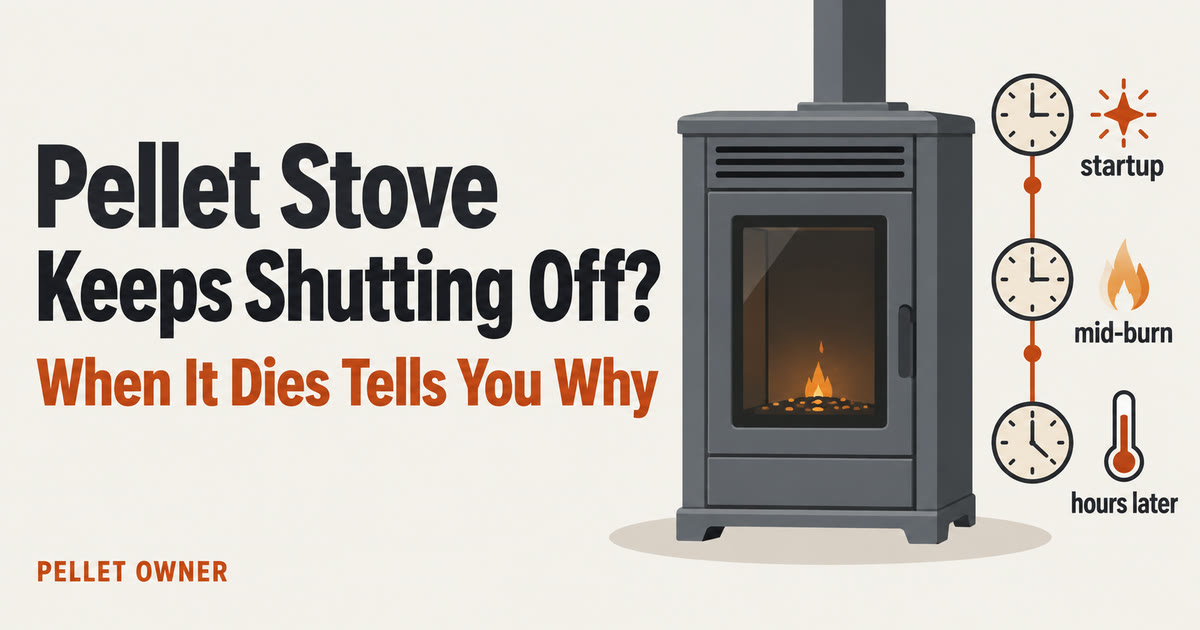
Here’s the trick that cuts through it: note when the stove dies. The moment it quits — during startup, half an hour in, or hours later — narrows the suspect list more than any single part swap. Work it by timing and the contradiction disappears.
Before hands go inside anything: shut the stove down from its controls, let it finish its cooldown cycle, let it go completely cold, and then unplug it — in that order. Pulling the plug on a running stove can spill smoke into the room, and the auger and hot surfaces don’t care that you’re troubleshooting. Nothing here involves testing with live wall power; that’s a technician’s job.
First, note when it shuts down
Three patterns, three different short-lists:
| When it dies | What it usually means |
|---|---|
| At startup, or soon after — never really caught fire | Ignition never “proved”: weak igniter, ash-plugged burn pot, not enough starting fuel, or the temperature sensor never saw heat rise |
| Mid-burn (30–60 min, or on and off) — fire was going, then faded | Fuel delivery faltering (bridging/fines), a lazy air-starved flame, or an intermittent draft/vacuum switch |
| Hours later or at random | Overheat safety tripping, hopper running low, an unlatched lid, or wind/downdraft |
If it cycles off and back on with the room already warm and no code, that’s the thermostat doing its job — see pellet stove thermostat.
Find your row, then read the matching section. If two rows sound like you, start with the earlier one. If it isn’t shutting down at all but misbehaving some other way, the pellet stove troubleshooting guide starts from the symptom.
Pattern 1 — It dies at startup (it never proved fire)
Every controller wants confirmation that a fire actually started, and it watches a temperature sensor to get it — though which sensor differs by brand. Harman and PelPro read an exhaust temperature probe; the classic Englander 25-PDV uses a heat sensor on the stove body feeding its control board instead. Either way, if the controller never sees temperature climb the way a real light produces — within its startup window — the stove gives up and shuts down, often with a code. It may already have fed pellets during that window, so check the burn pot with the stove off before any restart and follow your manual’s restart steps: lighting on top of a pot full of unburned pellets can mean a smoky start.
So a stove that quits early is usually telling you it couldn’t get a fire established, and the causes are the same ones behind a stove that won’t ignite at all:
- Ash-plugged burn pot. One of the most common causes owners find, and free. Crusted air holes choke the fire before it establishes. Scrape the pot, clear every hole, and vacuum the cavity underneath.
- Weak or misplaced igniter, or not enough starting fuel in the pot.
- A sensor that never saw heat. On Harman’s P61, for example, the manual is explicit: the feed motor won’t run until the exhaust probe senses 165 °F — if the fire’s not building heat, the stove won’t keep feeding it.
About the startup window — stoves are far more patient than people expect, so “it ran ten minutes then quit” is normal behavior for a stove that failed to light, not a bonus clue. A Harman P43 runs a full 36-minute start cycle before it gives up (and flashes 5 blinks). A PelPro PP130’s manual says to allow up to 20 minutes to start, and it will automatically retry once after a missed ignition. Englander’s classic 25-PDV is the odd one — its own manual quotes different startup times on different pages, so treat “about twenty minutes” as the idea, not a stopwatch. The takeaway: don’t diagnose a “shutdown” until the stove has actually finished trying.
Pattern 2 — It dies mid-burn (the fire faded)
The stove lit, ran, and then the flame starved out. This is usually a fuel-or-air problem.
- Fuel delivery faltering. If the flame shrinks and dies, the burn pot may be running out of pellets faster than they arrive — bridging (pellets arching over the void in the hopper) or fines packing the auger. That’s the auger-not-feeding diagnosis; a stove that shuts off because it ran out of fuel in the pot will often log the same “lost fire” code as a failed startup.
- A lazy, air-starved flame. Tall, orange, and slow instead of bright and active means poor combustion — usually a dirty burn pot, dirty combustion blower, or a clogged exhaust path. On a Harman, sustained poor combustion is exactly what triggers the 6-blink shutdown: the board tracks feed settings against exhaust temperature and cuts the stove as a safety measure when the math says it’s burning badly.
- An intermittent vacuum/draft switch. This little safety device watches for adequate draft; if its sensing port or hose is partly clogged with fly ash, it can drop out mid-burn and pull the stove offline — then read “fine” when you check it cold. It’s a prime phantom-shutdown suspect. See how the vacuum switch works.
Most of Pattern 2 is a cleaning problem in disguise. If the stove hasn’t had a proper deep clean recently, that’s the first move, not the last.
Pattern 3 — It dies hours later, or at random
When a stove runs happily for hours and then quits, or quits on no schedule you can pin down, the list changes:
- Overheat safety tripping. Stoves protect themselves from overheating, but
how they do it varies by brand — this is where the internet’s generic
“reset the high-limit and wait 30 minutes” advice falls apart, because it
doesn’t describe most stoves accurately:
- Englander 25-PDV has no separate resettable high-limit disc. A thermal sensor at the back of the firebox reports to the control board, which throws E-3, “Over Temperature Limit.” The manual’s direction is to check the combustion blower wiring and call technical support if it persists — not to jumper anything.
- PelPro PP130 protects against overheating through its electronics: the manual lists an “8 Flashes: Exhaust Over Temperature” alarm when exhaust temperature exceeds the allowable limit, with causes like a feed motor stuck on, unapproved fuel, or a dirty/failed convection blower not carrying heat away. (It also has a separate manual-reset snap disc on the feed tube — a distinct safety device the manual covers under replacement, not the everyday overheat cutoff.)
- Other brands differ again. The honest rule: your manual tells you what overheat protection your stove has and how (or whether) you reset it. What you should never do is bypass it — if an overheat safety trips repeatedly, the cause is thermal (often a dirty convection blower not moving heat away), and that’s a job to fix, not a switch to defeat.
- Hopper running low. Some stoves get unstable or shut down as the hopper empties and feed gets erratic. Keep it above a quarter full.
- An unlatched hopper lid or door. Many stoves have a lid switch that stops the stove when it’s not sealed — an easy one to knock loose.
- Wind and downdraft. A gusty day can disturb draft enough to trip the draft-sensing safety on some installs.
The sensors behind the shutdowns
It helps to know these aren’t random gremlins — they’re safety devices doing their jobs. Which ones your stove has, and what it calls them, is brand-specific:
- The fire/heat sensor. What confirms a fire is real and burning well — but not the same device across brands. Harman (ESP, Exhaust Sensing Probe) and PelPro (Exhaust Probe) read exhaust gas temperature; the classic Englander 25-PDV instead uses a heat sensor on the firebox feeding its board. If the reading goes out of range or says the fire’s out, the stove shuts down — Harman flashes 3 blinks for an ESP fault, PelPro flashes 2 for an “Exhaust Probe Fail,” Englander logs E-2 for a failed start.
- Vacuum / draft (pressure) switch. Confirms adequate draft. Clogs with fly ash and causes intermittent, maddening shutdowns.
- Overheat protection. A thermal-sensor-plus-board scheme (Englander → E-3; PelPro → an “Exhaust Over Temperature” alarm). Same goal: cut the stove if it runs too hot.
No single sensor is universal — the concept of “confirm the fire, watch the temperature” is, but the hardware and the codes aren’t. Check your model’s manual for which sensor it uses and what its codes mean.
When it’s the pellets
Worth a separate mention because it’s common and cheap to rule out: damp pellets, or bargain pellets heavy with fines and filler, cause exactly the mid-burn fade and hard-starting that sends people chasing sensors. If shutdowns started with a new pallet of a different brand, try a bag of a known-good pellet before you order parts.
When to call a tech
Bring in a certified pellet stove technician (NFI) when:
- An overheat code (like Englander’s E-3) comes back after you’ve cleaned the blower and checked wiring — the cause is thermal and needs diagnosis.
- A vacuum switch, combustion blower, or exhaust sensor needs actual electrical testing (that’s live-power work).
- Any code persists after the reset procedure in your manual.
- The fix would mean disassembling or modifying the venting.
I’m not an NFI tech myself, and the principle behind this guide is simple: “keeps shutting off” is the stove protecting itself, and the job is finding what it’s protecting against, not silencing the alarm.
FAQ
Why does my pellet stove keep shutting off after about 20 minutes? On several models a shutdown near the end of the startup window points to a failed or missed ignition — the stove never established a real fire, so its sensor never confirmed heat. The exact window varies by model (a Harman P43 runs a full 36-minute cycle; a PelPro PP130 allows up to 20 minutes), so check yours. Look at the burn pot (ash-plugged holes), the igniter, and whether enough pellets are reaching the pot — the same causes as a stove that won’t ignite.
Why does my pellet stove shut off after running for hours? Different problem. Suspect an overheat safety tripping (often from a dirty convection blower not moving heat away), a hopper running low, or an unlatched lid. How the overheat protection works — and whether you reset it — depends entirely on your model.
Should I bypass the high-limit or safety switch to keep it running? No. These are the parts keeping a solid-fuel fire from becoming a house fire. If one trips repeatedly, fix the cause (usually heat not being carried away, i.e. cleaning) or get a technician — never defeat it.
Is a pellet stove shutting off always a broken part? Usually not. In owners’ reports, repeat shutdowns very often trace back to cleaning — a plugged burn pot, a caked combustion blower, or an ash-clogged vacuum switch port — long before any part is actually dead.

Walt Hensley — Walt Hensley is the pen name of Pellet Owner’s editor. I’m not an NFI-certified technician, and I don’t sell stoves, pellets, or parts. Every guide here starts from the manufacturers’ owner’s and service manuals, is cross-checked against what owners consistently report, and says which is which — including what you can safely check yourself and when it’s time to call a certified technician.