Harman 2 Blinks: Lid, Door or Draft? What to Check First
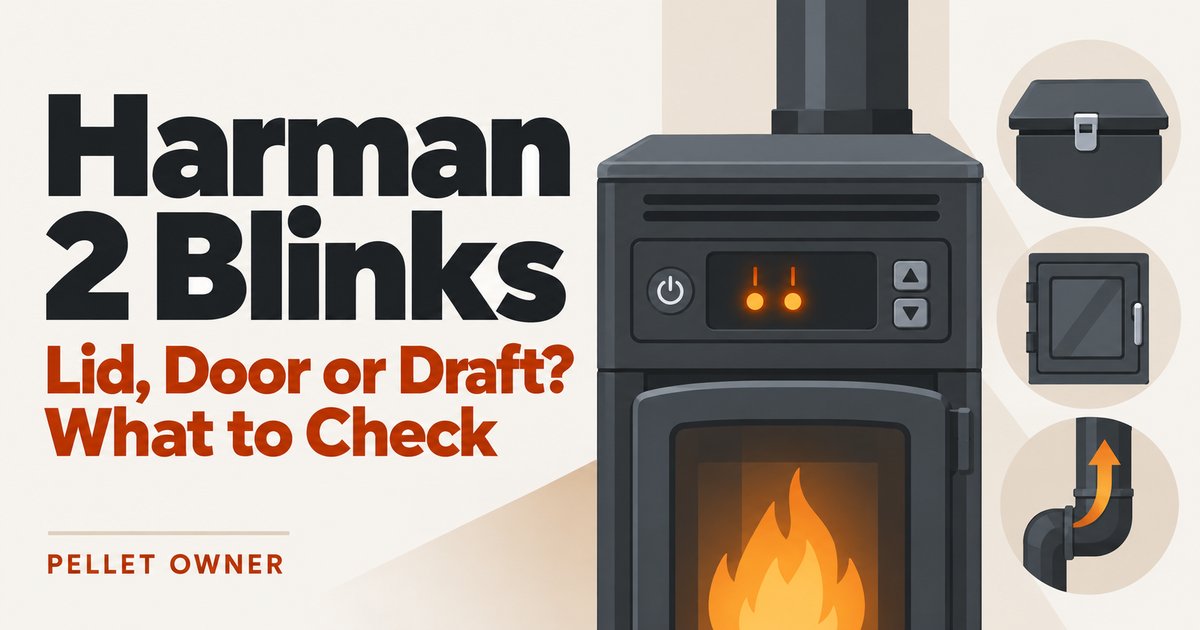
On Harman’s -C stoves (P43-C, P61-C, P68-C), two blinks means an open feed circuit, “typically from pressure switch or hopper switch,” so the stove won’t feed pellets. The owner’s manual says the code clears itself once the circuit is complete; in practice: lid latched, doors closed and sealed, draft restored. There’s no reset and no reason to unplug. Still blinking with everything closed and clean? Call your dealer. Classic P43 and P61 manuals don’t list 2 blinks.
This is the deep dive on one code. Counted a different number? Start with the full Harman blink code table. Not sure it’s a code at all? The symptom-by-symptom troubleshooting guide starts from what the stove is doing instead.
Smoke or a CO alarm comes before anything below. Two blinks tells you the stove stopped feeding, not that the room is safe.
- Harman’s -C manual: shut down with the Mode Selector at OFF. “If you pull the plug to shut down the stove, all motors will stop. This may cause incomplete combustion and smoke in the firebox. If the load door is opened, the smoke may escape.” Unplug only for servicing, once the stove is “completely cool and combustion blower must be off.”
- This site’s rule, not Harman’s text: if a CO alarm sounds, the smoke is heavy, or anyone feels unwell, turn the stove OFF at its controls on your way out (don’t unplug it), get everyone outside, and call 911 from there. A lingering smoke smell or visible smoke without an alarm: shut down from the controls, ventilate, call your dealer, and don’t relight until it’s checked.
What does 2 blinks mean on a Harman?
I checked the -C owner’s manual line by line, in both editions (P-Series R26, 11/25, and the Pathfinder-branded 08/26, same text). Its status-light table:
“2 Blinks: Indicates an open feed circuit, typically from pressure switch or hopper switch. Blink status automatically clears when feed circuit is complete. Does not blink if door/hopper is opened when stove is off.”
The pressure switch is a safety device. The manual calls it the Low Draft Pressure Switch, “a differential pressure switch that monitors the negative pressure (Draft) in the firebox. If the draft becomes too low for proper combustion, the switch opens, cutting power to the feed motor and the igniter circuits.” The same part shows up as the “firebox low pressure switch,” the “Differential Switch” in the parts list, or the “vacuum switch” on forums.
What you notice: pellets stop dropping and the fire burns down.
Which Harman do you have? 2 blinks isn’t on every board
- Classic P43 (manual R18, 03/13): “Feed Adjuster,” AUTO/MANUAL igniter switch, Room Temp and Stove Temp modes. Lists 3, 4, 5 and 6 blinks, no 2. An open draft or lid switch shows in the indicator lights instead: during a feed cycle, “the feed motor light on the control will stay illuminated.”
- Classic P61, manual ignition (manual R10): lists 1, 3, 4 and 6, no 2.
- -C generation (P43-C, P61-C, P68-C): “Feed Limit,” AUTO/DISABLED igniter switch, Room Temp and Constant Burn modes. Lists 2, 3, 4, 5 and 6, no 1.
- Other boards: forum reports describe a different 2-blink meaning on some older boards (a J2 jumper on the P61-2’s control board; a feeder microswitch on very old P61s), and owners of non-C P43, P61A and P68 stoves report 2 blinks too. No manual I can cite covers those. Don’t assume the -C definition: identify your board with the manual for your serial number and your dealer. J2 and microswitch faults are technician work either way.
When do the 2 blinks show up? (That’s your first clue)
| When you see it | What it points to | First move |
|---|---|---|
| Right after a door or the hopper lid was opened with the stove running | An open circuit | Close and latch everything; the manual says the code clears itself once the feed circuit is complete |
| Right after a cleaning | Something not seated | Doors, lid and latch; the feeder cover if the yearly cleaning was done |
| Comes and goes: feeding stops for a few minutes, then resumes | A seal or the draft at the edge | Gaskets, vent, combustion blower |
| Steady from startup with everything closed | The draft path or the switch | Does the combustion blower run? Is the vent clear? Blower dead, or both fine: dealer |
| With a smoke smell, visible smoke or a CO alarm | A safety problem first | The box at the top of this page |
What causes 2 blinks on a Harman? (Check in this order)
The order is mine, easiest and free first; the manual doesn’t rank causes. The forum cases below come from stoves that aren’t -C models, or whose thread doesn’t say.
- A door or the hopper lid not fully closed and latched. The -C manual wants both “closed and latched during operation and during power failures to minimize risk of smoke or burn-back.” Owners report a hopper-lid latch that kept the lid from sealing its gasket (P43, hearth.com, 2022) and a front door that wasn’t quite shut (P68, 2020). Owner.
- A gasket that’s loose, worn or missing. The technician’s table: “Firebox draft may be too low for sensing switch in feeder circuit to operate. Check for closed doors, loose or missing gasket on doors or hopper lid.” The owner’s chart has you inspect the hopper lid gasket monthly and the door gasket yearly. No manual documents it, but owners are consistent about the dollar-bill test; see pellet stove gasket replacement. Owner (inspection).
- Something not seated after a cleaning. After the yearly feeder cleaning, the manual says to reinstall the cover “making certain it is seated properly on the feeder body and tighten as tightly as you can by hand.” Forum advice also mentions a fines-box cover put back badly. Owner if you did the cleaning; otherwise, dealer.
- Low draft from a dirty or blocked vent. Per the manual, fly ash “will restrict the flow of the flue gases”; it recommends cleaning the system after approximately 1 ton of pellets, and its yearly “Total Clean” covers “the combustion fan and venting/exhaust path,” careful not to damage the ESP probe. Owners traced one Accentra’s 2 blinks to an ash plug at the top of the vent (2017), and a dealer’s guide to Harman control panels (Northeast Pellet Stoves, May 2024) calls 2 blinks “an airflow problem” to start on “with cleaning the stove and piping.” Owner: what you can reach from the ground, stove cold. Heights and roofs: a pro. Routine: deep clean checklist.
- A dirty, slow or failed combustion blower. The technician’s table lists “Feed motor or combustion blower has failed.” My read: a slow or failed blower can drop the draft enough to open the switch. On a P61A, owners found a seized blower impeller (2020). Cleaning the fan blade as the manual describes: owner. The motor: dealer.
- The switch, its tubes, the hopper switch or the wiring. “This switch is connected into the AC (high voltage) wiring.” On that P61A, the tubes at the pressure switch also had a dust plug. Dealer.
What can you check yourself?
After the smoke and CO box at the top:
- While it’s running, eyes only: both doors and the hopper lid closed and latched? If the code clears once you latch them, that was it.
- Cold and unplugged, in Harman’s order: “Turn unit to the off position, let appliance completely cool and combustion blower must be off. Now you can unplug appliance before servicing.” Then inspect the lid and door gaskets and see whether the Total Clean is due.
- The feeder cover, only if you did the yearly feeder cleaning yourself: reinstalled seated and hand-tight? If someone else did it, or you’re unsure, ask your dealer. The manual shows that job with the rear motor covers removed; the code alone isn’t a reason to open the feeder.
- On restart, listen: does the combustion blower spin up? If not, dealer.
- What you don’t do: anything electrical, any test with the stove powered, nothing behind the panels beyond the cleaning the manual gives you. The -C panel’s own label: “WARNING: HIGH VOLTAGE — Disconnect power before removing panel.”
How do you reset 2 blinks on a Harman?
You don’t: “Blink status automatically clears when feed circuit is complete.” The “manual reset” in the same table (unplugging for a few seconds) belongs to the 3-blink code. Some online advice says to cut power at the breaker to “hard reset” the board; on a stove that’s still burning, that stops every motor, exhaust blower included, and fixes nothing this code needs. Latched, sealed, clean, blower running, and still blinking? Dealer.
When is it a dealer job?
- Anything in the technician’s table, which the -C manual says “can only be used by a qualified service technician.” I quote it for what the maker lists, not as a to-do list.
- The pressure switch, its wiring and tubes, the hopper switch, the combustion blower motor and the control board.
- Draft measurement and the “low draft voltage” setting. The installation manual gives that to the installer, with a draft meter: “If the unit is adjusted too low, the low draft pressure switch will not allow the feed motor or the igniter to operate.”
- 2 blinks only when the range hood, bath fans or dryer run? Tell the dealer. The installation manual lists those among the causes of negative pressure: “Risk of Asphyxiation! Negative pressure can cause spillage of combustion fumes and soot.” That it could also pull the draft low enough to open the switch is my reading, not the manual’s.
- Never jumper the switch, not even as a test. The -C manual lists “Disable safety switches” among its DO NOTs; the vacuum switch guide explains why.
Have your model and serial number ready.
How is 2 blinks different from 5 and 6 blinks?
Two blinks: the feed circuit is open, and the code clears itself. Five (igniter in AUTO only): the stove “failed to light within the 36 minute start cycle.” Six: it lit, but the board calculated poor or incomplete combustion “for more than 25 minutes” (the -C window). A dirty vent or a tired gasket can sit behind more than one code, and the -C manual lists “blocked or partially blocked inlet air” (a stuck backdraft damper, a blocked outside-air cover) among the 6-blink causes.
FAQ
Does 2 blinks mean my vacuum switch is bad? Not by itself. “Vacuum switch error” is a fair shorthand for the pressure-switch side, but it leaves out the hopper switch and isn’t a verdict on the part. The manual ties an open switch to a real condition: draft too low for proper combustion, or doors, gaskets or the lid. Although plenty of troubleshooting pages send you straight to a new switch, check the lid, seals and draft first; testing the switch is dealer work.
Can a classic P43 or P61 show 2 blinks? Their manuals (P43 R18, P61 R10) don’t list it, but owners of non-C P43, P61A and P68 stoves report it: check the manual for your serial number with your dealer. And although forums say newer Harmans have no 2-blink code, both -C owner’s manuals in my set list one.
Is it safe to keep running a stove that keeps flashing 2 blinks? Not as a habit. The switch opens when the draft is too low for proper combustion, so the stove is asking for a seal, a cleaning or a service call. With any smoke smell or a CO alarm, the box at the top applies.

Walt Hensley — Walt Hensley is the pen name of Pellet Owner’s editor. I’m not an NFI-certified technician, and I don’t sell stoves, pellets, or parts. Every guide here starts from the manufacturers’ owner’s and service manuals, is cross-checked against what owners consistently report, and says which is which — including what you can safely check yourself and when it’s time to call a certified technician.