Pellet Stove Vacuum Switch: Test It Before You Replace It
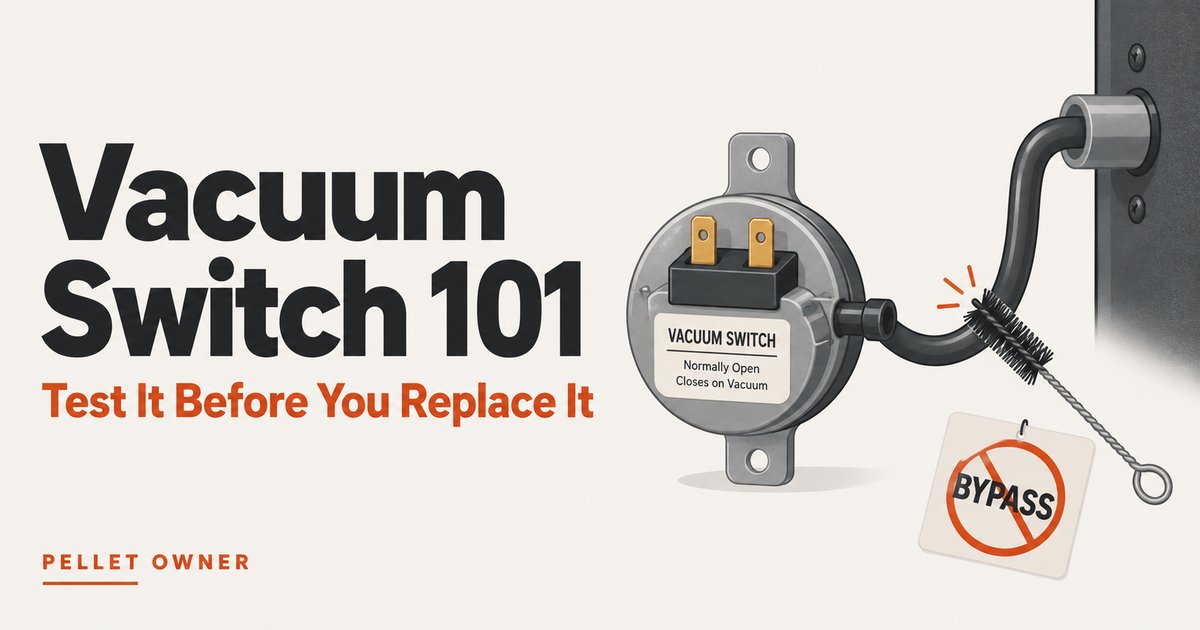
Somewhere online, right now, someone is buying a replacement vacuum switch for a stove that has a perfectly good vacuum switch. It’s one of the most-swapped parts in the pellet world, and most of the time the swap doesn’t fix anything — because the switch was doing exactly its job, reporting a real problem somewhere else.
The vacuum switch is a small, cheap safety part with an outsized reputation for causing trouble. Understanding what it actually watches for — and running a five-minute check before you spend a dime — saves you the part, the shipping, and the weekend you’d lose chasing the wrong thing. Here’s the whole picture in one place: what it does, the free checks that come first, why the “bypass” you read about is off-limits, and how to tell a bad switch from a bad blower.
What the vacuum switch actually watches
The vacuum switch is a fail-safe for draft. Its whole job is to confirm that your combustion blower is actually pulling air through the firebox and pushing exhaust out the vent — before the stove commits to dropping fuel and, on many stoves, before it keeps running.
Mechanically it’s simple. On many stoves the switch is normally open — no electrical connection — and it’s plumbed by a small hose to a point that sees the negative pressure (the vacuum) the combustion blower creates. When the blower pulls enough vacuum, that pressure closes the switch, completing a circuit that tells the control board “draft is good, proceed.” Lose the vacuum — blower fails, vent clogs, a door or gasket leaks — and the switch opens again, and the board reacts.
What the board does when the switch opens depends on your stove’s architecture, so check your manual rather than trusting a generic answer. On many designs the switch sits in series with the auger, so an open switch simply cuts fuel feed. Others fault out and shut down. Harman’s ESP/pressure-based systems behave differently again. The common thread across all of them: no confirmed draft, no fuel. That’s the switch protecting you from dumping pellets into a firebox that can’t vent its exhaust.
Symptoms of a bad vacuum switch
Here’s the frustrating part, and the reason this part gets over-replaced: the symptoms of a bad switch and the symptoms of low draft that a good switch is correctly catching look identical from the outside. Owners commonly report the same short list either way:
- The auger won’t feed — you get ignition-ready but no pellets, because the switch is open and cutting feed. (More on that in auger not feeding.)
- It lights, runs a few minutes, then quits — the stove starts on stored conditions, then the switch opens once it’s supposed to be seeing steady vacuum, and the stove shuts off.
- It won’t start at all — the switch never closes, so the start sequence never gets its “draft good” signal.
Every one of those can be a genuinely faulty switch. But every one of them can also be a good switch honestly reporting weak vacuum — a clogged hose, a dirty exhaust, a tired gasket, an ash-packed vent. That overlap is exactly why the next section matters more than the part page.
Before you buy one: it’s usually NOT the switch
This is the rule nobody puts up front, so I will: assume the switch is fine and prove otherwise. A vacuum switch is a dumb, reliable little component. Far more often, it’s opening because the vacuum really is low — and the fix is cleaning, not a new part.
Work this order before you condemn the switch:
- The vacuum-switch hose/tube. The small hose connecting the switch to its sensing point gets clogged with fly ash or slips off a fitting, and then the switch can’t “see” the vacuum even when draft is fine. On the PelPro PP130, for example, the switch is reached by removing the right side panel, and the tube should be clear and connected at both ends — a good thing to confirm on any stove. A blocked or cracked hose mimics a dead switch perfectly.
- The exhaust and vent. Fly ash narrows the path the combustion blower pulls against, so real vacuum drops. This is where your chimney cleaning and deep clean pay off — a clean vent and heat exchanger restore the draft the switch is looking for.
- Gaskets and the door seal. A leaking door or a worn gasket bleeds off vacuum before it ever reaches the switch. A stove that’s also throwing a smoke smell is telling you the same story from another angle: pressure isn’t where it should be.
Owners and sweeps widely describe cleaning the tube and the exhaust as the first move — and it’s common for a “bad switch” to disappear the moment the hose is cleared. Do this order first and you’ll often skip buying the part entirely.
How to think about testing it
Once the hose is clear and the vent is clean, the remaining question is whether the switch itself has failed — and that’s where the owner’s part ends. Testing a pressure or vacuum switch means working on the stove’s wiring and safety circuit, so it’s a job for your dealer or a qualified technician. Two things are still worth understanding before they arrive.
The tube check is yours. With the stove shut down from its controls, completely cold, and unplugged, the five-minute job is the hose from the order above: clear of ash, not cracked, and seated firmly at both ends. That’s the check owners lean on, and it needs no tools and no live power.
What a technician is checking. A vacuum switch is normally open: at rest it reads open, and it should close when the combustion blower’s vacuum is applied to it. A tech confirms that against your model’s spec with the right tools. The forum trick of blowing into the switch port and listening for a click only tells you the diaphragm moves, not that the switch trips at the right pressure, so it isn’t a verdict either way.
Should you bypass the vacuum switch? No
You’ll see “just bypass the vacuum switch” tossed around in forums, sometimes pitched as a quick test: jump the switch, and if the stove suddenly feeds, blame the switch. Don’t do it — not even for a few seconds.
Bypassing the vacuum switch defeats a safety device, and the manuals are blunt about it: Harman’s and PelPro’s both list “disable safety switches” among the things you must not do. That switch is what stops your stove from dropping fuel into a firebox that can’t vent. A “quick test” means running a stove whose draft problem you haven’t found yet with its draft protection switched off — exactly the moment smoke and carbon monoxide can be pushed into your home instead of out the vent, along with a fire risk.
If the free checks in this guide (the hose, the exhaust path, the combustion blower) don’t clear it, confirming whether the switch itself has failed is a job for your dealer or a qualified technician, who can test it without defeating it on a running stove. If the switch is bad, the fix is a new, approved switch — never a jumper.
Vacuum switch vs. combustion blower: telling them apart
Because both sit in the draft chain, a failing combustion (exhaust) blower throws nearly the same symptom as a bad switch: the stove lights and then quits a few minutes later. The difference is architectural, and it’s how you avoid replacing the wrong part.
- Listen and look at the blower. The combustion blower should spin up and run steadily. If it’s not turning, running slow, noisy, or caked with ash, low vacuum is the blower’s fault — and a good switch is correctly catching it. A new switch fixes nothing here.
- Follow the logic. A bad blower produces genuinely low vacuum, so the switch opens correctly. A bad switch (or clogged hose) reports low vacuum when the blower is actually pulling fine. The tube check and the “is the blower spinning?” look separate the two.
- When it’s the blower, that’s a bigger job than a switch — cleaning it is owner work (see the deep clean), but replacing a combustion blower on a combustion appliance is where a lot of owners hand off, and here’s how to tell which blower failed.
Short version: a good switch plus a weak blower behaves like a bad switch. Confirm the blower is actually moving air before you blame the switch.
If the switch has failed
If your dealer or technician confirms the switch has failed, the fix is the exact replacement part — a small, inexpensive one. If your manual gives a replacement procedure, follow it with the stove shut down, cold, and unplugged; if it doesn’t, have the technician who tested it make the swap. Two rules either way:
- Match the part to your stove. Vacuum switches are calibrated to a specific trip pressure; the wrong one either won’t close or won’t protect. Englander’s vacuum switch, for instance, is Part CU-VS; PelPro and others have their own. Check your manual or the part number and match it exactly rather than grabbing a generic look-alike.
- Replace a tired hose with the right hose. If the tube was the real culprit, a fresh length is cheap insurance against doing this again next season — but use the high-temperature hose your manual or the part specifies (Englander’s wiring diagram labels it a “High Temp Vac Hose”), not whatever tubing is in the drawer.
The point of this whole guide is to reach for a new switch last, after the cleaning has ruled out the free fixes.
FAQ
What does a pellet stove vacuum switch do? It’s a draft fail-safe. It confirms the combustion blower is pulling enough vacuum to vent exhaust before the stove feeds fuel — and, on many stoves, keeps confirming it while running. It’s normally open and closes when vacuum is applied; lose the vacuum and it opens, and the board cuts feed or shuts down (behavior varies by model — check your manual).
How do I know if my vacuum switch is bad? You usually can’t from symptoms alone — no feed, a few-minute shutdown, or a no-start all look the same whether the switch is faulty or a good switch is catching low draft. Clear the sensing hose, clean the exhaust, and confirm the combustion blower is spinning first; those free steps fix it most of the time.
Can I bypass a pellet stove vacuum switch? No — not even briefly as a test. It defeats a safety device (Harman’s and PelPro’s manuals list “disable safety switches” among the things you must not do), and it risks smoke, carbon monoxide, and fire. If the free checks don’t fix it, have a dealer or technician test the switch, and replace it with an approved part if it has failed.
Why does my stove keep shutting off if the switch is new? Because the switch usually isn’t the cause. A new switch on top of a clogged hose, ash-packed vent, leaking gasket, or a weak combustion blower will keep opening for the same reason the old one did — the vacuum is genuinely low. Fix the draft, not the messenger.
Is it the vacuum switch or the combustion blower? Check whether the combustion blower is actually spinning and moving air. If it’s dead, slow, or ash-choked, that’s your low vacuum and a good switch is doing its job. A switch that won’t close even with the blower running strong is the switch’s own fault.

Walt Hensley — Walt Hensley is the pen name of Pellet Owner’s editor. I’m not an NFI-certified technician, and I don’t sell stoves, pellets, or parts. Every guide here starts from the manufacturers’ owner’s and service manuals, is cross-checked against what owners consistently report, and says which is which — including what you can safely check yourself and when it’s time to call a certified technician.