Harman 6 Blinks: What the Code Means and How to Clear It
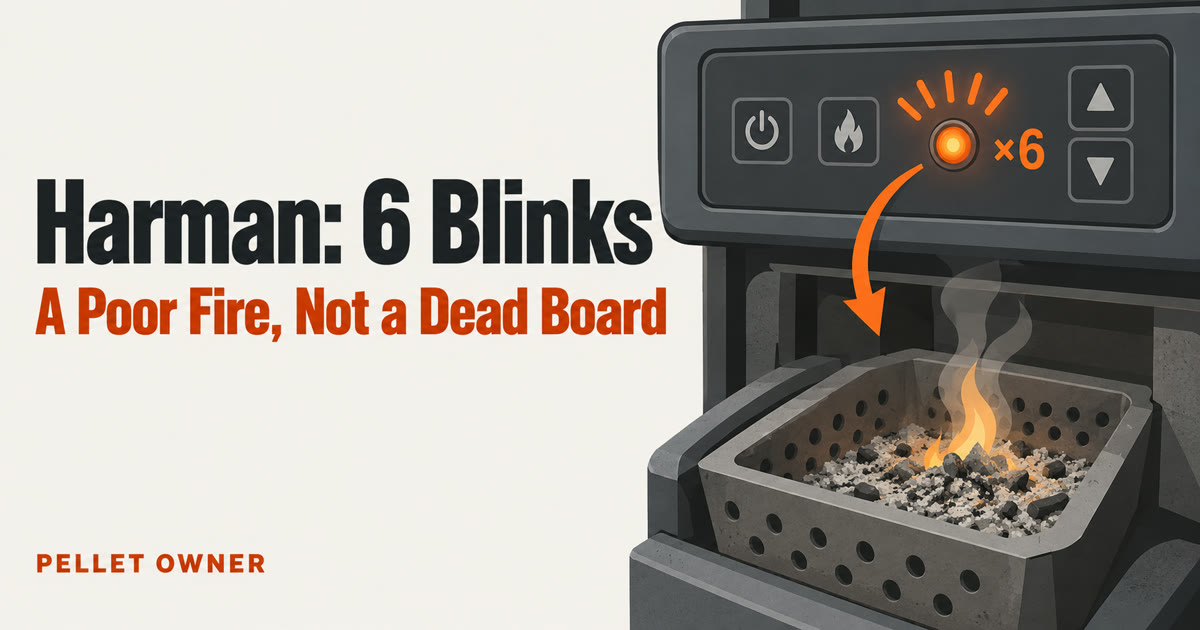
Six blinks on a Harman status light means the control board calculated poor or incomplete combustion for longer than it will tolerate — more than 50 minutes per the classic P43 and P61 owner’s manuals, more than 25 minutes per the owner’s manual for the -C models. On the P43 and the -C, simply running the hopper dry can set it too. The P43’s list of causes doesn’t include the board: it points to a dirty burn pot, blocked airflow, or fuel that stopped feeding. Here’s how to work through it.
This is the deep dive on one code. If your stove is blinking a different count — or you’re not sure you counted right — start with the full Harman blink code table and come back.
What does 6 blinks mean on a Harman?
The Harman P43 owner’s manual (rev. 3-90-04301R18, 03/13) defines the 6-blink status light as the board having calculated poor or incomplete combustion for more than 50 minutes — and notes that a six-blink status “may be set” if the stove is allowed to run out of pellets. The classic P61 manual-ignition manual (item 3-90-05810, R10) lists the same meaning with the same 50-minute window, without the out-of-pellets note.
How does a control board “calculate” combustion quality? Through the ESP — the Exhaust Sensing Probe, a temperature sensor in the exhaust path. The board compares what it’s feeding (your feed setting) against what the fire is producing (ESP temperature). My reading: fuel going in while exhaust temperatures stay low is what a weak or dying burn looks like to the board. Once it has calculated poor combustion for its time window, the board shuts the stove down as a safety feature and blinks six. That’s the same probe that triggers the 3-blink code when it goes out of range entirely — the ESP sits at the center of Harman’s error logic.
One distinction matters here: on the P43, a stove that fails to ignite within the 36-minute start cycle throws a 5-blink code, not a 6 — and only in Igniter AUTO mode. The classic manual-ignition P61 has no 5-blink at all. So a 6-blink points to a fire that lit (or was lit by hand) but burned badly or starved out afterward. In practice the two codes overlap in their physical causes, which is why both roads lead to the same cleaning checklist below.
Which Harman generation do you have?
Harman’s blink codes — and their exact numbers — can change between manual revisions, so pin down which manual applies to your stove before acting on anything:
- Classic P43 (manual rev. R18, 03/13): 6 blinks = poor/incomplete combustion for more than 50 minutes; the manual adds that it may be set if the stove runs out of pellets.
- Classic P61, manual ignition (manual R10): same meaning, same 50-minute window (no out-of-pellets note).
- -C generation (P43-C, P61-C, P68-C): Harman’s P-Series owner’s manual for these boards (8390-044C, R26) gives the same meaning with a shorter window, more than 25 minutes, and the same out-of-pellets note. Don’t assume 50 minutes applies.
That change in the window is exactly why I won’t state one universal number — verify the code in your model’s manual (Harman posts them online) or call a dealer with your serial number.
Why check cleaning before the control board?
Because the board is doing its job: it measured a bad fire and shut it down. The causes the P43 lists for this code live in the firebox, the air path and the fuel feed, not in the electronics. Here’s the list, in the order I’d check it — the first cause comes straight from the P43’s code definition, causes 2 through 7 from the P43 manual’s troubleshooting section for this code (p. 27; the -C manual lists the same six):
- You ran out of pellets. The easy case — the fire starved, the ESP cooled, the board counted it as failed combustion. Refill and reset.
- Ash- or carbon-plugged burn pot holes. Combustion air has to come up through the pot. Crusted holes strangle the fire slowly — exactly the long, weak burn this code is built to catch.
- The air chamber under the burn pot filled with fines. Same effect from one level down: the cavity that feeds air to the pot packs up with pellet dust and ash.
- Blocked inlet air. A stuck backdraft flapper or an obstructed outside-air inlet cover chokes the supply side.
- A blocked or partially blocked flue. If exhaust can’t leave, fresh air can’t enter. Ash buildup in the venting is the slow, sneaky version.
- Dirty combustion blower blades. Fly ash on the impeller weakens the draft that pulls air through the whole system.
- Fuel that stops feeding properly. The P43 lists “fuel restrictions” too, pointing back to its no-feed section: “Restriction in the hopper or feeder.” A jam or bridging that slows pellets to a trickle starves the fire just like an empty hopper.
Notice what that list is: a tour of what a thorough cleaning and a clear feed path fix. Neither the board nor the igniter is on it. A 6-blink stove made fire; it just couldn’t sustain a healthy one. (If your igniter genuinely tested dead during all this, that’s a separate job — see the igniter replacement guide.)
One more thing about the ESP itself: no manual lists it as a 6-blink cause, but it’s plausible that a probe coated in fly ash could make a fire look weaker to the board than it is. The manuals tell you to brush the flue area where the ESP lives during cleaning — and to be careful not to damage the probe with the brush. Gentle.
What can you check yourself?
First, the safety baseline from the P43 manual: shut the stove down normally from its controls and let it go completely cold — only then unplug it before cleaning or opening anything. Never pull the plug to shut it down. The -C manual says the same: pull the plug and all motors stop, which may cause incomplete combustion and smoke in the firebox, so unplug only once the stove is completely cool and the combustion blower is off. On top of that, my own rule: don’t jumper switches, don’t bridge connectors, and leave any test that needs live power to a technician. The P43 manual warns of a risk of electrical shock and tells you to disconnect power before servicing the unit. I’m not an NFI technician, and nothing here needs you to act like one.
With the stove cold and unplugged:
- Check the hopper. If it ran dry, you’ve found it. Refill, reset, done.
- Scrape the burn pot and clear every hole, then open the clean-out and vacuum the chamber underneath. This overlaps heavily with the won’t-ignite checklist — same physics, same fixes. Brand-by-brand steps: how to clean the burn pot.
- Check the air inlet: flapper moves freely, outside-air cover clear (owners commonly report bird nests there after summer).
- Look at the flue through the cleanouts your manual assigns to you, and brush per its schedule — gently around the ESP.
- Clean the combustion blower blades as part of a full deep clean.
Then reset: for the 6-blink, turn the Mode Selector to OFF, then back to your mode (that’s the procedure in the P43 and -C manuals; the unplug-style manual reset belongs to other codes, and the P61 manual prints no specific reset for this one, so follow yours or ask your dealer). If you only refilled an empty hopper, that reset is the whole fix.
When should you call a technician?
- The code returns on a genuinely clean stove. A repeating 6-blink after a real deep clean means draft or combustion needs instruments and experience — stop resetting and get it looked at.
- The combustion blower is suspect. Cleaning the blades is yours; electrical diagnosis of the blower or anything at the board level is not.
- Anything involving live power or bypassing a safety. No exceptions.
And resist the reset-loop habit. A 6-blink is a safety shutdown: the board judged the fire was burning incompletely, and incomplete combustion is how creosote gets made. Overriding it repeatedly without fixing the cause is building a chimney problem on an installment plan.
FAQ
Does 6 blinks mean my igniter is bad? Not directly. On the P43, a failed ignition — no fire within the 36-minute start cycle — throws a 5-blink, and only in Igniter AUTO mode. A 6-blink means combustion went poorly after there was fire. The physical causes overlap (dirty pot, weak airflow), so run the same checks; only replace an igniter that actually fails a test.
Is the 6-blink code the same on every Harman? The meaning — poor or incomplete combustion — is the same in the three manuals I’ve verified, but the window isn’t: more than 50 minutes on P43/P61 boards (R18/R10 manuals), more than 25 minutes on the -C generation (P43-C, P61-C, P68-C) per its owner’s manual (8390-044C, R26). Always confirm against your own manual.
How do I reset a Harman 6-blink code? Mode Selector to OFF, then back to your mode, per the P43 and -C manuals. But reset after the fix — refilling the hopper or cleaning — not instead of it. If the code comes back on a clean stove, call your dealer rather than resetting in a loop.

Walt Hensley — Walt Hensley is the pen name of Pellet Owner’s editor. I’m not an NFI-certified technician, and I don’t sell stoves, pellets, or parts. Every guide here starts from the manufacturers’ owner’s and service manuals, is cross-checked against what owners consistently report, and says which is which — including what you can safely check yourself and when it’s time to call a certified technician.