Harman 3 Blinks: The ESP Probe Code, Explained
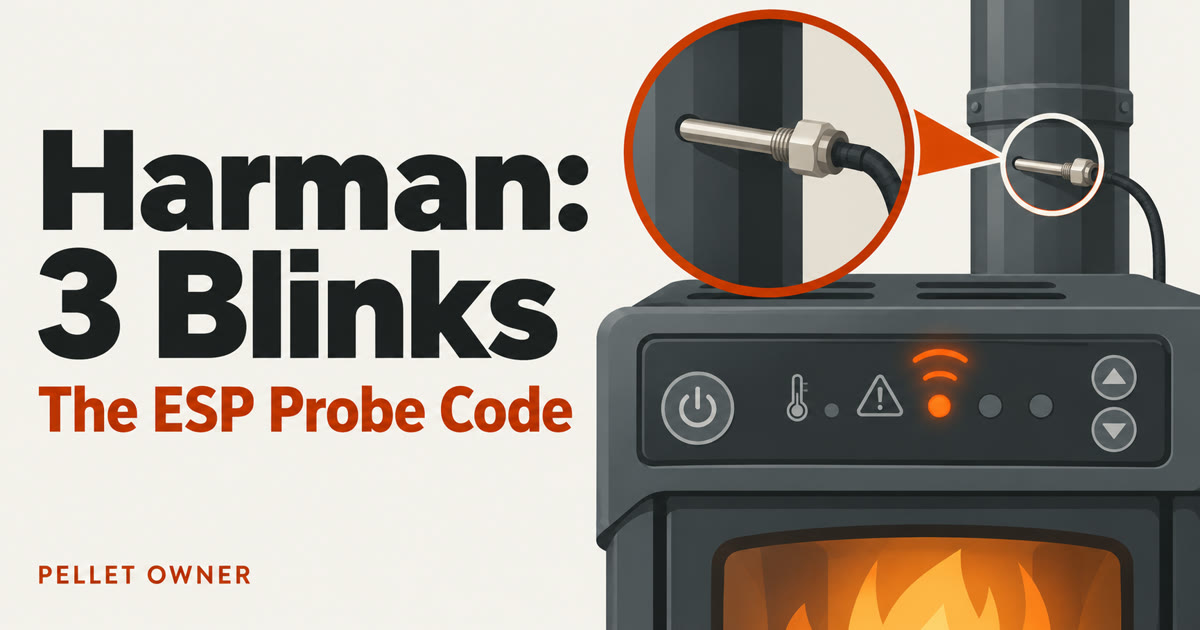
Three blinks on a Harman status light means the ESP — the Exhaust Sensing Probe — read out of range or failed. That’s the definition in both classic Harman manuals I’ve verified, the P43 (rev. R18) and the manual-ignition P61 (R10), and in the owner’s manual for the -C models (P43-C, P61-C, P68-C). First move: a manual reset, done only once the stove has shut down — Mode Selector to OFF, fire burned out, everything stopped. Then unplug, wait a few seconds, plug back in. (All three manuals warn against pulling the plug to shut down a burning stove.) If the code returns immediately, suspect a damaged or disconnected probe; if it doesn’t, your exhaust path may need cleaning.
That’s the short version. The longer version matters, because this code sits on top of the single most important sensor in the stove — and because Harman blink codes are only as trustworthy as your knowledge of which board you have.
What does 3 blinks mean on a Harman pellet stove?
Here’s what the manuals I’ve verified say:
- P43 classic (owner’s manual rev. 3-90-04301R18, 03/13): the ESP went out of range too many times within a specified window. The manual’s instruction: do a manual reset. If the code comes right back, the ESP may be damaged or disconnected; if it doesn’t, the exhaust system may need cleaning.
- P61 classic, manual-ignition version (owner’s manual R10): ESP probe failure, with the same first move — a manual reset (once the stove has shut down: unplug briefly, reconnect).
- -C generation: P43-C, P61-C, P68-C (Harman’s P-Series owner’s manual 8390-044C, R26): the ESP has failed, has a broken connection, or has gone out of range too many times. Manual reset; if the error still occurs, call your dealer.
So unlike codes that owners report changing meaning between board generations (2 blinks is the usual example), the 3-blink code is consistent across all three manuals I can verify: all point to the ESP. The P43 adds a useful fork (out of range too many times; reset, then probe or cleaning), while the P61 simply calls it a probe failure.
Which board do you have? Check before you act. These meanings are verified against the P43 R18 (03/2013), the classic manual-ignition P61 (R10) and the -C generation’s R26 owner’s manuals — nothing else. The -C table agrees on 3 blinks but differs elsewhere: 2 blinks is an open feed circuit, the 6-blink window is more than 25 minutes instead of more than 50, and there’s no 1-blink. The classic P68, XXV, and Accentra are similar-era stoves whose status-light codes I haven’t verified, so check the code against the manual for your exact model and board revision before acting. Harman posts manuals online; your serial number plus a dealer call settles it in minutes.
For the whole code set in one place, the master blink-code table is the parent to this article.
What is the ESP probe, and why does it trigger this code?
The ESP is a temperature sensor in the exhaust path, and it’s not a minor accessory — it’s how the control board knows what the fire is doing. The board runs the stove by comparing feed settings against ESP temperature. Two numbers from the manuals show how central it is:
- On the manual-ignition P61, the feed motor won’t even start until the ESP senses 165 °F — the board demands proof of a warm exhaust before it will deliver pellets.
- On the P43, the distribution blower comes on when the ESP reaches 350 °F (at 81% output).
Combustion tracking and blower timing run through this one probe (and on the manual-ignition P61, so does the go-ahead to feed). So when the board says “my ESP is reading out of range,” it’s really saying “I’ve lost my eyes.” A stove that’s also struggling to light or feed pellets on startup can be the same story from a different angle — that’s won’t-ignite territory.
And here’s why a 3-blink isn’t automatically bad news: the P43’s own fork sends a code that doesn’t return right away to cleaning, not to parts. My reading, not the manual’s wording: a probe coated in fly ash, or an exhaust path restricted enough, can push the readings out of range without anything being broken.
What causes the 3-blink code?
In the order I’d check them (the manual gives two branches, not a ranking):
- A dirty exhaust path or ash-coated probe. This is the case the P43 manual itself points to: if the code does not return immediately after a reset, the exhaust system may need cleaning. My read is that fly ash on the probe or ash restricting the flue can push the ESP’s readings out of the range the board expects. Owners who’ve chased this code report that a thorough cleaning is the most common ending to the story.
- A disconnected or loose probe connection. The manual’s other branch: a code that comes right back after reset suggests the ESP is damaged or disconnected. A connector that’s worked loose gives the board nothing to read.
- A failed ESP probe. Sensors age in a hot, dirty environment. When cleaning doesn’t fix it and the connection is sound, the probe itself is the suspect. Confirming it is a dealer/tech diagnosis, not a guess.
- A board-side fault. Last on the list, and firmly technician territory. If a known-good probe on a clean stove still throws 3 blinks, the problem is upstream of the sensor.
If your stove has been shutting down mid-burn without a clear code, or alongside other codes, widen the lens with the keeps-shutting-off guide — a weak draft or dirty stove shows up in more than one costume.
What can you check yourself?
First, the reset — which is also the test. Harman’s official manual reset is to disconnect the power cord for a few seconds and reconnect it. Do it on a stove that has already shut down, never as the way to shut one down: both classic manuals say never to pull the plug on a burning stove. On the P43 the combustion blower stops and smoke escapes through the window and door gaskets; on the P61 all motors stop and the firebox fills with smoke. The -C manual warns the same (all motors stop, which may cause incomplete combustion and smoke in the firebox) and says to unplug only once the stove is completely cool and the combustion blower is off. So if there’s still fire in the pot, turn the Mode Selector to OFF and let it burn out — on the P43 that can take more than an hour — until the stove has cooled and everything has stopped. Then unplug it, wait a few seconds, and plug it back in. Do it once, and pay attention to the result, because the timing of the code’s return is the diagnostic:
- Comes back immediately → probe damaged or disconnected. That’s a call to the dealer, not a second reset.
- Doesn’t come back right away → the manual’s other branch: the exhaust system may need cleaning.
Second, the cleaning — cold and unplugged, no exceptions. Shut the stove down normally from its controls, let it go completely cold, and only then unplug it before opening anything. Then do a real cleaning of the exhaust path — flue, ash traps, combustion area — per your manual’s routine. One specific warning both manuals make a point of: when you brush the flue area, be careful not to damage the ESP probe with the brush. It lives right where you’re working. Gentle strokes around it; it’s a sensor, not a nail.
What you should not do: anything electrical. No live-power tests, no jumpering, no probing connectors with the stove plugged in — the P43 manual warns of a risk of electrical shock and tells you to disconnect power before servicing the unit. And neither owner’s manual publishes a do-it-yourself electrical test spec for the ESP, so I’m not going to repeat resistance numbers from forums as if they were one. Past the cleaning, leave connectors and wiring to your dealer; the P43’s control panel carries its own “HIGH VOLTAGE — Disconnect power before opening cover” label.
When should you call a technician?
- The code returns immediately after one manual reset — that’s the manual’s own instruction: call your dealer.
- The code keeps coming back after a genuine cleaning. Repeated power-cycling isn’t a fix; it’s how people burn a season resetting a stove that’s asking for a part.
- Anything at the probe, wiring, or board level — replacement, connector repair, board diagnosis. Live electrical parts — dealer job.
Have your model and serial number ready when you call — given how much these codes vary by board revision, that number does half the diagnosis before the van starts.
How is 3 blinks different from 6 blinks?
Both codes run through the ESP, which trips people up. The difference: 3 blinks means the board can’t trust the sensor — the reading itself went out of range. 6 blinks means the board trusts the sensor and doesn’t like what it sees — it computed poor or incomplete combustion for longer than its time window and shut down as a safety measure. Different verdicts, same witness. If your stove is throwing sixes, that code has its own logic and its own do-not-ignore rules — covered in the 6-blink deep dive.
FAQ
How do I reset a Harman 3-blink code? Manual reset, per the P43, P61 and -C manuals: disconnect the power cord for a few seconds and reconnect — but only once the stove has shut down. If there’s still a fire, turn the Mode Selector to OFF and wait until it has burned out and everything has stopped; the same manuals warn against pulling the plug to shut down a burning stove. Do it once. If the code returns immediately, the manual says to call your dealer — don’t keep power-cycling.
Can a dirty stove cause 3 blinks on a Harman? Yes. The P43 manual says that if the code doesn’t return right after a reset, the exhaust system may need cleaning, and owners report cleaning as the most common fix. My read is that a fly-ash-coated probe or a restricted exhaust path can push ESP readings out of range without anything being broken.
Is the ESP probe expensive to replace? The manuals don’t print prices: the P43 parts list names the “Thermister Probe (ESP Probe)” without one, so get a quote from your dealer with your model and serial number. Confirming it’s the probe (and not the connection or the board) and replacing it are dealer/technician work, since it involves the control area.
Do all Harman stoves use the same 3-blink meaning? The two classic manuals I can verify — P43 R18 and manual-ignition P61 R10 — agree: ESP out of range or failed. So does Harman’s P-Series owner’s manual for the -C boards (8390-044C, R26), though other codes in its table differ. Always verify against the manual for your model and revision.

Walt Hensley — Walt Hensley is the pen name of Pellet Owner’s editor. I’m not an NFI-certified technician, and I don’t sell stoves, pellets, or parts. Every guide here starts from the manufacturers’ owner’s and service manuals, is cross-checked against what owners consistently report, and says which is which — including what you can safely check yourself and when it’s time to call a certified technician.