Pellet Stove Ash Disposal: Safe Steps, How Often, Garden Use
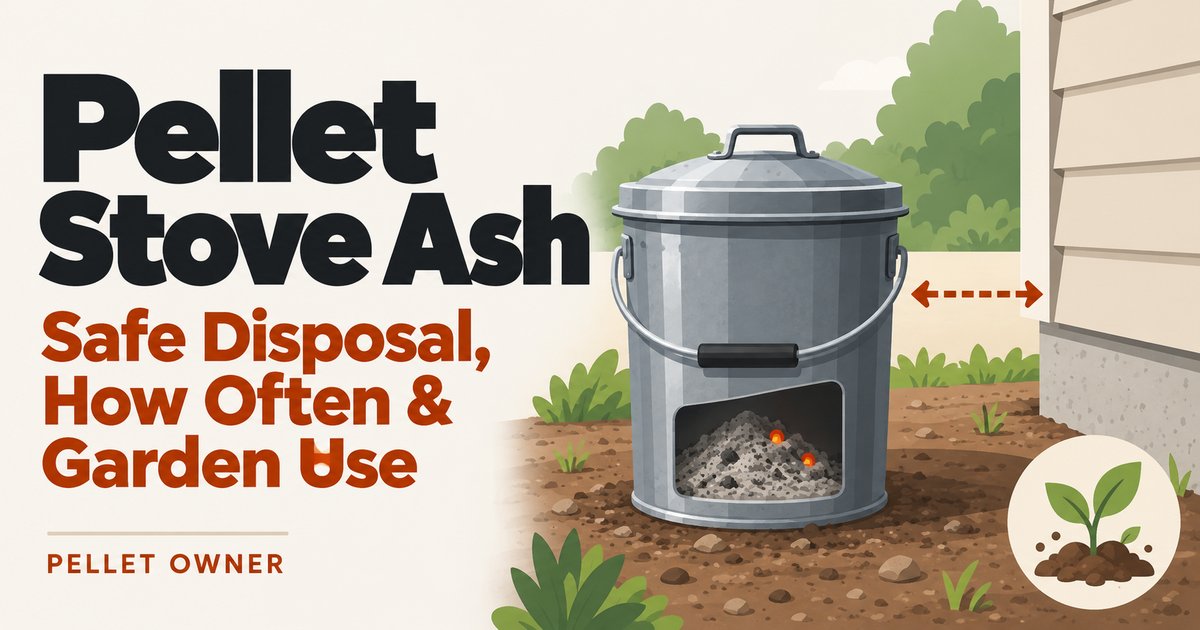
Treat pellet ash as if it hides live embers. Put it in a steel or metal can with a tight-fitting lid (never plastic, cardboard or a bag) and set it outside on the ground or a noncombustible surface, away from anything that burns: at least 10 feet from the house, says the U.S. Fire Administration. Keep it closed until completely cold, which one fire-safety program puts at four days minimum. Cold wood-pellet ash can go on the garden, sparingly.
That’s what to do with pellet stove ash. When to empty it, and whether the fire can still be going, depends on your manual; I went through the ash sections of every manual I work from, brand by brand.
Before step 1: pellet ash hides live embers.
- Harman’s manuals: live pellets sucked into a vacuum “WILL LIGHT THE VACUUM ON FIRE AND MAY ULTIMATELY CAUSE A HOUSE FIRE.”
- Englander’s: metal parts in the firebox “can remain HOT long after the fire has gone out and EVEN after the Shut-Down cycle is complete.”
- In February 2026, a Wisconsin fire department traced a house fire to pellet stove ash cleaned out the day before and left in a plastic container on the back porch (reported by WBAY and the Door County Pulse).
So: never plastic, cardboard, a bag or the trash can, and never a household vacuum.
How do you empty a pellet stove safely? (Step by step)
- Check your stove’s rule first (table below). Only Harman’s -C models allow emptying the pan while the stove runs. Everyone else: off at the controls, and cold.
- Get the can and lid ready before you open anything. That’s my order, not a manual step: steel or metal can, lid at hand, standing on a noncombustible surface (never carpet or wood), gloves on. The -C maintenance chart says “Wear protective gloves.”
- Move the ash.
- Harman (ash pan): open the ash door, lift the pan out by its handle, empty it into the can, slide it back and latch the door. The P61 adds: “Close the ash door while dumping ashes.”
- Englander (no pan in its procedure): after the complete Shut-Down cycle, let the unit “completely cool down,” then scoop the ash from the ash areas to the left and right of the burn pot.
- PelPro PP130-C: “Stove must be turned off and cold.” Remove the baffles and vacuum the residual ash, then the ash on the firebox floor. “Do NOT vacuum hot embers.”
- Lid on, outside. Harman’s P43 says the closed container “should be moved outdoors immediately”; the -C chart says “steel non-combustible container with tight fitting lid outside.”
- On the ground or a noncombustible floor, “well away from all combustible materials” (the manuals’ wording). Named sources add the distances: the U.S. Fire Administration says at least 10 feet from the home and any other buildings; Tahoe Living With Fire says not in or against the garage, not on or under a wooden deck, not under a porch, and not next to the woodpile. By the same logic, I’d keep it away from your pellet bags too.
- Closed until every ember is cold. The manuals give a condition, not a clock: keep it in the closed container “until all cinders have been thoroughly cooled.” Tahoe Living With Fire: “Four days or 96 hours is the minimum recommended cooling period for ashes.”
- Nothing else in that can. The P43: “Other waste shall not be placed in this container.”
How often should you empty a pellet stove ash pan? (By brand)
| Stove | How often | Stove state | Container and where |
|---|---|---|---|
| Harman P43 (classic, R18) | After about 1 ton, so “a few times a year” (with a corn mix, “may need emptied weekly”) | “It is recommended that the stove is cold and shut down when removing the ash pan” | Steel, tight-fitting lid, “moved outdoors immediately” |
| Harman P61 (classic, R10) | After about 1 ton | Same recommendation: cold and shut down | Metal, tight-fitting lid, noncombustible floor or the ground |
| Harman -C (P43-C, P61-C, P68-C) | Weekly | “Unit does not need to be turned off. Reduce to low burn during removal.” Gloves | Steel, tight-fitting lid, outside |
| Englander 25-PDV and 25-PDVC | Twice a week (scraped toward the ash areas daily) | Complete Shut-Down cycle, then completely cool | Non-combustible, airtight lid, noncombustible surface or the ground |
| PelPro PP130-C | “Weekly or as needed” | “Stove must be turned off and cold” | Metal, lid (“Metal container with lid” is on its tool list) |
Fuel moves these numbers. Harman’s manuals warn that higher-ash fuel means more frequent ash removal, and the ash content is what separates pellet grades (see softwood vs hardwood pellets).
Forge & Flame, the company behind Harman and PelPro, lists “Emptying Ashes Monthly” on its maintenance blog. The -C owner’s chart says weekly. Follow your manual, not a blog.
Can you empty the ash pan while the stove is running?
Only if your manual says so, and among the manuals I work from, only one does: Harman’s -C owner’s manual (R26 and the Pathfinder edition). Its chart, under “Weekly · Empty Ash Pan,” says “Unit does not need to be turned off. Reduce to low burn during removal,” with protective gloves and the ashes going into “a steel non-combustible container with tight fitting lid outside.” Its troubleshooting page, which is written for service technicians, adds a hint: turn the Temp Dial to 1 about 30 minutes before removing ashes, for “a cooler stove and ash pan.” A sensible extra, not the permission.
The classic P43 and P61 print the same hint, but their ash sections say “It is recommended that the stove is cold and shut down when removing the ash pan.” I’d follow that and not read the hint as permission. Englander and PelPro: off and cold. Don’t carry the -C permission over to any other stove.
Why it matters: the pan can hold embers. Even while scraping the burn pot with the fire going, the P43 warns: “Do not scrape the fire out of the pot.”
How long do pellet stove ashes stay hot?
Two different clocks run here.
Cold enough to clean the stove. The manuals give a condition, not hours: turned off, completely cool, and the combustion (exhaust) blower stopped, per Harman’s -C and PelPro, with Englander’s warning about hot metal (box above). No manual gives a number. In a long-running hearth.com thread (2009), owners report waiting anywhere from about an hour and a half to overnight before vacuuming, and one describes a shop vac that started smoking after an hour.
Cold enough to throw out or spread. Again a condition, “until all cinders have been thoroughly cooled.” The one figure is from Tahoe Living With Fire, a Lake Tahoe fire-safety program: 96 hours minimum (step 6), then a recheck after a week in the can before it goes in the trash.
What should you never put pellet ash in, or near?
- Plastic, cardboard or paper. Tahoe Living With Fire rules out “a plastic garbage box or can, a cardboard box or paper grocery bag.” The U.S. Fire Administration: “Never empty the ashes directly into a trash can.”
- A bag, including the empty pellet bag. Some owners on the forums bag the ash and drop it straight in the garbage. The manuals say otherwise: “Ashes should be placed in a steel container with a tight fitting lid” (P43), “a metal container with a tight fitting lid” (P61).
- Near the places in step 5, in a household vacuum, or with other trash in the same can.
Can you put pellet stove ash in your garden or on your lawn?
Yes, with conditions, and US university extensions set them:
| Do | Don’t |
|---|---|
| Soil test first, and skip it if pH is above 7.0 (Iowa State) | Spread it before it’s completely cold |
| No more than about 20 lb (one 5-gallon bucket) per 1,000 sq ft (Iowa State); UW–Madison says 15 to 20 lb a year | Use it around blueberries, azaleas or rhododendrons (both) |
| Winter or early spring (Iowa State); on moist soil, not on a windy day (UW–Madison) | Use ash from treated or painted wood or trash (both) |
| Wood-pellet ash only | Overdo it where potatoes grow: UW–Madison says scab gets worse at higher pH |
Sources: Iowa State University Extension and Outreach, “Using Wood Ashes in the Home Garden” (revised February 2025); UW–Madison Extension, “Using Wood Ash in the Home Garden” (revised February 2020).
The limit these guides can’t set: they’re about wood ash. Use only ash from wood pellets you know. The classic P43 is approved for a corn/pellet mix (up to 50%), and the extension guides don’t cover that ash; Harman’s manuals also rule out fuel with additives (“such as soybean oil,” in the P43’s words). And cold first: the P43 says ash headed for “burial in soil or otherwise locally dispersed” stays in the closed container until all cinders are thoroughly cooled.
From the community side, most owners who spread it on lawns and gardens advise watching pH and keeping it away from acid-loving plants, which matches the extension advice.
Other uses owners mention, and one to skip
- Ice and traction: owners are split. Some spread it on icy walks; others warn that wet ash turns into a paste that sticks and gets tracked indoors. Cold ash only, either way.
- Not on the stove glass. Many owners swear by an ash paste for the glass, but the manuals rule out abrasives: “avoid the use of abrasive cleaners” (P43), “do not use abrasive substances” (Harman -C), “Do NOT use abrasive cleaners” (PelPro). See how to clean pellet stove glass.
Do you need an ash vacuum?
If you vacuum, it has to be the right kind, and never on warm ash. Harman: never a household vacuum, but “a shop vacuum that is equipped with a fine dust filter called a HEPA filter or a vacuum specially made for ashes and soot,” and only once the stove is completely out. PelPro lists an “Ash vacuum” among its tools and wants embers “thoroughly cooled to prevent a fire in the vacuum.” The P61: “Be sure the stove is cold if you use a vacuum.” Englander only singles out its small “door ajar” port, which gets a brush, not a vacuum.
What to look for: a fine (HEPA-type) filter, a design made for ash, and the temperature limit on its spec sheet. One major shop-vac brand rates its ash vacuum for “cold and warm ash below 100°F”; the manuals’ rule is stricter, with the stove completely out and cold. For the rest of the routine, see the deep clean checklist.
FAQ
Can I throw pellet ash in the trash? Only cold, after days in a closed metal can. The U.S. Fire Administration says never to empty ashes directly into a trash can, and Tahoe Living With Fire says to check them again after a week. Check your local trash rules too.
Should I wet the ashes? The U.S. Fire Administration says “Pour water on the ashes.” That’s fire-agency advice, not a manufacturer requirement: none of the stove manuals I work from mentions water. If you do, do it inside the metal can.
Is pellet stove ash the same as wood ash? For the garden, ash from wood pellets you know (no additives) is the wood ash the extension guides cover. Ash from a corn mix or from fuel with additives isn’t, so keep it out.
Is pellet stove ash good for grass? Only if a soil test says your lawn needs it, and then no more than about 20 lb per 1,000 square feet (Iowa State; UW–Madison says 15 to 20 lb a year).

Walt Hensley — Walt Hensley is the pen name of Pellet Owner’s editor. I’m not an NFI-certified technician, and I don’t sell stoves, pellets, or parts. Every guide here starts from the manufacturers’ owner’s and service manuals, is cross-checked against what owners consistently report, and says which is which — including what you can safely check yourself and when it’s time to call a certified technician.