How to Clean Pellet Stove Glass (and Why It Turns Black)
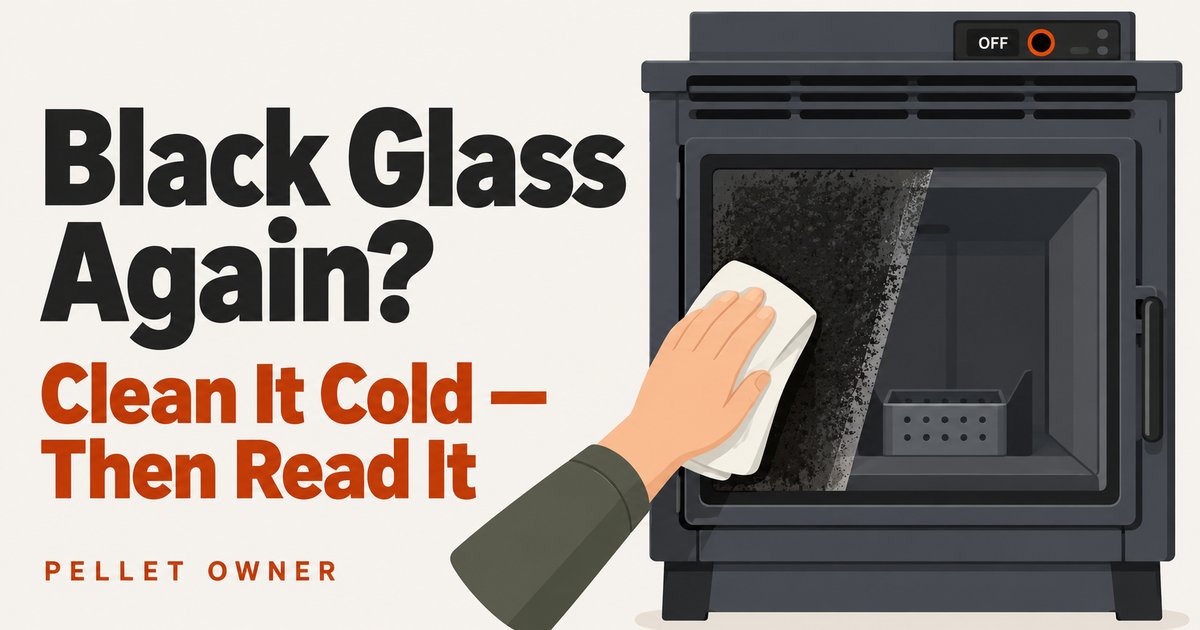
To clean pellet stove glass: shut the stove down from its controls, let it go completely cold, then clean it with a soft, non-abrasive cloth and the cleaner your manual names — a mild glass cleaner in Harman’s P43, a ceramic glass cleaner in PelPro’s PP130 — and buff dry. Skip anything abrasive, ash paste included. But if your glass blacks over again in hours or days, you don’t have a cleaning problem. You have a combustion problem.
That second half is the part many glass-cleaning guides skip, and it’s the misconception worth killing on sight: “black glass is normal — you just have to scrub harder.” No. Some light gray film is normal: Harman’s P43 says soot and fly ash will accumulate on the glass and occasionally need cleaning. Glass that paints itself black between cleanings is the stove telling you the fire is burning dirty, and no cleaner on any shelf fixes that. Let’s do both halves: the cleaning done right, and the diagnosis when cleaning isn’t the answer.
How do you clean pellet stove glass?
First, the ground rule for every job on this site: the stove is shut down from its controls, completely cold, and unplugged before your hands go near the firebox. Glass holds heat long after the flame is out. Cold means cold.
Then:
- Open the door and lift off the loose stuff. Take the powdery fly ash off gently with a soft brush, without grinding it across the glass. Owners find this is often most of the job on a well-run stove.
- Use the cleaner and cloth your manual names. Harman’s P43: “a soft cloth and mild glass cleaner.” PelPro’s PP130: apply a ceramic glass cleaner and use a non-abrasive cloth to remove the residue. The Englander and P61 manuals I’ve checked don’t name a method; there, a ceramic glass cleaner and a non-abrasive cloth is the conservative choice, and your dealer can confirm.
- Go easy. Light pressure, and a second pass on stubborn spots rather than a harder scrub.
- Buff dry. A dry, soft cloth leaves the glass clear. Don’t relight until the glass and gasket area are dry.
- Look at the glass and the door gasket while you’re there. Thirty seconds: glass free of chips or cracks, and the rope gasket around the door and glass intact and seated — not frayed, torn, flattened, or hanging loose (PelPro’s rule is to replace gasketing that frays, tears or shows other visible damage). That visual check is owner territory; replacement goes by your manual’s parts and procedure. Englander’s manuals go as far as making gasket replacement an annual requirement, glass gasket included — that’s how seriously manufacturers take a good seal.
What about the ash trick? Many owners swear by a damp paper towel dipped in fine ash from the ash pan. Ash works because it’s a mild abrasive, and that’s the problem: Harman’s P43 says to avoid abrasive cleaners, and PelPro’s PP130 says not to use them. I’d skip it and use what your manual names.
What should you never use on pellet stove glass?
The window isn’t ordinary glass — it’s a high-temperature ceramic panel (Harman’s P43 manual, for example, specifies 5 mm ceramic glass), and the rules are about protecting that surface and its seal:
- Nothing abrasive. Harman’s P43 says to avoid abrasive cleaners and PelPro’s PP130 says not to use them, so skip scouring pads, steel wool, razor blades, gritty cleansers and ash paste. PelPro also says not to run the stove with the glass scratched (Englander calls surface scratches normal; follow your own manual).
- No cleaner your manual doesn’t allow. If your manual names a product, use that one; if it names none, ask your dealer before reaching for whatever spray is under the sink.
- Never clean hot glass. Harman and PelPro both say so outright. Cold-only isn’t just about your fingers — a wet cloth doesn’t belong on a hot ceramic panel, and neither does an open door on a stove that can restart. Full shutdown, cold, unplugged.
- Don’t soak the gasket. Keep the cleaner on the glass, not dripping into the rope gasket around it.
Buildup with actual thickness to it is past routine haze — that’s a dirty-burn symptom, which is the next section. It’s also a reason to have the vent checked: Harman’s P43 says creosote in the chimney or venting should be removed once the layer reaches 3 mm or more (see the chimney cleaning guide).
Why does my pellet stove glass turn black so fast?
Here’s the diagnostic half, the part that saves you from scrubbing the same window every two days all winter.
Black soot on the glass comes from combustion that isn’t finishing. Harman’s P43 says incomplete combustion leads to soot that collects in the exhaust venting, and PelPro’s PP130 troubleshooting lists black ash on the glass alongside a large, lazy, orange flame. Owners describe the healthy fire as low, busy and bright, and the problem one as tall, lazy and dark-tipped. The glass is just the visible scoreboard. If yours blacks over in hours or a day or two, stop cleaning and start reading the fire — the full guide is how to read your pellet stove flame, and the suspects the manuals and owners point to are:
- A dirty burn pot — ash and carbon plugging the air holes the fire breathes through. Harman’s P43 lists a burn pot that needs cleaning among the causes of a poor burn, and PelPro’s fix starts with cleaning the stove, fire pot included.
- Ash-blocked air passages or intake — the airflow strangled somewhere you can’t see. The P43’s “poor air to fuel mixture” points at the burn pot clean-out cover and the air intake.
- A door or ash-pan gasket that isn’t sealing — the stove pulls its combustion air through a designed path, and a leaky gasket lets it cheat. That frayed rope you spotted in step 5 above and a fast-blacking window can be the same story. Inspection is yours; replacement goes by the manual.
- Feed and air out of balance. Harman’s P43 lists a feed rate set too high among the causes of half-burned pellets, and PelPro ties black ash on the glass to an incorrect air-fuel adjustment, fixed by turning its fuel trim dial counterclockwise for more combustion air.
- The pellets themselves — PelPro lists poor fuel quality and high ash content, and its fix is to try a different brand. Owners add bark-heavy fuel to the list; the softwood vs. hardwood guide covers the ash-versus-species question.
Three of those five are cleaning and sealing, not products. The honest fix for chronically black glass is a proper deep clean — burn pot, air passages, blower — and a gasket check. Scrubbing the window harder treats the scoreboard, not the game.
How often should you clean pellet stove glass?
Your manual sets the schedule, and they differ. PelPro’s PP130 manual puts glass (with ash removal) on the weekly or as needed routine; Harman’s P43 simply says the glass will occasionally need cleaning. A weekly wipe during the cold-stove routine is a sensible default — quick when the film is fresh, much longer once it’s baked on for a month.
In my view, the interval between cleanings is also information. If glass that used to stay clear for a week now goes gray to black in a couple of days, read it as an early sign that combustion is sliding, and act on it before it turns into a stove that’s failing to light. Free diagnostic, right at eye level.
FAQ
What can I use to clean pellet stove glass? What your manual names: Harman’s P43 says a soft cloth and a mild glass cleaner; PelPro’s PP130 says a ceramic glass cleaner and a non-abrasive cloth. Clean only with the stove shut down, cold, and unplugged, and avoid anything abrasive — including the damp-ash trick many owners use, since both manuals say to avoid abrasive cleaners.
Is it normal for pellet stove glass to turn black? Some light gray fly-ash haze is normal; Harman’s P43 says the glass will occasionally need cleaning. Glass that turns properly black — especially within hours or a day or two — is not a cleaning problem, it’s incomplete combustion: a lazy flame depositing unburned carbon on the window. Diagnose the burn (air, cleanliness, gaskets, fuel) instead of just scrubbing.
Can I clean pellet stove glass while it’s hot? No — Harman and PelPro both say never to clean the glass hot. Shut the stove down from its controls, let it go completely cold, and unplug it first. Hot glass is a burn risk, a wet cloth doesn’t belong on a hot ceramic panel, and you don’t want a stove that can restart while the door is open.
How do I stop my pellet stove glass from turning black? Fix the burn, not the window. Keep the burn pot’s air holes scraped clean, keep air passages clear with a regular deep clean, check that the door and ash-pan gaskets seal, keep feed and air in balance, and burn decent low-ash pellets. Owners aim for a low, busy, bright flame.
Why is there brown or thick buildup on the glass instead of gray film? Heavy staining or a deposit with real thickness points to a dirty burn. It’s also a reason to have the vent checked: the same kind of burn builds creosote there, and Harman’s P43 says a creosote layer of 3 mm or more in the chimney or venting should be removed. If the buildup returns within days, treat it as a combustion problem: read the flame, deep clean, check gaskets.

Walt Hensley — Walt Hensley is the pen name of Pellet Owner’s editor. I’m not an NFI-certified technician, and I don’t sell stoves, pellets, or parts. Every guide here starts from the manufacturers’ owner’s and service manuals, is cross-checked against what owners consistently report, and says which is which — including what you can safely check yourself and when it’s time to call a certified technician.