Softwood vs Hardwood Pellets: Which Is Better?
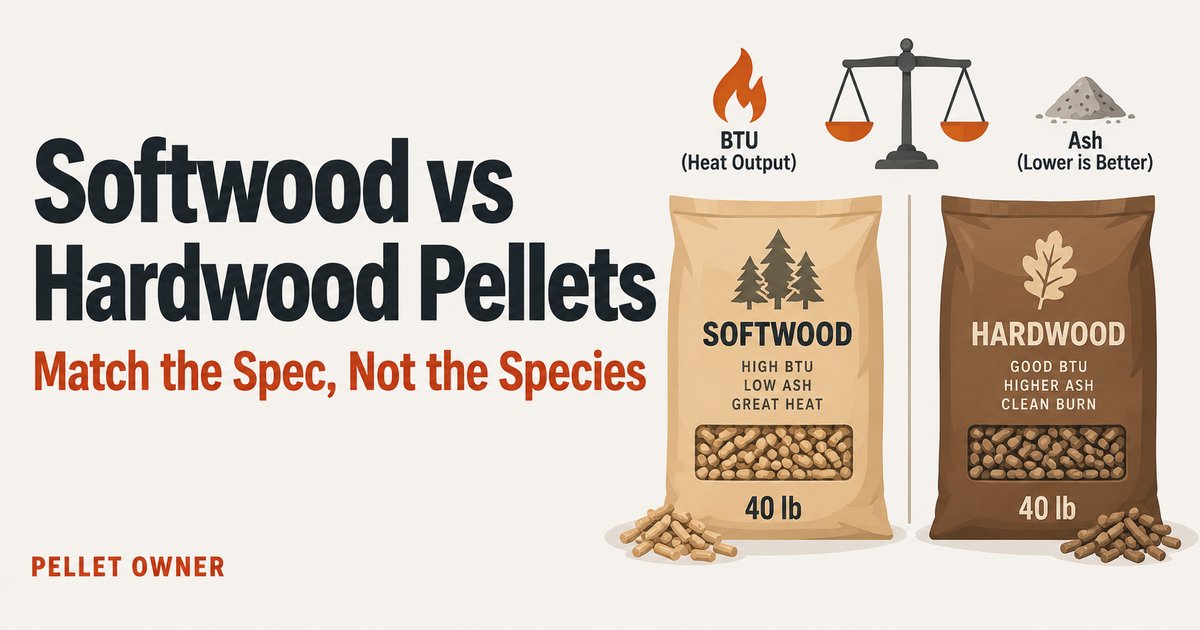
Every fall the same question shows up at the stove shop and in every pellet forum: “Should I buy softwood or hardwood pellets this year?” It sounds like it should have a clean answer, and almost every page you’ll find offering one is run by somebody who sells pellets or the equipment that burns them. Their verdict tends to match what’s in their warehouse.
So here’s the neutral version, from a site with no pellets to sell. The short of it: for most stoves sold in the US, a good softwood pellet burns as well or better than a hardwood one — and either way, the species on the bag matters far less than the quality inside it and what your stove’s manual asks for. Let me show you why the rule you know from firewood flips, what the numbers actually say, and the one buying rule that beats the label every time.
The short answer
If you take nothing else from this: buy on quality and on your stove’s spec, not on the word “hardwood” or “softwood.” A clean, low-ash, low-moisture softwood pellet will typically run hotter and leave less to clean than a mediocre hardwood one — the opposite of what firewood taught you. The species is a weak signal. The ash grade, the moisture, and whether your manual calls for a particular class of fuel are the strong ones.
That’s the whole article in three sentences. The rest is why, so you can walk into buying season and not get talked into a story.
The counterintuitive twist
With firewood, hardwood wins and it’s not close. A cord of oak or maple holds far more energy than a cord of pine because hardwood is denser — more wood packed into the same space — and it burns longer. Every wood burner learns this, and it feels like it should carry straight over to pellets.
It doesn’t, and here’s the reason. Pellets are milled sawdust compressed under huge pressure into a uniform, dense little cylinder. That process erases the density difference between species — a softwood pellet and a hardwood pellet come out at nearly the same physical density because the machine, not the tree, sets it. So the firewood advantage (hardwood is denser as it grows) is gone by the time it’s a pellet.
What’s left is the wood’s own chemistry, and here softwood actually has an edge. Softwoods — pine, fir, spruce, Douglas fir — carry more resin and natural oils (lignin), and those are energy-dense. Pound for pound, that’s why softwood pellets are commonly cited as burning a touch hotter than hardwood ones. This is misconception number one to drop: “hardwood pellets are better because hardwood firewood is better” is simply false for pellets. The thing that made hardwood win as a log doesn’t survive the pellet mill.
BTU and ash: what the numbers actually say
You’ll see BTU-per-pound and ash-percentage figures thrown around on vendor blogs, usually with no source and no two pages agreeing. Treat them as ballpark industry ranges, not lab results — I haven’t burned these side by side in a controlled test, and neither has most of the internet quoting them. With that caveat, here’s roughly where the commonly cited numbers land:
| Heat (commonly cited) | Ash (commonly cited) | |
|---|---|---|
| Softwood pellets | ~8,500–9,000 BTU/lb | ~0.3–0.6% |
| Hardwood pellets | ~8,000–8,500 BTU/lb | ~0.6–1.2% |
Read that carefully: the ranges overlap, and a top-tier hardwood can beat a bottom-tier softwood on both counts. The pattern owners repeatedly report is that on average softwood runs a bit hotter and a bit cleaner — but “on average” across the whole market tells you nothing about the specific bag in front of you. That’s exactly why the number that’s actually printed and certified — the ash grade — matters more than the species word.
The real buying rule: match your stove’s spec, not the species
Here’s the rule that beats the label. In the US, pellet quality is graded by the Pellet Fuels Institute (PFI), and the grade you want to read is on the bag. As of September 2026, the PFI Standard defines three residential grades, and the dividing line most relevant to you and your ash pan is inorganic ash content:
| PFI grade | Ash content limit |
|---|---|
| PFI Premium | ≤ 1.0% |
| PFI Standard | ≤ 2.0% |
| PFI Utility | ≤ 6.0% |
(Source: Pellet Fuels Institute Standard Specification, as published September 2026.)
Notice what that table does: it sorts pellets by how much ash they leave, which is what actually drives your cleaning schedule and your clinker risk — regardless of species. A PFI Premium softwood and a PFI Premium hardwood are both held to under 1% ash. That’s the honest comparison, and it’s the one the bag lets you make.
Then check what your manual says. Some stoves are tuned and warrantied around a particular fuel class — many manufacturers specify PFI Premium-grade pellets and some will note whether a higher-ash fuel voids the warranty or requires more frequent cleaning. Don’t guess at this; your manual is the authority for your specific stove, and running a fuel it doesn’t sanction is how people end up with avoidable service calls. (Here’s what else your stove can — and can’t — burn.) Match the grade your manual asks for first, then pick whichever species at that grade you like and can get cheaply.
Quality beats species
This is the part the vendor pages soft-pedal, because it undercuts the tidy “hardwood vs softwood” framing that sells: the word “premium” on a bag, by itself, guarantees nothing. “Premium” is only meaningful when it’s the PFI Premium grade, tested and certified. A bag that just prints the word “premium” as marketing is making no promise you can hold it to.
Three things drive real-world quality, and species is only one of them:
- Contaminants and bark. Pellets made with bark or dirty feedstock leave more ash and more of the silica and minerals that fuse into clinkers — no matter the species. Clean, debarked sawdust is the tell.
- Moisture. Wet pellets burn cooler and dirtier and can swell and jam an auger. A quality pellet is bone-dry.
- Species and resin. Real, but — as we saw — a smaller factor than the market makes it, and it’s the only one of the three that the “hardwood/softwood” word on the bag actually tells you about.
How to read a PFI label for real: look for the PFI Fuel Grade seal and the grade name (Premium / Standard / Utility), not just the marketing text. The seal means a third party is standing behind the ash, moisture, and durability numbers. No seal, and you’re trusting the brand’s own copywriting.
On brands: owners in the forums repeatedly praise names like Cubex and Okanagan (both softwood) and gripe about inconsistency from others batch to batch. Take that as forum opinion, not a ranking — pellet quality varies by production run and by what’s stocked in your region, and a name that’s great one winter can slip the next. The label and your own stove tell you more than any brand reputation.
What about clinkers?
This is where ash stops being an abstract percentage. Higher-ash fuels — which, on average, skews toward hardwood and toward dirtier or barkier pellets of any species — give you more of the mineral content that melts and fuses in the burn pot into hard, glassy lumps called clinkers. A clinker chokes airflow through the pot and can drag down combustion and trip shutdowns.
So the softwood-vs-hardwood question and the clinker question are the same question wearing two hats: lower ash, fewer clinkers. If you’ve been fighting crusty lumps in your burn pot, the fuel is a prime suspect, and it’s worth reading the full breakdown in the clinkers guide before you blame the stove.
How to test a brand in your own stove
You don’t have to take my word, a vendor’s, or a forum’s — your stove will tell you in a few days. This is the most reliable “test” there is:
- Buy one or two bags of a new pellet (not a whole ton on faith).
- Burn it for two or three days and watch two things: the flame and the ash pan. A good pellet gives a bright, lively, mostly-yellow flame and leaves a modest amount of fine, light ash. A poor one gives a lazy, dark, sooty flame and fills the pan fast with heavy ash and lumps. (What a healthy flame looks like is its own topic — see how to read your flame.)
- Check the burn pot for clinkers after a couple of days.
If the flame is bright and the ash pan stays light, buy the ton. If you’re emptying the pan constantly and finding clinkers, that brand doesn’t suit your stove — and no BTU chart is going to change what your own ash pan is telling you. It’s also just easier on cleaning day: a low-ash pellet and a proper ash vacuum (never a household vacuum — fly ash blows straight through it) turn the deep clean into a quick job.
One more practical note for buying season: how much you go through matters as much as which bag you buy. If you’re budgeting a ton or planning your winter supply, the bags-per-day guide will get your math straight.
FAQ
Which pellets burn hotter, softwood or hardwood? On average, softwood — because the pellet mill erases hardwood’s density advantage and softwood’s resin content gives it a slight edge in heat. Commonly cited ranges put softwood around 8,500–9,000 BTU/lb and hardwood around 8,000–8,500, but the ranges overlap and a top-grade hardwood beats a low-grade softwood. Treat those as ballpark industry figures, not lab numbers.
Do hardwood pellets produce more ash? On average, yes — hardwood pellets are commonly cited a bit higher on ash than softwood — but it’s the grade and cleanliness of the pellet, not the species alone, that decides it. A PFI Premium pellet of either species is held to under 1% ash. Read the PFI grade on the bag rather than the species word.
Are softwood pellets cheaper? It varies entirely by region and what’s produced near you — in parts of the West, softwood is cheaper and dominant; in the Northeast, hardwood is often more available. Price follows local supply, not a national rule, so compare what’s actually on the pallet in your area.
Which pellets last longer? Higher-BTU pellets (often softwood) release more heat per pound, so you may burn slightly fewer of them for the same warmth. But “lasts longer” is dominated by how you run the stove and how well the pellets are made — a clean, dry, high-grade pellet of either species outlasts a wet or dirty one.
Should I just always buy hardwood because it’s “better wood”? No — that’s the firewood rule, and it doesn’t survive the pellet mill. Buy the PFI grade your manual calls for, at the lowest ash you can get, from whichever species is clean, dry, and affordable near you.

Walt Hensley — Walt Hensley is the pen name of Pellet Owner’s editor. I’m not an NFI-certified technician, and I don’t sell stoves, pellets, or parts. Every guide here starts from the manufacturers’ owner’s and service manuals, is cross-checked against what owners consistently report, and says which is which — including what you can safely check yourself and when it’s time to call a certified technician.