Pellet Stove Power Outage: What Happens and What to Do
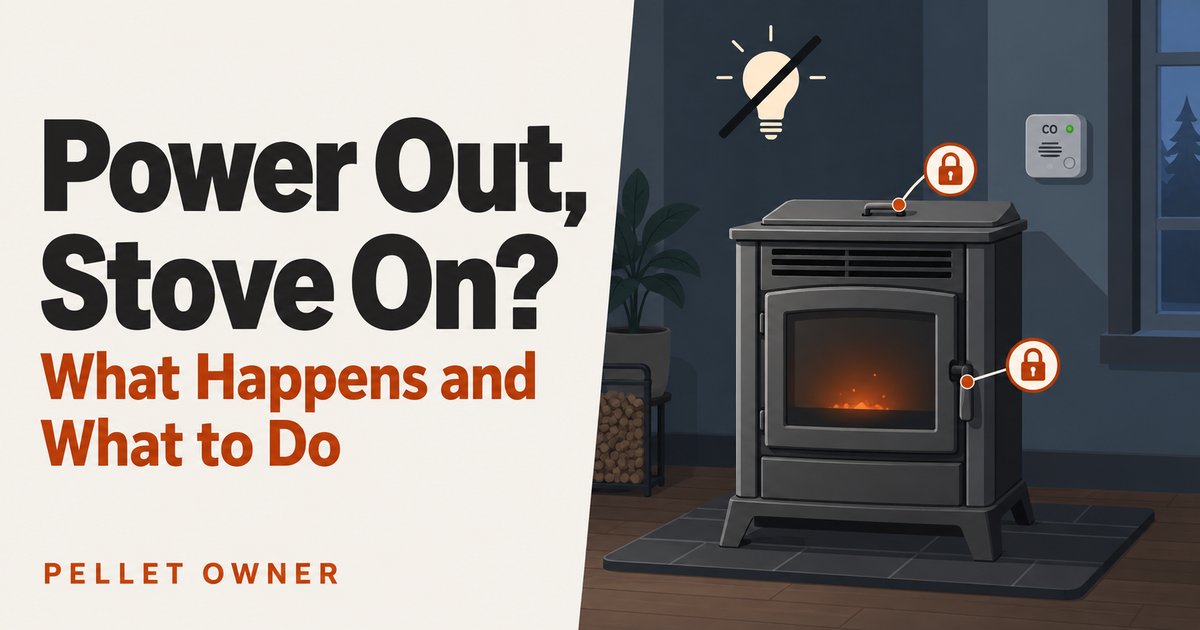
When the power goes out, a pellet stove’s auger, igniter and blowers all stop. The fuel already in the burn pot keeps burning until it goes out on its own, and with the exhaust blower stopped, smoke can seep into the room. Keep the door and hopper lid closed, don’t unplug the stove, and get everyone outside if smoke is heavy or a CO alarm sounds. What happens when the power returns depends on the brand.
I checked what each manual says happens when the power comes back, the part nobody tells you before the first storm.
What happens to a pellet stove when the power goes out?
Everything electric stops: the auger, the igniter, the combustion (exhaust) blower, the room blower and the control board. No new fuel reaches the fire, and nothing pulls exhaust up the vent. Harman’s P43 manual: “A power failure will cause the combustion blower to stop. This may lead to exhaust seeping into the room. Vertical rise in the venting may provide natural draft. It is, however, no guarantee against leakage.”
No manual says how long the fire lasts. Forge & Flame, the company behind Harman and PelPro, says in its support FAQ that it “will continue to burn until it goes out on its own,” and to keep the stove’s doors closed. Owners’ outage stories on the forums run from a campfire smell at the door gasket to, in the worst thread, “The entire house filled with smoke” (hearth.com, December 2008).
What should you do when the power goes out?
This site’s rule, whatever the brand: if the smoke is heavy, a CO alarm sounds or anyone feels unwell, get everyone outside and call 911 from there. If it costs you no time, turn the stove’s control to OFF on your way out — don’t unplug it — and don’t run the stove again until it has been checked. (The manuals ask for CO detectors; this protocol is ours, not theirs.)
Otherwise:
- Keep the door and hopper lid closed and latched. Harman’s P43 and -C manuals: “Always keep appliance doors and hopper lid closed and latched during operation and during power failures to minimize risk of smoke or burn-back.” Englander (both generations) warns that opening them during an outage “may cause fire to burn in the hopper.”
- Don’t unplug it. Englander, on smoke during a power failure: “DO NOT UNPLUG UNIT!!” Some online guides suggest unplugging after shutdown if the power is unstable; while there’s fire or heat in the stove, the manuals point the other way. PelPro and Harman’s -C allow it only once the stove is completely cool and the exhaust blower is off, the same rule as for a stove that won’t turn off.
- On an Englander, open an outside door and a window. Its manual: “Open the closest outside door and a window to eliminate the home’s natural draft.” With smoke in the room, wait “at least one hour” for it to clear. Harman’s and PelPro’s manuals don’t list this step; with smoke in the room it’s still my suggestion (the site’s, not theirs), and it never means opening the stove.
- Check that your CO alarm works without grid power. The CPSC’s winter-storm warning (February 19, 2026) calls for battery-operated or battery-backup CO alarms on each level of the home and outside separate sleeping areas. PelPro and Harman’s -C installation manual ask for a CO detector on every floor; Englander “highly recommends” them.
- Leave the stove alone. No lighting or feeding it by hand (see below).
Why do some pellet stoves smoke in a power outage?
Without the exhaust blower, only natural draft moves smoke up the vent, and the house can fight it. Harman’s manuals: “the stove must be able to draft naturally without exhaust blower operation. Negative pressure in the house will resist this natural draft if not accounted for in the pellet appliance installation.” Natural draft comes from vertical rise in the vent, and each manual asks for some:
| Stove | What the manual asks of the venting |
|---|---|
| Harman P43 and -C | “Strongly recommends” a vertical run of at least five feet, preferably above the roof line |
| Harman P61 (classic) | A vertical section “three to five feet high,” which “will provide natural draft in the event of a power failure” |
| Englander 25-PDVC (SBI) | “We require a minimum vertical rise of 36 in. (3 ft.),” to help clear smoke in a power failure; the classic 25-PDV manual recommends it |
| PelPro PP130-C | Through a wall, at least 60 inches of vertical pipe recommended, to “help prevent the possibility of smoke or odor venting into the home during a power outage” |
Upkeep is your part. Harman’s -C manual: “UPS or Battery Backup cannot prevent smoke leakage from an improperly maintained unit. Keep the venting system clean and free from obstructions and maintain all gaskets to keep an airtight seal.”
Venting changes are installer work. If your vent has less vertical rise than your manual asks for, raise it with your installer; don’t modify it yourself.
Can you run a pellet stove without electricity?
Not the electric stoves these manuals cover. None describes running without power, and every manual-lighting procedure assumes it: Harman’s P43 start-up begins “Make sure the unit is plugged into a 120 VAC, 60 HZ electrical source,” the -C’s emergency procedure ends with the Mode Selector on Constant Burn, Englander’s manual start ends by pressing ON, and PelPro has no manual-lighting procedure at all.
Some online guides describe lighting a pellet stove with a propane torch and running it on natural draft. That’s how US Stove’s non-electric, gravity-fed Wiseway is meant to start, according to its listings at Tractor Supply and Home Depot (checked October 2026). None of the manuals for the electric stoves I work from describes anything like it, and Englander warns that opening the hopper during an outage “may cause fire to burn in the hopper.” Don’t try it.
What happens when the power comes back?
It depends on the brand, the setting and how long the power was out:
| Stove | When the power returns, per the manual |
|---|---|
| Harman P43 (classic) | In “Automatic” setting, a stove with automatic ignition responds to the set point and ESP (exhaust probe) temperature “and resume[s] normal operation.” In “Manual” setting or without automatic ignition: ESP cool, it stays shut down; fire out but ESP still warm, “the feeder may restart,” then it shuts down and may flash 6 blinks; fire still burning, it resumes |
| Harman -C (P43-C, P61-C, P68-C) | Same logic; the manual prints the second case as “In ‘Idle’ Mode, or for units without automatic ignition” |
| Harman P61 (classic) | Not described in its manual |
| Englander 25-PDV and 25-PDVC | Out “approximately three minutes or less”: back to its previous state (ON returns as Start-Up; Start-Up, Shut-Down and OFF as themselves). Longer: OFF. Then “press the ‘ON’ button to re-start the unit, if necessary” |
| PelPro PP130-C | Not described; its “Power Related” troubleshooting covers only generators, 110 volts and battery backup |
Not in the table? Find the “power failure” or “loss of power” section of your manual before the next storm, or ask your dealer.
How do you restart a pellet stove after a power outage?
There’s no universal sequence. Follow your brand’s branch.
Harman P43 and -C. In Automatic, a Harman with automatic ignition may just pick up again; keep the doors and lid closed and leave it alone. If it simply stays shut down, start it as your manual describes. If it shuts down again with 6 blinks:
- Mode Selector to OFF; let the shutdown finish.
- Wait until it’s completely cool and the combustion blower has stopped before you unplug it or reach in: “Smoke spillage into room can occur if appliance is not cool before unplugging” (-C manual).
- Clean the burn pot, with “no unburned fuel in the ash pan prior to lighting a fire” (P43 manual).
- Plug it in and turn the Mode Selector back to your mode (OFF and back is the 6-blink reset). More in the Harman 6 blinks guide.
Englander, no smoke in the room. After a short outage it returns to its previous state on its own (a stove that was ON restarts through Start-Up). If it came back in Shut-Down, leave the panel alone: “The unit will exit the Shut-Down cycle if you press any buttons during Shut-Down.” If it came back OFF, its rule for every start applies: wearing gloves and with the unit cool (firebox metal can stay hot long after the fire is out), remove the wear plate and dump all ashes, “burnt or partially burnt.” Then press ON once.
Englander, smoke in the room during the outage. Its manual gives a separate sequence, in a different order:
- Hopper and door closed, unit plugged in, nearest outside door and windows open until the smoke clears (at least an hour).
- Power back: press ON “and let the unit run for at least 30 minutes.”
- Smoke again: press OFF and call technical support before restarting, “as damage could have occurred due to the power failure.”
- No smoke: press OFF, let it shut down completely and cool, then clean the burn pot area before restarting.
Don’t open the stove to clean before that sequence. A stricter line from this site: if you had to get everyone out, skip it and have support or a technician check the stove first.
PelPro PP130-C. Not described. Plugged in but no response: see the next section. Red 4 (missed ignition) on the restart: turn the dial to OFF and, once the stove is cold and unplugged, clean the fire pot, one of the three causes PelPro lists with fuel and the igniter. During start-up, the manual says “DO NOT: Try to restart, manually add pellets or use any type of accelerant.”
Harman P61 (classic). Not described either, so this is the site’s call, not Harman’s: if it doesn’t carry on by itself, treat the relight as a cold start. Let it cool completely, clear unburned pellets from the burn pot, and use its normal manual-lighting procedure, in line with the -C manual’s rule never to light by hand a stove “that has been operated recently and is not at room temperature.”
Pellet stove won’t start after a power outage?
- Englander: look for E-1. The manual lists “power failure” among the situations in which its vacuum switch shuts the unit off with that code. The reset is pressing ON once (after the burn-pot step); if it persists, call technical support.
- Harman: 6 blinks is the branch above.
- PelPro PP130-C: for “Stove plugged in but no response,” the manual’s list is: unplug the stove, check your home’s circuit breaker, reset the snap disc (red button on its back; it’s on the feed tube, inside the stove body), and visually inspect wires, blowers and power cord. Do it with the stove completely cool. If the snap disc trips again, call a technician.
Owners who’ve chased a no-start after an outage report a control board that needed resetting, a blown board fuse, a tripped high-limit or a board damaged by a surge (hearth.com threads, 2014 and 2015). Englander’s table does list replacing its 6-amp fuse after a surge, but a blown fuse is a symptom; on this site, fuses, boards and wiring are technician work. The P43, -C, Englander and PelPro manuals all recommend a surge protector, and the classic P61 warranty excludes “power failures and/or surges.” For the rest of a no-start, see why a pellet stove won’t ignite.
Can you run a pellet stove on a generator or battery backup?
If you run a generator: the CPSC (February 19, 2026) says “NEVER operate a portable generator inside a home, garage, basement, crawlspace, shed or other enclosed spaces” and to run it “outside only, at least 20 feet away from the house,” exhaust pointed away. The CDC (page last reviewed August 26, 2026) adds never “less than 20 feet from any window, door, or vent,” and to “use a battery-powered or battery backup CO detector in your home.”
Then check what your stove’s manual allows:
| Stove | What the manual says |
|---|---|
| Harman P43 (classic) | “Strongly recommends installing battery back-up to minimize entry of smoke into the room in the event of power loss.” Approved UPS (APC BE750G, TrippLite INTERNET750U): “safe shut-down only.” Surefire 512H on a deep-cycle battery: up to eight hours |
| Harman -C | UPS or battery backup “for areas prone to power outages” (one approved UPS, safe shutdown only, or an approved inverter/charger). “Some generator or battery back-up systems may not be compatible with the micro-processor electronics” |
| PelPro PP130-C | “Forge & Flame recommends a steady state generator”; the stove “has not been tested for use with a third party battery backup” |
| Englander 25-PDV and 25-PDVC | Neither manual mentions generators or battery backup |
| Harman P61 (classic) | Nothing on backup power |
Any battery runs out, and the P43 manual says what follows: “If the power is out for longer than battery life, smoke leakage may still occur unless your stove has been safely shut down.” Sizing and gear are in battery backup for pellet stoves.
What not to do in a power outage
- Don’t open the stove door or the hopper lid.
- Don’t unplug a stove with fire or heat in it.
- Don’t light or feed it by hand, and never with a torch.
- Don’t run a generator indoors, in a garage, or within 20 feet of windows, doors or vents.
- Don’t skip your manual’s restart steps or relight by hand on top of unburned pellets (Englander’s smoke-back sequence, 30 minutes running before cleaning, is the manual’s own exception).
- Don’t jumper switches to force a restart or modify the venting.
FAQ
How long does a pellet stove keep burning after the power goes out? No manual gives a time. Forge & Flame says the fire continues “until it goes out on its own.” Keep the door and hopper lid closed meanwhile.
Will my pellet stove restart by itself when the power comes back? Some will: a Harman with automatic ignition in Automatic can resume, and an Englander returns to its previous state after an outage of about three minutes or less. The PelPro PP130-C and classic P61 manuals don’t describe it.
Should I unplug my pellet stove during a power outage? Not while it has fire or heat in it. Once it’s completely cold, unplugging it until the power is steady is your call; none of these manuals asks for it during an outage, and what they recommend is a surge protector. On an Englander that put smoke in the room, leave it plugged in: its restart sequence needs it.

Walt Hensley — Walt Hensley is the pen name of Pellet Owner’s editor. I’m not an NFI-certified technician, and I don’t sell stoves, pellets, or parts. Every guide here starts from the manufacturers’ owner’s and service manuals, is cross-checked against what owners consistently report, and says which is which — including what you can safely check yourself and when it’s time to call a certified technician.