Battery Backup for a Pellet Stove: How to Size It Right
“If the power goes out I’ll be fine — I’ve got the pellet stove.” It’s a common belief among new owners, and it’s the one that leaves people cold in an outage. A pellet stove is not a wood stove. It doesn’t run on the fire alone: it needs electricity to turn the auger, spin the combustion blower, and push heat into the room with the convection fan. Cut the power and the stove goes dark like any other appliance.
Worse, cutting power dead in the middle of a burn isn’t just inconvenient — it can be a safety problem, which is the part the brand blogs skip. So the real question isn’t whether to get a backup, it’s how to size one so it actually carries your stove through an outage. This is the brand-agnostic version: the watt math first, then real gear by use case, with no ax to grind about whose battery you buy.
Does a pellet stove work without power?
No. And this is the misconception worth clearing up before you spend a dollar on batteries.
Every core function of a pellet stove is electric:
- The auger motor feeds pellets from the hopper into the burn pot. No power, no fuel.
- The igniter — a resistive heating element — lights the pellets on startup.
- The combustion (exhaust) blower creates the forced draft that pulls combustion air in and pushes exhaust out the vent.
- The convection/room blower moves the heat into your living space.
Lose electricity and all of that stops: the auger quits feeding and both blowers go silent. Whatever is already in the burn pot keeps smoldering until it burns out on its own, with nothing pulling the smoke out — and you’re not getting useful heat off it the way you might off a log. Keep the stove door and hopper lid closed and latched until the power is back. Harman’s manuals print that as a caution (“to minimize risk of smoke or burn-back”), and Englander’s tell you not to open the hopper lid or the door during an outage.
There’s a safety wrinkle, too. A pellet stove is designed to end a burn with a controlled shutdown: the auger stops, but the combustion blower keeps running for several minutes to clear the last of the exhaust out of the vent while the firebox cools. If the power is yanked mid-burn, that blower stops instantly while there’s still smoldering fuel and hot gas in the firebox. With the forced draft gone, that exhaust can find its way back into the room instead of up the vent — which is one cause of a smoke smell in the house. A backup that lets the stove finish its normal shutdown (or keep running) isn’t a luxury; it’s the difference between a clean stop and smoke indoors.
One honest caveat up front: a stove backup is not a whole-house generator. It’s sized to run one appliance — your stove — not your fridge, well pump, and furnace. Keep the job that small and it stays affordable.
How many watts does a pellet stove use?
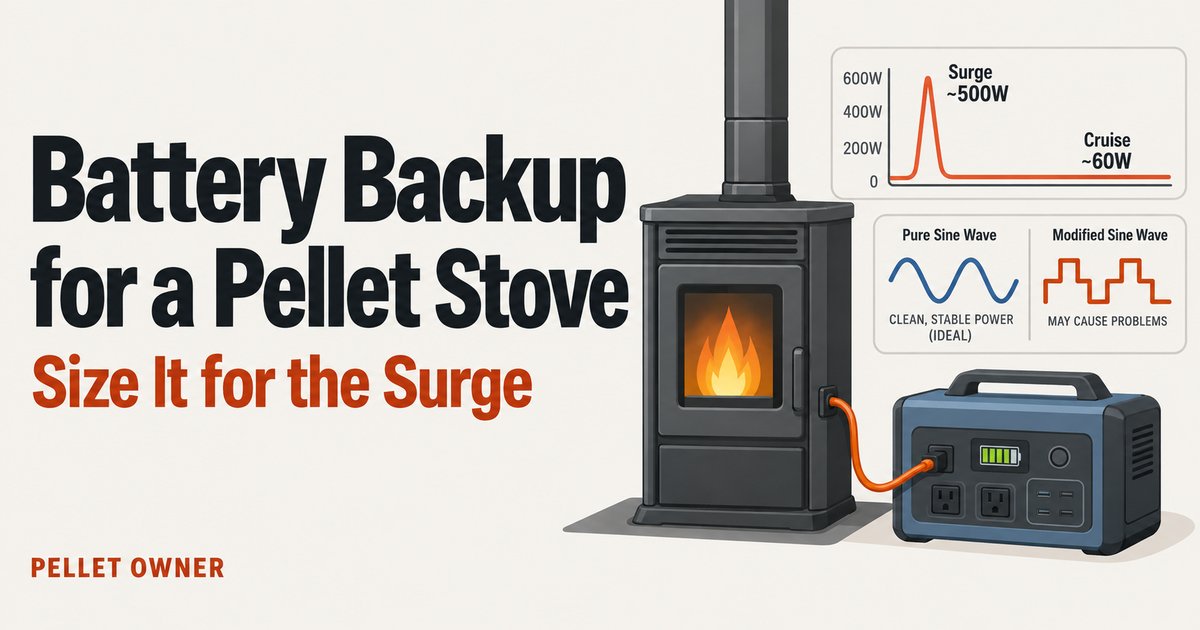
Here’s the number that trips people up. A pellet stove’s power draw isn’t constant — it has a startup surge and a much lower cruise draw, and you have to size for the surge.
Based on what owners and industry sources commonly report, a typical pellet stove pulls roughly:
| Phase | What’s running | Commonly reported draw |
|---|---|---|
| Startup surge (~first 5 min) | Igniter ON + blowers | ~300–500 W |
| Cruise (steady burn) | Combustion blower + room fan + auger cycling | ~50–80 W (some ~100 W) |
The startup surge is the igniter’s fault. That resistive element is the single biggest load the stove ever pulls, and it’s only on for the first few minutes of each ignition. Once the fire is established and the igniter shuts off, draw drops to that modest cruise figure for the rest of the burn.
The sizing rule falls right out of that: size for the surge, not the cruise. A backup that can only deliver 100 W will happily run a stove that’s already lit but will choke — or fail to start — the moment the igniter fires. That’s the same startup load that matters when a stove won’t ignite on weak power.
These are ballpark, community-consensus figures, not a spec I measured on your stove. The real number is on your own machine. Check the nameplate (usually a sticker on the back) or your manual for the stove’s rated wattage or amp draw, and size to that. If your manual gives amps, watts ≈ volts × amps (so 4 A at 120 V ≈ 480 W). When in doubt, round up.
Pure sine wave vs modified sine wave
If you take one technical point away from this article, make it this one: for a pellet stove, you want a pure sine wave output. This isn’t marketing — it’s a real difference in the shape of the AC waveform.
Grid power (and a pure sine wave inverter or UPS) delivers a smooth, rounded waveform. A cheaper modified sine wave unit approximates it with a blocky, stepped waveform. Simple resistive loads (an incandescent bulb, a kettle) don’t care. But a pellet stove is full of things that do:
- The igniter is resistive but sensitive to the RMS voltage a stepped waveform delivers — it can run hot, run weak, or fail to reach ignition temperature.
- The blower and auger motors run rough on a modified waveform: they can hum, overheat, lose speed, or trip the stove’s own controls, and over time the dirty waveform stresses the motor windings and the stove’s control board.
That’s why a bargain “computer UPS” pulled off a desk is a common disappointment here — many of the cheapest ones put out modified sine wave, and even the ones that are pure sine wave are often sized for a PC’s brief draw, not a stove’s sustained one. Buy pure sine wave for anything driving a pellet stove, full stop.
Sizing it: from watts to hours
Runtime is just capacity divided by draw. Power stations are rated in watt-hours (Wh); roughly:
Runtime (hours) ≈ usable Wh ÷ average watts drawn
The trap is which watts you plug in. You size the inverter for the ~300–500 W surge (it has to survive startup), but you estimate runtime off the ~50–80 W cruise, because that’s where the stove spends almost all its time. Knock off ~10–15% for inverter inefficiency and don’t count on draining a battery to zero.
A worked example, using a cruise draw of ~70 W:
| Battery capacity | Rough runtime at ~70 W cruise |
|---|---|
| ~300 Wh | ~4 hours |
| ~500 Wh | ~6–7 hours |
| ~1,000 Wh | ~12–14 hours |
| ~3,000 Wh | ~1.5–2 days |
Those are planning numbers, not guarantees — your real runtime depends on your stove’s actual draw, how often the igniter re-fires, and the battery’s condition and temperature. But they show the shape of the decision: a few hundred Wh bridges a short outage; a few thousand Wh gets you through a multi-day one.
Three setups by use case
There’s no single “best” backup — it depends on how long an outage you’re planning for. Here are three tiers, each with a named example or two so you can see the class of product. Model specs below are from each manufacturer’s listings as of September 2026; versions change, so confirm the exact SKU before you buy.
(a) Bridge the gap — 1 to 3 hours
For short, common outages — the lights flicker, the utility fixes it within an hour or two — a pure sine wave UPS that the stove is plugged into full-time is the simplest answer. When grid power drops, it switches over instantly, so the stove never even notices and can either keep running or complete its controlled shutdown.
- Example: CyberPower CP1500PFCLCD. Rated 1500 VA / 1000 W with PFC pure sine wave output (the “PFC/Sinewave” in the name is the part that matters), per CyberPower’s product listing (September 2026). The 1000 W rating clears the igniter surge with room to spare; the modest battery is meant to bridge, not run overnight — expect a couple of hours at cruise, not a full night.
- Harman owners, check your manual first. The -C owner’s manual (8390-044C, R26) names one approved UPS, the Tripp Lite INTERNET750U, and says a UPS “provides safe shut-down only. It is not intended for continued operation.”
(b) Overnight — through the night
For “the power’s out and it’s 10 pm,” you want either a dedicated inverter/charger or a mid-size power station.
- Example: Tripp Lite APS700HF / APS750. These are 12V DC-to-AC inverter/chargers (you supply a deep-cycle battery): the APS700HF is rated 700 W continuous and the APS750 750 W continuous (up to ~1500 W peak), per Tripp Lite’s specs (September 2026). Pair with a big enough battery and they run overnight and recharge it when the grid returns. Harman’s owner’s manual for its -C stoves (P-Series 8390-044C, R26) describes this setup: an inverter/charger on a 12-volt deep-cycle battery that runs the stove for up to eight hours and trickle-charges the battery while power is on. It says to use only Harman-approved battery backup devices and sends you to forgenflame.com for the approved inverter/charger, so if you own a Harman, check that list rather than assuming any model qualifies.
- Example: a mid-size power station like the Jackery Explorer 1000 v2 — 1070 Wh, 1500 W output (3000 W surge), per Jackery (September 2026). At a ~70 W cruise that’s roughly 12–14 hours: a night, plus margin.
(c) Multi-day — days, not hours
For rural outages or ice storms that last days, you want a large power station you can recharge (from solar or the grid between outages).
- Example: EcoFlow DELTA 3 — 1024 Wh, 1800 W output (3600 W surge), per EcoFlow (September 2026); expandable if you need more.
- Example: Jackery HomePower 3000 — 3072 Wh, 3600 W output (7200 W surge), with a built-in fast UPS transfer, per Jackery (September 2026). At cruise draw that’s on the order of a day and a half to two days on one charge.
All of these examples are pure sine wave, which is why they’re on the list. Recommend by the math — surge headroom and the Wh you need for your target runtime — not by the logo.
What to avoid
- A cheap computer UPS as your only plan. Many are modified sine wave, and even pure sine wave desktop units are usually sized for a PC’s short draw, not a stove’s. Fine as a bridge in a pinch; not a real backup.
- Modified sine wave anything. See above — it’s the fastest way to a stove that won’t light or a motor that runs hot.
- Sizing to the cruise number. A 100 W backup runs a lit stove and then fails the instant the igniter fires on the next startup. Size to the 300–500 W surge.
- Assuming “it turns on” equals “it’s enough.” A backup that powers the stove but can’t sustain the surge, or dies in an hour, isn’t sized right.
Don’t forget the controlled shutdown
Circle back to the safety point, because it’s the reason a backup is worth doing properly. A pellet stove needs to end its burn on its own terms: auger off first, combustion blower running on for several minutes to purge exhaust and let the firebox cool. If your backup dies mid-burn — battery flat, inverter too small — you get the same abrupt cutoff as an outage, and the same risk of exhaust backing into the room.
So size the backup to do one of two things: run the stove until grid power returns, or at minimum carry it cleanly through a full controlled shutdown so nothing is left smoldering with the blower dead. A backup that quits in the middle is worse than useless — it lulls you into leaving the stove running when you shouldn’t. And if you’re smelling exhaust or the stove is cutting out on its own, sort that out before you trust any backup to babysit it.
For the bigger running-cost picture — how much fuel all this actually burns — see how many bags of pellets per day a stove goes through.
FAQ
Can I run a pellet stove on a UPS? Yes, if it’s a pure sine wave UPS rated for the startup surge — commonly ~300–500 W while the igniter is on. A basic computer UPS often isn’t (many are modified sine wave and undersized), so choose one rated well above your stove’s nameplate wattage.
How long will a battery backup run my pellet stove? Roughly usable watt-hours ÷ cruise draw. At a ~50–80 W cruise, a ~500 Wh unit runs a handful of hours, ~1,000 Wh gets you overnight, and ~3,000 Wh stretches to a couple of days. Size the inverter for the surge but estimate runtime off the lower cruise number, and check your own stove’s draw.
Will a pellet stove work in a power outage? Not on its own — it needs electricity for the auger and both blowers, so it stops when the power does. It only keeps running if you’ve plugged it into a battery backup or generator sized for its startup surge — and a portable generator runs outdoors only, never in a garage or basement (the CPSC says at least 20 feet from the house), because its exhaust is carbon monoxide. If the power goes out with a fire going, keep the stove door and hopper lid closed until the power is back — the fuel already in the burn pot keeps smoldering with no blower to clear the smoke. For what to do while the power’s out — and what your stove does when it comes back — see pellet stove power outage.
How many watts does a pellet stove use? Commonly ~300–500 W during the ~5-minute startup (igniter on) and ~50–80 W at steady cruise. These are typical figures; your stove’s nameplate or manual has the real number — size your backup to that.

Walt Hensley — Walt Hensley is the pen name of Pellet Owner’s editor. I’m not an NFI-certified technician, and I don’t sell stoves, pellets, or parts. Every guide here starts from the manufacturers’ owner’s and service manuals, is cross-checked against what owners consistently report, and says which is which — including what you can safely check yourself and when it’s time to call a certified technician.