Englander 25-PDVC Error Codes (2023 SBI Models)
Search “Englander 25-PDVC error codes” and you’ll get a mess: content-mill pages promising “7 easy solutions” with E-code lists that run E-0 through E-7, forum threads where one person swears E-2 means “high temp” and the next says “failure to light,” and a scanned PDF nobody wants to squint through. The definitions contradict each other, and half of them describe a different generation of stove.
So I went to the source — the actual SBI manual (ref. 46313A, January 2023) that ships with the current line. Here’s the honest version, verified against that manual: what the codes really are, what causes each one, and how to reset. The first surprise is how short the real list is.
This article covers the current SBI-built line: the 25-PDVC, 25-PDVCH, 55-SHP10, 55-SHP10L, and 55-TRP10 — all documented by the same 2023 manual. If you have the older 25-PDV (built by England’s Stove Works), the codes and the reset are the same but the board, parts and some operating details differ; see the identification box below.
First: which Englander do you actually have?
This is the number-one reason people get bad answers online — they mix two different stoves. Before you trust any code definition, confirm your generation.
| Classic generation | Current generation | |
|---|---|---|
| Models | 25-PDV, 55-SHP22, 55-TRP22 | 25-PDVC, 25-PDVCH, 55-SHP10, 55-SHP10L, 55-TRP10 |
| Maker | England’s Stove Works (ESW) | SBI |
| Manual era | ~2013 | 2023 (ref. 46313A) |
| Tell-tale | Row of small bottom buttons (Low Fuel Feed / Low Burn Air / Air on Temp) that the “6-4-1” advice grew up around | Same three factory-preset buttons; a “C” in 25-PDVC on the label and the 2023-era manual point to the SBI build (confirm with the serial number) |
Check the rating label on the back or side of the stove for the model number and build year, and match it to your manual. If your model number ends in C (25-PDVC) or is a 55-SHP10 / 55-TRP10, you’re very likely in the right place — but the “C” is a strong hint, not proof: SBI’s own manual notes that 25-PDVC units with serial numbers below 150,000 use the older PU-CB04 board, so confirm with the serial number, the manual that came with your stove, and the board. If it’s a plain 25-PDV without the C, the code meanings and the reset are the same but the board, parts and some operating details differ — read the classic-generation guide instead: the Englander E2 and “6-4-1” walkthrough.
The master error-code table
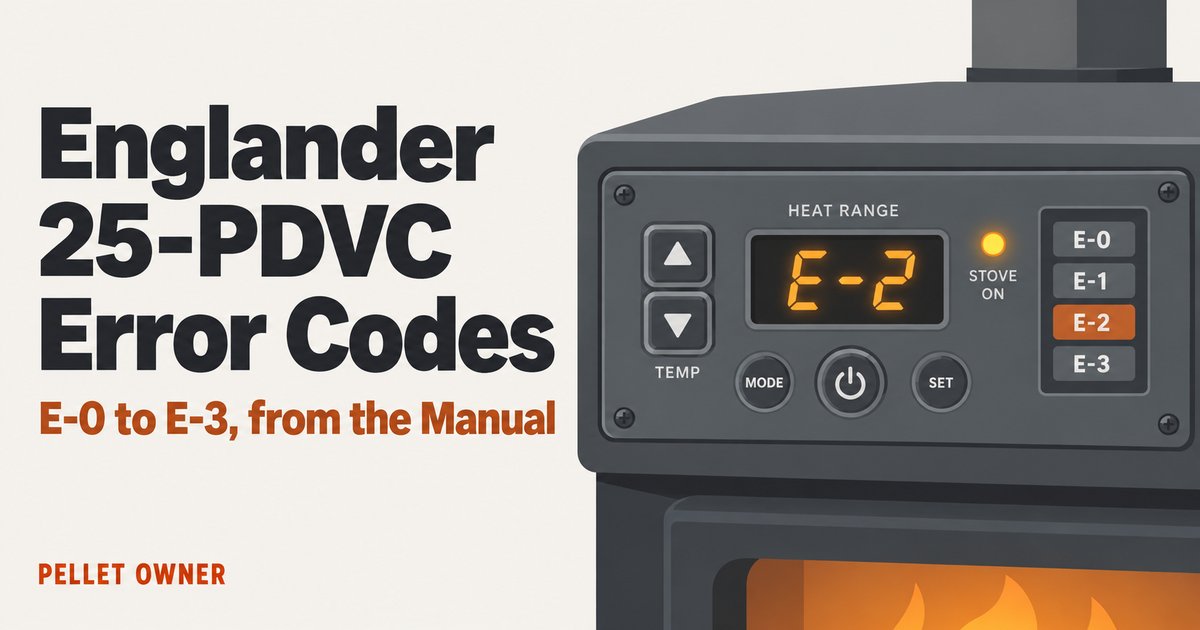
Here’s the part the web gets wrong. The SBI manual documents exactly four codes — no E-4, no E-5, nothing higher. The codes appear in the Heat Range and Blower Speed windows on the control board. If a page online lists E-5 or E-7 for this stove, it invented them.
| Code | Meaning (per the manual) | Most likely cause | First move |
|---|---|---|---|
| E-0 | No Error | — | Nothing wrong; normal operation |
| E-1 | Vacuum Loss | Exhaust blower not running (loose connection at the control board, bad blower, or bad vacuum sensor), blocked flue, an installation that back-drafts, or a loose/cracked vacuum hose | With the stove out, cold and unplugged: check the flue for blockage and look over the vacuum hose; control-board connections go to support or a technician |
| E-2 | Fail to Start | A failed light: loose heat sensor, a start setting that’s too low, or buildup on the igniter | Start on 5–9; check the heat sensor connection and the igniter for buildup |
| E-3 | Over Temperature Limit | A combustion-blower fault driving exhaust temperature out of range | Check the combustion blower wiring, then call support |
That’s the whole list. Four codes, and one of them (E-0) just means everything’s fine. The value here isn’t length — it’s that every row above is what the manual actually says, not what a forum guessed.
Now the three that mean something, one at a time.
E-2: Fail to Start (the one you’ll see most)
E-2 means the stove ran its ignition cycle and the control board never confirmed a real fire established. It’s a failed light, not a board failure. The manual’s troubleshooting page ties E-2 to three things — a loose heat sensor, the start setting, and buildup on the igniter — and the everyday causes of any failed light sit right behind them. Work this list with the stove off, cold, and unplugged, before you suspect any electronics:
- Buildup on the igniter, or a dirty burn pot. The manual’s fix for a failure to start is to check the igniter for buildup. Ash crusted over the burn pot’s air holes chokes the fire the same way before it catches.
- Starting too low. The manual’s own advice: always start the stove on a Heat Range of 5–9, not 1. A cold start on a low setting can fail to build a fire in time.
- A loose heat sensor. If the sensor at the back of the firebox is loose, it reads wrong and the board thinks the light failed even when it didn’t. The manual’s fix: check the stove connection.
- No fuel arriving. If the auger isn’t turning, nothing reaches the burn pot. The manual treats that as its own problem (a loose set screw, the gear motor, something jammed in the auger, or carbon buildup in the feed tube), not as part of the E-2 entry.
These are the same suspects behind any pellet stove that won’t ignite — start there for the full walkthrough of the physical fail-to-start causes.
E-1: Vacuum Loss
E-1 means the stove isn’t sensing enough draft to run safely, so it stops. The manual’s troubleshooting page ties E-1 to an exhaust blower that isn’t running (a loose connection at the control board, a bad blower, or a bad vacuum sensor), a blocked flue, and an incorrect installation that causes a back draft — plus a note to check for a loose or cracked vacuum hose on the vacuum switch.
Before you touch anything inside the stove, let it finish its shutdown and cool down, then unplug it: that troubleshooting page opens with “always disconnect the unit from the power source before attempting any repair.” Then the cheap checks come first: look over the vacuum hose for cracks or a loose fit, and check the flue for blockage — nests, rodents, or soot after a summer off. The manual’s other E-1 fix, checking the connection at the control board, means working on the stove’s wiring: leave that to support or a technician. Installation problems (a vent that back-drafts, a missing outside-air hook-up) are for your installer or dealer. If the hose and venting are clean and it still trips, the vacuum sensor itself may be the culprit. That’s the vacuum switch story, and it’s also a classic reason a stove keeps shutting off mid-run. Full walkthrough for both generations: Englander E-1.
E-3: Over Temperature Limit — and the manual’s own inconsistency
Here’s where I have to be straight with you, because the manual contradicts itself and the honest move is to say so.
The code-definitions page (page 14) defines E-3 = Over Temperature Limit — the stove got too hot and shut down on its high-limit safety. But the troubleshooting page (page 27) labels E-3 as “Blower failure.” Those look like two different things, and the web copies one or the other without reconciling them.
They’re not really in conflict once you see the mechanism. E-3 is formally an over-temperature trip. A failing combustion blower is one of the things that can drive exhaust temperature out of range — if the blower isn’t moving air correctly, heat backs up and trips the limit. So the manual’s troubleshooting answer makes sense: check the combustion blower wiring first, then call support. Treat a repeating E-3 as a real thermal fault for a technician, not something to reset away.
How to reset an SBI Englander
The SBI reset is simple, and there’s one trap in it:
- Press the “ON” button once — only once. During start-up, a second press just restarts the whole cycle, so it feels like the reset “didn’t work” when it actually did.
- If the code clears and the stove starts normally, you’re done.
- If the code keeps coming back, stop and contact technical support before trying again. The number is printed in your manual — and I’m deliberately not publishing it here, because it can change; use the support line for your SBI generation’s manual, not one you copied off a forum for the older stove.
Never shut the stove down by unplugging it. Use the “OFF” button (the display shows “SD”) and let the shut-down cycle finish. On shut-down the upper auger stops, but the room and exhaust blowers and the lower auger keep running — the room blower cuts out once the stove cools to around 95 degrees (the manual doesn’t print the unit). Pulling the plug mid-run skips that cool-down, which the manual warns against outright.
A word on the start-up timing (and the “6-4-1” question)
Two numbers people conflate: with the Auto-Start igniter, the igniter cycle runs 13 minutes, but the control keeps the stove in Start-Up mode (“SU”) for 20 minutes. Those are two distinct timings — don’t panic at minute 14 thinking the light failed; the board is still in start-up. And again: press ON only once during start-up.
As for the famous “6-4-1” the forums prescribe — the three bottom buttons (Low Fuel Feed, Low Burn Air, Air on Temp) — the SBI manual is plain: they’re factory preset and “should not be adjusted by the user” (page 36; page 21 adds that they “should not require any changes”). Its federal tamper warning (page 37) also says the stove’s manufacturer-set minimum low burn rate “must not be altered.” The manual doesn’t publish “6-4-1” as the official or universal factory values either, so if you see a page claiming “6-4-1 is the correct Englander setting,” it’s not coming from this manual. Leave those buttons where the factory set them; if the stove still seems to under-feed after the cleaning and fuel checks, call SBI support instead of changing them. The full story on “6-4-1” — and why the forums keep prescribing it — is in the classic-generation “6-4-1” article.
When it’s a part, not a code
Most codes clear with cleaning and a look at connections. When they don’t, three parts are the usual suspects:
- Igniter — a weak, worn, or misplaced Auto-Start igniter is the physical cause behind a stubborn E-2.
- Vacuum switch / sensor — a failed sensor keeps throwing E-1 even with clean venting. (On the SBI line the vacuum shut-down switch carries the part number CU-VS — handy when you order.)
- Combustion (exhaust) blower — a failing blower is what the manual ties to a repeating E-3, and it’s diagnostic territory, not a reset.
If you buy a replacement igniter or vacuum switch, verify the part fits your model before ordering — the SBI 25-PDVC / 55-SHP10 line and the older ESW 25-PDV don’t always share the same part, and that’s exactly the mix-up this whole article exists to prevent.
I’m not an NFI-certified technician, and I’ll say plainly where DIY stops: burn pot, pellets, the vacuum hose, and a look at the venting are yours; anything electrical (control-board connections, testing the igniter or sensor), a repeating E-3, and anything touching the venting go to a certified pellet stove tech. The exhaust side is the one part of this machine where guessing isn’t worth it.
FAQ
What does E2 mean on an Englander pellet stove? On the SBI 25-PDVC / 55-SHP10 line, E-2 is “Fail to Start” — the ignition cycle ran and the control board never confirmed a fire caught. It’s a failed light: the manual points to a loose heat sensor, starting too low (start on 5–9), and buildup on the igniter, and a dirty burn pot or damp pellets cause the same thing. Check those before suspecting the board.
What is the E1 code on an Englander? E-1 is Vacuum Loss — the stove doesn’t sense enough draft to run. The manual lists an exhaust blower that isn’t running (a loose connection at the control board, a bad blower, or a bad vacuum sensor), a blocked flue, an installation that back-drafts, or a loose/cracked vacuum hose. With the stove cold and unplugged, start with the vacuum hose and a flue check.
How do I reset my Englander pellet stove? Press the ON button once — only once (a second press during start-up just restarts the cycle). If the code returns, the manual says to stop and contact technical support rather than keep restarting. Never reset by unplugging; use OFF and let the shut-down cycle finish.
How many error codes does the 25-PDVC have? Only four: E-0 (No Error), E-1 (Vacuum Loss), E-2 (Fail to Start), and E-3 (Over Temperature Limit). There is no E-4 through E-7 on this stove — any longer list you find online was invented, not taken from the SBI manual.
Why does the manual say E-3 is both “over temperature” and “blower failure”? The manual is internally inconsistent, and I’ll call it: page 14 defines E-3 as Over Temperature Limit, while the page-27 troubleshooting labels it “blower failure.” They reconcile because a failing combustion blower can drive exhaust temperature out of range and trip the limit. Check the combustion blower wiring first, then call support — treat a repeating E-3 as a real thermal fault.
Is this the same as the 6-4-1 fix? No. “6-4-1” refers to the three bottom buttons (Low Fuel Feed / Low Burn Air / Air on Temp) on the Englander control. The SBI manual says those are factory-preset and shouldn’t need changing, and it does not publish “6-4-1” as the official values. See the classic 25-PDV “6-4-1” article for the full story, and the pillar Harman status-light blink codes if you’re cross-referencing another brand’s codes.

Walt Hensley — Walt Hensley is the pen name of Pellet Owner’s editor. I’m not an NFI-certified technician, and I don’t sell stoves, pellets, or parts. Every guide here starts from the manufacturers’ owner’s and service manuals, is cross-checked against what owners consistently report, and says which is which — including what you can safely check yourself and when it’s time to call a certified technician.