Englander E1 Error: What Vacuum Loss Means and What to Check
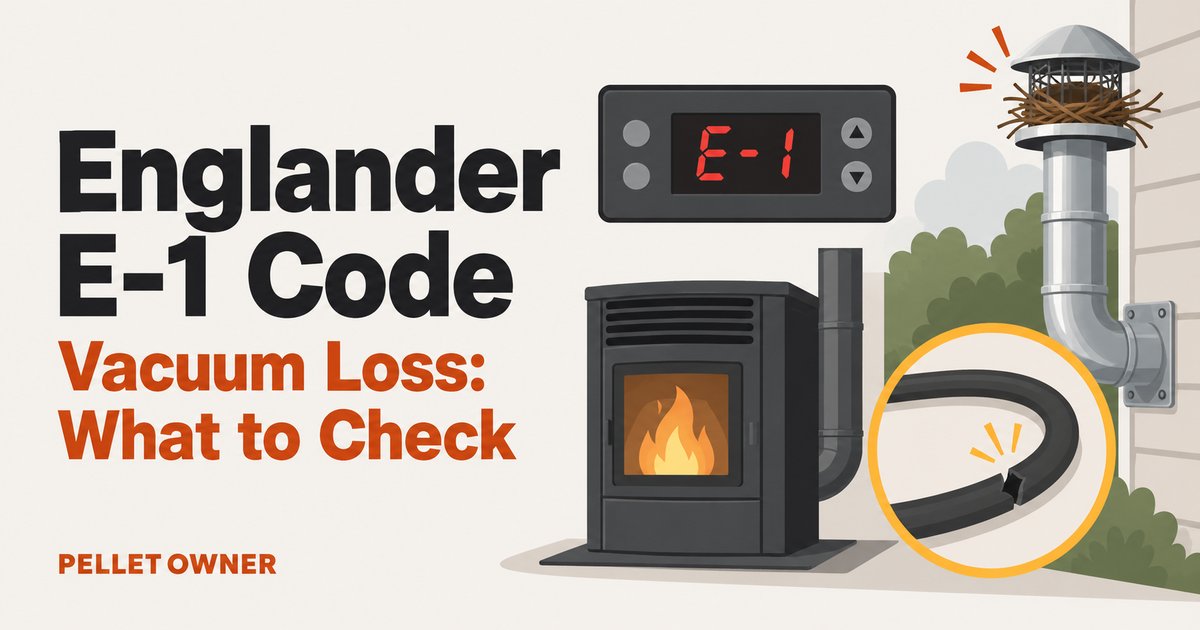
On an Englander 25-PDV (classic) or 25-PDVC (current SBI build), E-1 means Vacuum Loss: a vacuum switch shut the stove down because it lost the draft the exhaust blower creates. Both manuals tie it to an exhaust blower that isn’t running, a bad vacuum sensor, a blocked flue, an improper installation, or a loose or cracked vacuum hose. Reset with one press of ON; if E-1 comes back, stop and call support.
Before anything else: smoke or CO
- Heavy smoke, a CO alarm, or anyone feeling unwell: turn the stove OFF at its controls on your way out (don’t unplug it), get everyone outside, and call 911 from there.
- Smoke coming into the room: both manuals give the same smoke-back steps. Don’t open the hopper or the stove door, and “DO NOT UNPLUG UNIT!!” If the power hasn’t failed, press OFF right away, open the nearest outside door and windows, wait for the smoke to clear (at least an hour), and don’t restart before calling technical support. If the smoke came with a power failure, follow the manual’s separate restart steps.
- No smoke, but it failed to start or didn’t finish shutting down: open the closest outside door and a window before you open the stove’s door or hopper lid, so smoke leaves through the outside-air hook-up, not the room.
Both manuals recommend smoke and carbon monoxide detectors; the SBI manual calls a CO detector “strongly recommended.”
What does E-1 mean on an Englander pellet stove?
Page 14 of both manuals lists four codes: E-0 (no error), E-1 = Vacuum Loss, E-2 = Fail to Start and E-3 = Over Temperature Limit. The reset: press ON “(only once),” and if a code keeps showing, contact technical support “before further attempting to restart your unit.”
Two more pages explain the code:
- Page 15: if the combustion (exhaust) blower fails, “a Vacuum Shut-Down Switch will automatically stop the stove,” the board shows E-1, and you contact technical support. Venting matters because “the natural draft is needed to clear the smoke from the stove.”
- Page 19: the switch “will either stop the top (feed) auger or shut the unit off; if the unit turns off an E-1 Code (error code) will appear.” The situations it names: “power failure, Combustion Blower failure, improper flue installation, a blocked flue (from rodents, nests, etc.), or ‘dirty burning’ from burning improper fuel.”
So E-1 doesn’t name a broken part. The stove lost its draft and shut down on purpose. Pages that list E-4 to E-7 for these stoves, call E-1 a “low fire” code, or say it’s “not in general use” don’t match either manual. The full code table is in the Englander 25-PDVC error codes guide.
Which Englander do you have? (What changes for E-1)
| Classic (England’s Stove Works) | Current (SBI) | |
|---|---|---|
| Models in the manual | 25-PDV, 55-SHP22, 55-TRP22 (manual dated 10/7/2013) | 25-PDVC, 25-PDVCH, 55-SHP10, 55-SHP10L, 55-TRP10 (manual 46313A, 2023) |
| Control board | PU-CB04 | PU-CB19, or “PU-CB04 if stove Serial Number is below 150,000” |
| Vacuum switches | Two: PU-VS and CU-VS. The wiring diagram runs a “HIGH TEMP. VAC. HOSE” from one to the back of the firebox and from the other to the combustion blower | One: CU-VS. “High Temp Vac Hose connects to back of firebox” |
| “Door ajar” vacuum port | Right wall of the burn chamber | To the right of the burn pot |
The same in both: the code meaning, the one-press reset, the page-27 troubleshooting table, the smoke-back steps and the 13-minute igniter start-up cycle.
Two cautions. A “C” on the label is a strong hint, not proof: the SBI manual says 25-PDVC units with serial numbers below 150,000 use the PU-CB04 board, so go by the serial number on the rating label, the manual that came with the stove and the board, and call the support line in your generation’s manual. And the classic manual doesn’t say which of its two switches stops the feed and which one shuts the stove down with E-1, so this guide won’t guess.
What causes E-1? The manual’s list, read off the page
Both manuals print the same troubleshooting table on page 27, and two of its rows carry E-1. I read it row by row on the page itself, because it’s easy to misalign: the “tighten connection on sensor” fix that circulates for E-1 belongs to the row above it, “Room air blower not operating.”
| Cause (manual’s words) | Row | What you can look at | Support or technician |
|---|---|---|---|
| Exhaust blower not operating: “Loose connection → Check connection at c/board”; “Bad blower → Replace blower” | 4 (E-1) | Whether the exhaust blower starts when you press ON | The board connection and the blower |
| “Bad vacuum sensor → Replace vacuum sensor” | 4 (E-1) | Nothing to test yourself | Testing or replacing the switch |
| “Blocked flue (E-1) → Check for flue blockage (nests, rodents, excess soot, etc.)” | 11 | Cap, clean-out tee and joints you can reach from the ground, stove cold | Ladder or roof work |
| “Improper installation (E-1) → Check for loose flue/pipe connections. Also be sure to have proper Outside Air hook-up,” which “may cause a back draft” | 11 | Outside-air pipe connected, screen at its end clear | Any change to the installation |
| “Also check for loose or cracked vacuum hose on vacuum switches” | Note | A visual check, stove out, cold and unplugged | Re-seating or replacing the hose |
The exhaust blower. Pressing ON starts “the upper auger, bottom auger and exhaust blower.” If the exhaust blower doesn’t start, that’s E-1 by the manual’s own logic, and the next call is to support. “Check connection at c/board” is not an owner step: the board sits behind the rear access panel, on the 120-volt line, and the table opens with “TO AVOID ELECTRICAL SHOCK ALWAYS DISCONNECT THE UNIT FROM THE POWER SOURCE BEFORE ATTEMPTING ANY REPAIR.”
The flue and the outside air. Fly ash “will collect in the exhaust venting system and restrict the flow of the flue gases,” and both manuals’ monthly routine includes inspecting the flue pipes and clearing ash from the clean-out tee. Owners chasing E-1 report elbows packed with soot and ash, and nests in the cap after a summer off. Outside air is mandatory on both stoves; the SBI manual wants its outside end screened and inspected “at least annually to be certain it is free from blockage.” One “easy fix” page says to vent with 4-inch pipe or bigger; the manuals call for 3-inch pellet vent, going to 4-inch above 4,000 feet or when the 3-inch run passes 15 feet. Sizing and back drafts are installer questions, and ladders and roofs belong to a sweep: pellet stove chimney cleaning, DIY vs pro.
The vacuum hose. The schematics label it “HIGH TEMP. VAC. HOSE,” and the switch sits inside the stove (#24 on the exploded diagram). Before you look: “To perform any maintenance inside the rear of the unit, the stove must be out (no fire), cooled down and unplugged. Electrical shock can occur if the unit is not unplugged from power.” If seeing the hose means taking the rear panel off, it goes back on before the stove is plugged in (“Do NOT Operate with Panel(s) Off”). Your part is a look: is it on at both ends, and is it cracked? In owner threads that traced E-1 to the hose, the crack was at an end, often on the hot side by the blower, and the threads that report a fix end with a new hose. Some owners trim the cracked end and push it back on; neither manual describes that. Re-seating or replacing it goes to support or a technician, with the high-temperature hose the schematics call for. (One parts seller’s blog calls it “low-temperature” silicone; the manual says otherwise.)
Power failure and fuel. During an outage, don’t open the hopper lid or the door, because it “may cause fire to burn in the hopper,” and open the closest outside door and a window. The full outage sequence, brand by brand, is in pellet stove power outage: what to do. “Dirty burning” points to the fuel note: “Pellets with high ash content will burn dirty and require the unit to be cleaned more often.”
Is it E-1, or did the stove just stop feeding?
These stop an Englander’s feed without the manual tying them to E-1:
- Door left open: “If door is left open (approximately) two minutes, unit will stop feeding and fire will go out.” No code is mentioned.
- A dirty “door ajar” port: it “must be kept clean, or the top auger will cease to function.” This one is yours: with the stove unplugged and cooled down, clear it with a brush or pipe cleaner, “not a vacuum.”
- Hopper lid open: the lid safety switch (AC-HLSB) keeps the top auger from turning, which in the manual’s words means “a stove that will not burn.”
A claim you’ll run into is that a door or lid that isn’t sealed throws E-1. Englander’s manuals don’t say that: those pages describe a stopped feed, and worn gaskets are tied to “air leaks resulting in smoke-backs,” with annual replacement mandatory. None of them mentions E-1. Owners chasing the code sometimes check the door gasket with the dollar-bill test anyway; no harm, but it won’t explain an E-1.
What can you check yourself? (In this order)
The rules first: never shut the stove down by unplugging it; maintenance starts only once it’s OFF and has finished its Shut-Down cycle, and firebox metal “can remain HOT… EVEN after the Shut-Down cycle is complete”; anything inside the rear needs the stove out, cold and unplugged. Smoke: back to the box at the top.
- Let it finish shutting down and cool. Then clear the burn pot: before every press of ON, the manuals want all ash, “burnt or partially burnt,” out of the burn pot area and from under the wear plate, with the unit cool, or it “can cause smoke-back and serious damage.”
- Check the vent and outside air from the ground, stove cold: cap, clean-out tee, reachable joints, the outside-air pipe and its screen.
- Press ON once and listen for the exhaust blower starting with the augers. If it doesn’t, press OFF, don’t open the stove, and call support. A second press during start-up just restarts the cycle.
- If E-1 comes back, stop restarting. The manual says to contact technical support “before further attempting to restart your unit.” Before you call, with the stove out, cold and unplugged, you can look at the vacuum hose and tell support what you found.
- Beyond that, it’s support’s call, including whether to restart after you’ve cleared something.
When is E-1 a job for support or a technician?
- The exhaust blower doesn’t start, or E-1 returns after the one press of ON.
- Anything at the control board, any electrical check, testing or replacing a vacuum switch (the classic has two, and the manual doesn’t say which does what), and re-seating or replacing the hose.
- The installation, a back draft or the outside-air hook-up (an installer), and anything up a ladder or on the roof (a sweep).
Never bypass the vacuum switch, not even as a test. Englander’s manuals don’t print a “do not bypass” line, but they describe the switch as the part that stops the stove when the draft goes. Some forum threads say don’t bypass it; others suggest jumping both switches to see what happens. A jumper test runs a stove whose draft problem nobody has found with its draft protection off, which is exactly when smoke and carbon monoxide can come into the room. A dealer or technician can test the switch without defeating it; more in the vacuum switch guide.
Why not just keep restarting it?
The manual allows one press of ON, then support. For a manual light, it even says to “first clean any pellets out of the burn pot (to prevent over-feeding).” My read: restart after restart keeps feeding pellets to a stove that can’t clear its smoke. And the pages that say to reset E-1 by unplugging the stove for a few minutes contradict the manual page that says “NEVER SHUT DOWN THIS UNIT BY UNPLUGGING IT FROM THE POWER SOURCE.”
FAQ
How do I reset an E1 code on an Englander? Press ON once. If E-1 comes back, contact technical support before trying again. Never reset or shut down by unplugging.
Why does my Englander show E2 and then E1? No manual explains that sequence. In owner threads it shows up alongside soot-packed vent elbows, cracked vacuum hoses, failing blowers and even a jammed top auger. Work through the E-1 checks above and tell support both codes appeared.
Can a dirty stove cause E1? Yes. A flue blocked with soot is on the E-1 row of the table, the manual says too much ash “hampers airflow” and “can cause smoke-back,” and “dirty burning” from poor fuel is on page 19’s list.
Is E1 always the vacuum switch? No. The table puts the exhaust blower, the flue and the installation beside it: real losses of draft that a good switch reports correctly. Check those before anyone orders a switch.
Can I run my Englander with the vacuum switch bypassed? No. It’s the device that stops the stove when the draft is lost. If it has failed, a technician replaces it; it never runs jumpered.
Does a power outage cause E1? Power failure is on the manual’s list. During an outage, keep the hopper lid and door closed and open the closest outside door and a window.
Cross-referencing another brand? Harman reports faults as status-light blinks, not E-codes. The symptom-by-symptom troubleshooting guide has a code table for Harman, Englander and PelPro.

Walt Hensley — Walt Hensley is the pen name of Pellet Owner’s editor. I’m not an NFI-certified technician, and I don’t sell stoves, pellets, or parts. Every guide here starts from the manufacturers’ owner’s and service manuals, is cross-checked against what owners consistently report, and says which is which — including what you can safely check yourself and when it’s time to call a certified technician.