Pellet Stove Blower Not Working? Find Which Blower First
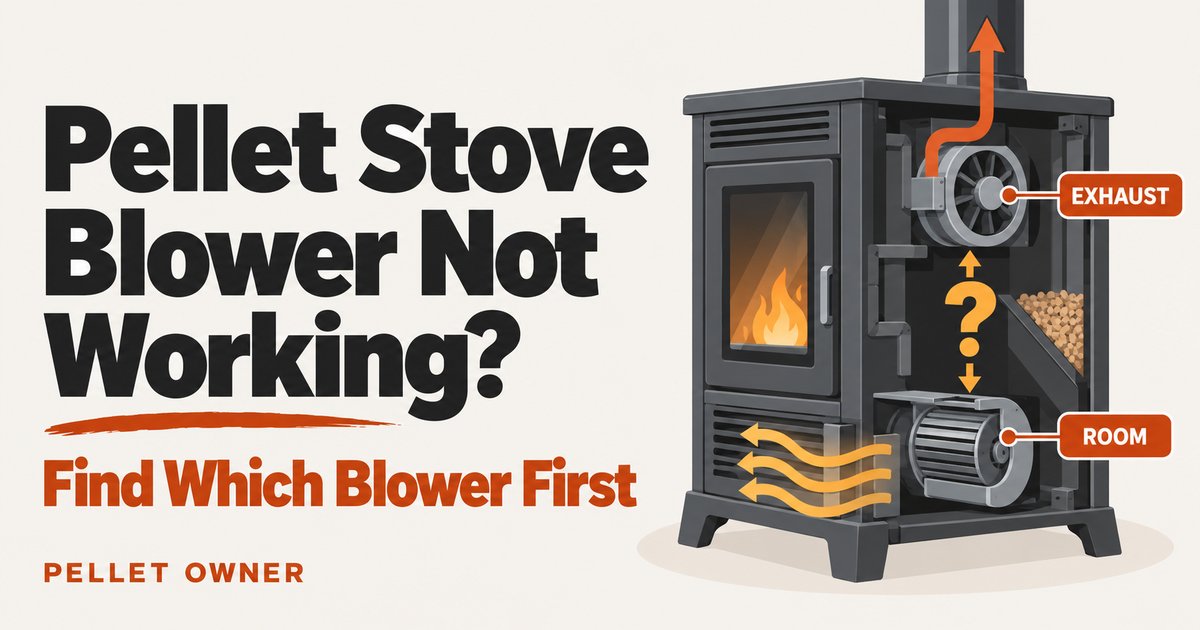
A pellet stove has two blowers, and they fail differently. If the exhaust (combustion) blower stops, the stove can’t vent: its draft switch cuts the fuel or shuts the stove down (on an Englander, with an E-1). Stop using it and call for service. If it’s the room (convection) blower, first check whether it should be running yet: several manuals have it wait until the stove heats up, and some stop it on purpose. Then dust, connections, motor.
This guide is about a blower that won’t run. If yours won’t stop, that’s the mirror problem: see pellet stove won’t turn off. Not sure it’s a blower at all? The symptom-by-symptom troubleshooting guide starts from what the stove is doing.
Before you touch anything
- Smoke in the room, a CO alarm, or anyone feeling unwell (this site’s rule, not a manual’s): turn the stove OFF at its controls on your way out, don’t unplug it, get everyone outside, and call 911 from there.
- A blower has stopped but the fire is still going: turn the stove down or OFF with its controls and let the shutdown finish. Don’t unplug a burning stove “to stop the fan.”
- Before any hands-on check: OFF, shutdown finished, completely cool, then unplug. PelPro: “Turn dial control to OFF, let Stove completely cool and exhaust blower must be off. Now you can unplug Stove before servicing.” Harman’s -C manual says the same of its combustion blower; Englander: “UNPLUG THE UNIT PRIOR TO ANY SERVICE WORK!”
- Never run it with panels off or parts missing. Englander’s label: “Do NOT Operate with Panel(s) Off.” Harman and PelPro forbid operating “without fully assembling all components.”
Which blower isn’t working?
| Exhaust (combustion) blower | Room (convection or distribution) blower | |
|---|---|---|
| Its job | Pulls air through the fire and pushes exhaust out; Harman’s stoves “rely on a combustion blower to remove exhaust from the firebox” | Moves heat into the room; per Englander, it “does not handle any by-products of combustion” |
| Where the manual puts it | Harman: behind the combustion blower cover (P43, P61) or the intake cover behind the ash pan (-C) · Englander: opposite the room blower · PelPro: behind the left side panel | Englander: left side · PelPro: behind the right side panel · Harman: the “distribution blower” |
| If it stops | No draft: the stove stops feeding or shuts down | The heat stays in the stove |
| What you’ll see | Englander: E-1 · PelPro: red 1 (“No vacuum” is a listed cause) · Harman: the fire goes out | A hot stove and a cool room |
Englander: if the combustion blower fails, “a Vacuum Shut-Down Switch will automatically stop the stove,” with E-1 on the board. PelPro’s feed motor needs the “vacuum switch … closed (ie exhaust blower on).” Harman lists “Feed motor or combustion blower has failed” under “FIRE HAS GONE OUT”; on its -C models, my read is that a slow or dead blower can drop the draft enough to open the pressure switch (2 blinks), though the manual never says it always will.
On the room side, PelPro lists a dirty or failed convection blower among the causes of its red-8 “Exhaust Over Temperature” alarm, and Forge & Flame, the company behind Harman and PelPro, says in its online troubleshooting guide that when it fails, “your stove overheats or shuts down.”
Is your room blower supposed to be running right now?
No manual I checked gives a time in minutes. Heat, the mode and the room sensor decide:
| Stove | What the manual says |
|---|---|
| PelPro PP130-C | Exhaust blower, igniter, pellets, then “Convection blower will automatically turn on after the Stove heats up.” It also runs on after shutdown. |
| Harman -C (P43-C, P61-C, P68-C) | It turns on “after your appliance has reached the set temperature” (in the ignition-cycle section: the stove’s operating temperature, not your room setting). Then, in Room Temp, it goes “on and off in accordance to what temperature the room sensor is reading.” |
| Harman P43 (classic) | In Room Temp it “will shut off as the room reaches the set temperature.” In Stove Temp with the igniter on Manual, it doesn’t run at low dial settings, by design, until the exhaust probe reaches 350 °F (81% output). |
| Harman P61 (classic) | Its speed rises “as the stove temperature increases.” In TEST the blowers alternate high and low. |
| Englander 25-PDV and 25-PDVC | On a cold start, run on “5” “until the room air blower begins to operate.” Blower speed follows the Heat Range. |
Running, but the room stays cool? That’s pellet stove not putting out heat.
Room blower not coming on: what to check
The box at the top comes first. Then:
- Is the stove asking for it? Mode, a room already at temperature, a stove still warming up, a P61 left in TEST.
- Harman: the panel lights. One “Indicates power to distribution blower.” My reading, not a diagnosis: light on with the blower still points at the blower or its connection; light off, the board isn’t calling for it or has a control problem. Either way it’s a dealer call, with no electrical tests. In one hearth.com thread (Accentra II, 2014), “blower light on, no air” ended with a gummy, slow motor that was replaced.
- Dust and pet hair, on your manual’s schedule, cold and unplugged:
- Harman -C: “Brush & vacuum the distribution fan” monthly, about every 25 bags, stove “turned off, cold and unplugged.”
- Englander: dust builds up on the blades; the manual has you remove the blower (power leads and four mounting screws) and clean it “with a vacuum or a soft paint brush.”
- PelPro: right side panel, vacuum the blades and housing. Its cleaning pages say “Monthly or as needed”; its summary table says “Annual or as needed.” Same manual, two readings: I’d use the shorter one. PelPro’s 2014 repair guide for its earlier dial stoves adds “make sure it spins freely” here; that’s a PelPro guide, within this access, cold and unplugged. Harman’s and Englander’s manuals print no spin check.
- Harman P43 and P61 (classic): no cleaning step printed for this blower; leave it to the annual service.
- Owners with pets report matted hair on the wheel.
- Connections, only where the manual says so. PelPro, for “Component (i.e. blower) fails to start or fails to turn off”: “Unplug your Stove · Check all connections and power plugs are secure · Visually inspect wires, blowers and power cord,” with its cold-and-blower-off rule first. Englander’s row “Room air blower not operating” lists “Loose sensor → Tighten connection on sensor” and “High ‘ON’ temperature → Adjust temperature lower.” Both are support calls: the row doesn’t say which sensor or setting, and the 25-PDVC manual says the lower buttons (one is “Air on Temp”) “should not be adjusted by the user.” Although forum answers say to set “Air On Temp” to 1, that’s the button the manual tells you to leave alone.
- Motor or board: technician. Humming without spinning, a hot smell or a stiff wheel means a part. Replace only by your manual’s printed procedure, with approved parts: PelPro kit KS-5020-1052; Englander PU-4C442 (25-PDVC) or PU-4C447 (25-PDV). Harman’s parts lists show the distribution blower (3-21-33647) but no owner replacement steps, so that’s dealer work. Englander and PelPro cover electrical parts for one year: call before you buy.
Exhaust (combustion) blower not running: stop and call
If there’s smoke, Englander’s instructions are the most complete: don’t open the door or the hopper, don’t unplug, open the nearest outside door and windows, press OFF if the power hasn’t failed, let it clear for at least an hour, and don’t restart before calling technical support. The CO rule in the top box applies on any brand. On an Englander, the stove will already have stopped itself with an E-1, and the manual says to contact Technical Support.
What the manuals give the owner, cold and unplugged:
- Harman P43: after each ton, open the combustion blower cover and clean the wheel “with a brush and a vacuum cleaner,” careful with the exhaust probe. The P61 does it in its 2-to-5-ton cleaning.
- Harman -C: the chart puts the combustion fan in the yearly Total Clean; the cleaning pages put its chamber (behind the ash pan) under “Monthly Cleaning – continued.” The shorter interval is the conservative one.
- Englander: the blower “should be removed annually and the blower tube vacuumed.” A motor gasket lets the motor come out without removing the whole blower; only “if you must remove or replace the entire Combustion Blower” does a new flange gasket go “between the blower flange and the steel exhaust tube.” Unsure the seal is right afterward? Leave it to the annual service.
- PelPro: annually or as needed, behind the left side panel; check the gasket if the blower comes off (kit 812-4400).
Technician territory: a blower that won’t turn, an E-1 or red 1 that returns after cleaning, any electrical diagnosis, any blower replacement on a Harman. Never jumper the vacuum switch, not even as a test; the vacuum switch guide separates a bad switch from a bad blower. If the stove won’t light at all, see the airflow checks in the won’t-ignite checklist.
Why is my pellet stove blower noisy?
| Sound | What the manual says | What to do |
|---|---|---|
| Metallic ticking as it heats and cools | Harman -C: metal “expanding and contracting”; it “does not affect the operation or longevity of your appliance” | Nothing |
| Pinging or rattling (Englander) | “Check blower for material” · “Check impeller blower screw” | Cold and unplugged, at the blower cleaning; otherwise support |
| Squeaking (Englander) | The auger, not the blower: build-up in the tube or auger alignment | The manual’s monthly feed-tube cleaning, or support |
| Rumbling or whistling (PelPro) | Clean the firepot, behind the baffles and the cap; adjust the trim | Cleaning and trim |
| Humming without spinning, grinding, noise that grows over the season | Not covered | Owners report worn bearings or a dirty, unbalanced wheel, and soot on exhaust-blower blades |
Some owners oil a noisy motor as a stopgap; none of the manuals in my set covers lubricating a blower motor, and a noisy or stiff motor is a replacement part. And although some forum posters suggest disconnecting a loud room blower and burning on, the replies warn about overheating, and the manuals back them (PelPro’s red 8; no running without all components).
Is a snap disc controlling your blower?
You’ll read online that a tripped snap disc with a red button sits behind the blower. The wiring diagrams in these manuals say otherwise:
- Harman P43 and -C: blowers on the control board, no snap disc. “The Control Board/ESP combination is responsible for all high limit safety control” (-C).
- Englander (both generations): blowers on the board plus a thermal sensor at the back of the firebox, no snap disc.
- PelPro PP130-C: one manual-reset snap disc, on the feed tube. When it trips the whole stove goes dead (“Stove plugged in but no response”), not just a blower; it sits inside the stove body, so cold and unplugged only.
Other brands may use them: check your manual.
When should you call a technician?
- An exhaust blower that won’t turn, or an E-1 or red 1 that returns.
- Any smoke.
- A motor that hums, smells hot or turns stiffly; a blown fuse.
- Anything behind the control or rear panel beyond your manual’s cleaning; any Harman blower replacement; a stove still under warranty.
I’m not an NFI technician; that list is where the manuals stop.
FAQ
Can I run my pellet stove without the room blower? No. PelPro ties a dirty or failed convection blower to its over-temperature alarm, and Harman and PelPro forbid running without all components.
Can I run it if the exhaust blower is dead? No. Englander shuts down with an E-1, Harman cuts the feed and igniter, and the blower is what keeps exhaust out of the room.
How long should the room blower take to come on? No manual gives minutes; it waits for heat (table above).
Why is my blower blowing cold air? Near the end of a shutdown, that’s normal: PelPro’s blowers “continue to run until after the exhaust temperature has cooled.”
Is a noisy blower dangerous? If it’s the exhaust blower and you smell smoke, follow the box at the top. Otherwise it’s maintenance, or a motor on its way out.

Walt Hensley — Walt Hensley is the pen name of Pellet Owner’s editor. I’m not an NFI-certified technician, and I don’t sell stoves, pellets, or parts. Every guide here starts from the manufacturers’ owner’s and service manuals, is cross-checked against what owners consistently report, and says which is which — including what you can safely check yourself and when it’s time to call a certified technician.