Pellet Stove Not Putting Out Heat? Find Which of 3 Problems
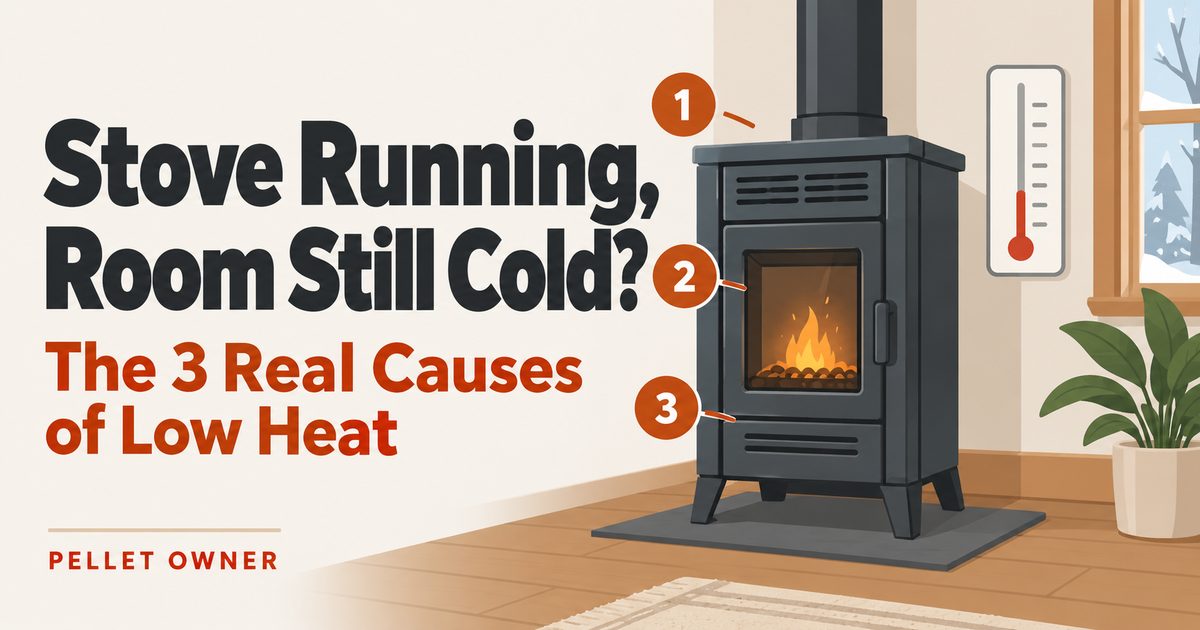
A pellet stove that runs but barely heats has one of three problems: a weak fire (feed set too low, a dirty burn pot or air path, a leaking gasket, damp or poor pellets), a good fire whose heat isn’t getting out (ash on the heat exchanger, a dusty or slow room blower, a room sensor throttling the stove), or a stove too small for the space. Start by looking at the flame and the ash.
First, the 60-second triage: is it the fire or the delivery?
Look, don’t touch — glass and grille are hot. Anything hands-on below happens with the stove shut down from its controls, completely cold, then unplugged. Not a heat problem? See the full troubleshooting guide.
| What you see | Branch | First check |
|---|---|---|
| Small fire, burn pot barely covered | A — weak fire | Feed setting |
| Tall, lazy, dark-tipped flame; glass going black | A — weak fire (air) | Burn pot, air path, gaskets |
| Half-burned pellets in the ash pan | A — air/fuel mix | Feed too high, air path, burn pot and exchanger |
| Busy, healthy flame but lukewarm air at the grille | B — heat stuck in the stove | Heat exchanger, room blower |
| Stove idles down before the far rooms warm up | B — sensor/thermostat | Where the room sensor sits |
| On high all day, stove room warm, house cold | C — capacity | Manufacturer’s rated capacity |
Not sure what “lazy” looks like? The flame guide shows the three types, and the glass guide covers glass that blackens in days.
Branch A — The fire itself is weak
Harman’s P43 and P61 manuals have a troubleshooting entry called LOW HEAT OUTPUT with four causes, in this order: (1) feed rate too low; (2) draft too low because of a gasket leak; (3) poor quality or damp pellets; (4) a combination of 1 and 2. That’s the order the table prints, not a ranking of how often each happens. Dealers who field these calls tend to say most turn out to be maintenance — an observation, not a statistic. I’d check the feed first because it takes a minute, then go straight to the cleaning.
Is the feed setting too low?
- Harman P43: Feed Adjuster at 4 for most premium pellets, 5 or 6 for higher-ash fuels, higher for maximum output. The manual’s reference: at maximum burn (Stove Temperature Mode, fan on high, dial at 7), run about 30 minutes and check the ash line on the front of the burn pot. The target is about 1 inch — much more, step the feed up one number; noticeably less, step it down. If you can’t get to about an inch even at 6, the manual says that’s not a problem. The P61 uses the same reference after 30 to 45 minutes. Harman also warns that too high a feed wastes fuel and that maximum settings aren’t needed in most cases.
- PelPro PP130: no separate feed knob; the Trim dial fine-tunes the air-to-fuel ratio (1 = least fuel and most air, 9 = most fuel and least air; factory 5). For a fire that’s too small, the manual says turn it clockwise one level at a time and wait 15 minutes after each change.
- Englander: turn up the Heat Range. Leave the bottom three buttons alone — the manual says they’re “preset at the factory and should not require any changes.” The forum “6-4-1” is dissected in the Englander E2 guide.
Is air leaking in where it shouldn’t?
Air sneaking in around a tired gasket weakens the draft through the burn pot — Harman’s cause #2.
- Doors shut, always. Englander’s current SBI manual warns that running with the ash pan or main door open means “smoke spillage and an inefficient, lazy burn.” Harman’s P43 says to keep the doors closed and “maintain seals in good condition.”
- The dollar-bill test. No manual documents it, but owners are consistent: close the door on a bill at several points around the door and ash-pan door; if it pulls out with no drag, that section isn’t sealing. If one fails, see pellet stove gasket replacement.
- A widely read hearth.com thread about a stove that no longer threw its old heat ended with the pair of fixes Harman’s tables point to: a gasket that wasn’t seating and heat-exchanger tubes that needed cleaning.
Is the burn pot or air path dirty?
Englander: too much ash “hampers airflow and reduces the unit’s efficiency.” PelPro: “Poor airflow leads to poor stove performance.” Clinker over the burn pot’s air holes is the classic case (clinkers have their own guide); the full routine is the deep-clean checklist, and the fall startup checklist catches it before the season starts. For half-burned pellets, Harman adds the burn pot clean-out cover and the air intake to the list.
Are the pellets damp or poor?
- Harman P43: high-moisture fuel “tends to cool the appliance thus, robbing heat from your home,” and “premium grade pellets will produce the highest heat output.” Both Harman manuals cap moisture at 8%.
- Englander’s “lazy fire” row lists excessive pellet moisture (keep pellets inside), excessive ash (remove the baffles, clean the unit) and low-quality pellets (use premium) — plus board settings and a bad exhaust blower, which are service items.
- PelPro, for a large, lazy, orange flame with black ash on the glass: clean the stove, “try a different brand of pellets,” or turn the Trim counter-clockwise for more combustion air.
If the problem started with a new batch, suspect the fuel; the softwood vs hardwood guide covers what actually matters on the bag.
Branch B — Good fire, but the heat stays in the stove
Ash on the heat exchanger tubes (or behind the baffles)
The heat exchanger is where fire becomes room heat. No manual phrases it this way, but owners are consistent that ash is a good insulator, and many notice the difference right after running the scraper or cleaning rods. The manuals schedule the job:
- Harman: scrape the heat exchanger when cleaning — “The cleaner the stove, the more efficient it will be” — more often with higher-ash or damp fuel.
- Englander: the large baffle plate comes out monthly to clean behind it.
- PelPro: remove the baffles and vacuum the ash, weekly or as needed.
The room blower: dusty, slow, or not coming on
- Englander: household dust builds up on the convection blower’s blades; the annual cleaning has you remove the blower to clean them. Its “room air blower not operating” row lists a loose sensor and a high “ON” temperature — both behind the panels and on the board, so treat them as a support call, not as permission to touch the bottom three buttons. On the SBI-built 25-PDVC, blower speed should match the heat range, and the board won’t let you set it lower.
- PelPro: remove the right side panel and vacuum the convection blower’s blades and housing, monthly or as needed.
- Harman: blower speed follows the mode selector and output. One by-design case catches people out: on a P43 in Stove Temperature Mode with the igniter switch on Manual, the distribution blower doesn’t run at low dial settings — the point is a big viewing fire without blowing heat into the room. It comes on automatically when the ESP reaches 350 °F (81% output).
For the full blower diagnosis — which blower, when it should run, and what the noises mean — see pellet stove blower not working.
Your room sensor or thermostat is throttling it
- Harman Room Temperature Mode sizes the fire to hold your setting and levels off as the room gets close; the distribution blower shuts off when it gets there. The P43 manual calls sensor locations more than 25 feet from the stove or in another room “not recommended.”
- PelPro PP130: in a temperature setting, the stove shuts down once the room is 2 °F above your setting and restarts when it drops. If it starts and stops a lot, the manual says to check that at least 2 inches of the ambient probe are exposed outside the stove body. It isn’t designed for an external thermostat.
Think about what the sensor feels. In the warmest spot in the house, it tells the stove to back off while the rooms you care about are still cold. As I read it, that’s not a weak stove; it’s a well-behaved stove reading the wrong room. Where each brand wants its sensor, and which stoves take a wall thermostat: pellet stove thermostat.
Branch C — The stove is doing all it can
Manufacturers publish capacities, and they hedge them:
- PelPro PP130-C: 1,225 to 2,500 sq ft “depending on climate zone,” output 9,605 to 40,667 BTU/hr.
- Englander 25-PDVC: “up to 2,000 sq ft,” a figure that “can vary greatly” and should be used with a BTU loss calculation for your home.
- Harman: the -C owner’s manual (8390-044C, R26) lists EPA BTU outputs (P43-C 18,780–33,250; P61-C 17,100–46,800; P68-C 15,900–53,100) but no square footage.
None of them gives a universal BTU-per-square-foot rule, and I won’t invent one. Owners coming from wood stoves often report that a pellet stove puts out less than they expected and that the heat tends to stay in its room — an experience report, not a spec.
What not to do to squeeze out more:
- Don’t alter the stove. Harman’s -C manual: “altering the stove for higher heat output may cause damage to the stove and could result in a house fire.”
- Don’t touch the minimum burn rate. PelPro and Harman both say it’s set at the factory and altering it is against federal regulations.
- Don’t connect it to ductwork. Harman: “Do not connect to any air distribution duct or system.”
- Don’t bypass a safety switch to keep it feeding. PelPro and Harman both list disabling safety switches among their don’ts — see why a vacuum switch bypass is never a fix.
“Just open the damper” — advice that may not fit your stove
A lot of online advice for a cold-running pellet stove boils down to “open the damper and turn up the feed.” The manuals describe three different setups:
- Harman doesn’t document an owner-adjustable air damper in these manuals: you set feed and mode, and the board tracks combustion through your feed setting and the ESP temperature. (They also forbid a flue damper in the exhaust vent.)
- Englander’s forum fix is the bottom three buttons, which the manual says are factory preset.
- PelPro gives you the Trim dial, with directions both ways.
Confirm what your model uses before turning anything; the flame guide walks through each.
When to call a technician
- The combustion blower sounds wrong or weak. Harman lists build-up on its blades and a failed blower among the causes of poor draft. Cleaning the blades is yours; electrical diagnosis isn’t.
- A code shows up. Harman 6 blinks means poor or incomplete combustion — see Harman 6 blinks. Other codes: Harman, Englander 25-PDVC, PelPro PP130.
- A lazy, smoky flame that persists after a genuine clean. Shut it down, check that your CO detector works, and call a technician; the smoke-smell guide lists the warning signs.
- Anything Englander’s lazy-fire row pins on board settings or the exhaust blower. That’s a support call, not a button-pressing session.
Most of these physical checks overlap with the won’t-ignite checklist: same burn pot, same air path.
FAQ
Why is my pellet stove burning but not hot? Either the fire is weaker than it looks (low feed, dirty burn pot, gasket leak, damp pellets) or the heat isn’t leaving the stove (ashed-over heat exchanger, dusty blower, throttling sensor). The flame and the ash tell you which.
Why is my pellet stove blowing cold air? While the fire winds down, the blowers keep running until the stove cools — PelPro’s manual says so — so cool air then is normal. Lukewarm air from a healthy fire is Branch B.
Can I just turn up the feed rate? Check it, since Harman lists low feed first — but use the manual’s ash reference, one step at a time. Too much feed wastes fuel, and it won’t fix a dirty stove.
Does a bigger flame mean more heat? No. Owners read a tall, lazy flame as too little air, and PelPro’s fix for a large, lazy flame includes turning the Trim for more combustion air. Englander’s manual notes that normal variation in flame height comes with no loss of efficiency.
How do I know if my stove is too small for my house? Compare your space and climate with the rated capacity, ideally with a BTU loss calculation as Englander suggests. If a clean, well-tuned stove runs flat out all day and the house still falls short, it’s likely capacity.

Walt Hensley — Walt Hensley is the pen name of Pellet Owner’s editor. I’m not an NFI-certified technician, and I don’t sell stoves, pellets, or parts. Every guide here starts from the manufacturers’ owner’s and service manuals, is cross-checked against what owners consistently report, and says which is which — including what you can safely check yourself and when it’s time to call a certified technician.