How to Read Your Pellet Stove Flame (Busy vs Lazy)
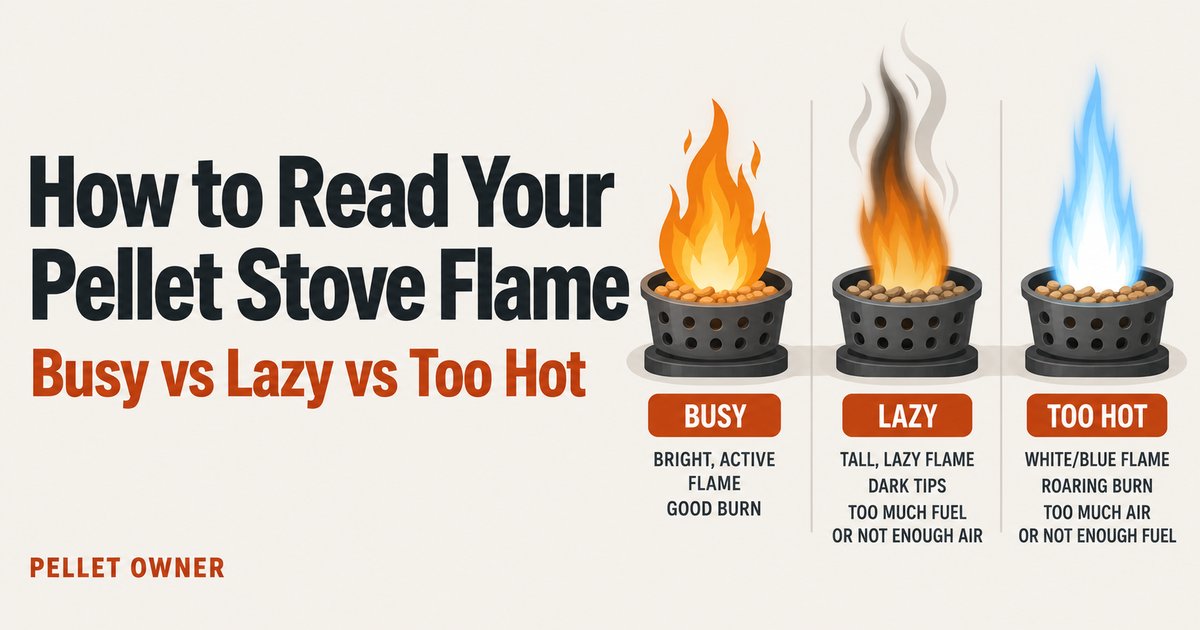
Here’s a belief that costs people heat every season: a big, tall flame means a hot stove. It’s backwards. On a pellet stove the flame is a gauge, not a trophy — and a tall, lazy flame is usually telling you the fire is starved for air, burning dirty, and throwing less heat into the room, not more.
The good news is the flame is the easiest diagnostic you own. You don’t need a meter. You just need to know what you’re looking at. Most of what goes wrong with a pellet fire shows up in the flame first — before a shutdown, before the glass blacks over, before you’re on the phone. Learn to read it and you fix the small stuff yourself and know when something’s actually wrong. Here’s the owner’s guide the near-identical content-farm posts don’t give you: what the three flame types actually mean, how to tell a lazy tall flame from an overfed one, and how to adjust it on the stove you actually own.
Bigger flame isn’t more heat
Start here, because it’s the misconception behind a lot of the flame questions online. Owners commonly assume flame height tracks heat output. It doesn’t.
A pellet stove makes heat by burning fuel completely and then blowing that heat across a heat exchanger into your room. Complete combustion needs the right amount of air mixed with the right amount of fuel. When the mix is right, the fire is compact, lively, and bright — it’s releasing most of the fuel’s energy as heat. When a flame grows tall, thin, and slow, that’s usually the opposite signal: not enough air to finish the burn, so fuel goes up the vent unburned as soot and creosote instead of turning into heat. Tall and lazy is wasted fuel.
So the flame you want isn’t the biggest one. Owners describe a good pellet flame as lower, busy, and bright — closer to yellow-white than deep orange, always moving, with clean tips. Chasing height gets you a dirtier burn, a sootier glass, and a colder room. Read the flame for quality, not size.
The three flames, in plain words
There’s no meter for this — you learn the three looks and compare against them. Here’s each one described the way it actually appears in the firebox.
Busy / ideal. Active and lively — the flame is dancing, not standing still. Bright orange-to-yellow, leaning toward yellow-white at a healthy burn. It sits fairly low over the burn pot and moves constantly. Crucially, no black tips — the top of the flame is clean, not smudged with dark smoke. A busy flame keeps the glass clear and the heat coming.
Lazy. Tall, thin, and slow — it stands up and waves lazily instead of dancing. The tips go dark or black, and you may see wisps of black smoke. This is the classic too-little-air fire: combustion isn’t finishing, so it’s making soot instead of heat. A lazy flame is what blacks over your glass (more on that below). This is the one to catch and correct.
Too-hot. The opposite problem — a white or bluish flame that roars and jumps with force, like a blowtorch. That’s too much air for the fuel, tearing through pellets and often lifting the fire off the pot. Less common than lazy, but it’s real, and the fix is the reverse: give it less air.
A quick way to hold all three in your head:
| Flame looks like | What it means | First move |
|---|---|---|
| Low, busy, bright yellow-white, clean tips | Good combustion — leave it | Nothing. This is the target. |
| Tall, thin, slow, black/dark tips, sooty | Too little air (or overfed) | See the tall-flame section below |
| White/blue, roaring “blowtorch,” lifting off pot | Too much air | Reduce combustion air |
If your flame doesn’t match “busy,” the next two sections tell you which way it’s off and what to do about it.
Lazy flame: the too-little-air fire
A lazy flame — tall, thin, dark-tipped, sooty — is almost always an air problem, and on a well-fed stove that usually means air isn’t getting in, not that the damper is wrong. Before you touch any adjustment, check the things that quietly choke a fire:
- A dirty burn pot. Ash and clinker plug the little air holes the fire breathes through. This is the single most common cause of a lazy flame, and it’s why it creeps in gradually over a week of burning.
- Blocked combustion-air intake or ash-packed passages. Fly ash builds where you can’t see it and strangles airflow.
- A door or ash-pan not sealing. Forced-draft stoves pull their combustion air through a designed path; a leaky door or ash-pan gasket lets the blower pull “lazy” air the wrong way and starves the burn pot. A worn gasket is a classic sneaky cause.
- Feed rate set too high for the air the stove is moving — more on that in the tall-flame section.
- Wrong or poor-quality pellets. High-ash or oversized fuel clogs the pot faster and burns dirtier; the difference between fuels is real enough that it’s worth reading up on pellet quality.
Notice that four of those five are cleaning and sealing, not knob-turning. That’s why the honest first answer to “why is my flame lazy?” is usually clean it. A burn pot scraped clean, clear air passages, and a door that seals fixes most lazy flames before any air adjustment — which is exactly what the deep-clean checklist walks through step by step. A lazy flame that also blacks the glass and keeps drifting toward shutdown is the same story getting worse; if yours is shutting itself off, start with airflow and cleaning.
Tall flame: lazy, or overfed?
This is the distinction nobody online makes, and it’s the whole game. A tall flame has two completely different causes, and telling them apart decides whether you clean, add air, or cut fuel.
Tall-and-lazy is the fire above: not enough air. The flame is tall but thin, slow, and dark-tipped, and the burn pot is not overflowing — the pellets are burning, just poorly. Fix: clean the burn pot and air passages, check the door and ash-pan seal, and if it’s still lazy after that, add combustion air (next section). You’re feeding it enough fuel; it can’t breathe.
Tall-and-overfed is a fuel problem wearing the same tall shape. Here the burn pot is getting more pellets than it can burn — you’ll see the pot piling up or overflowing, pellets stacking above the air holes, sometimes unburned pellets spilling into the ash pan. The flame is tall because there’s simply too much fuel in the pot, and burying the air holes under a pile also starves it, so it goes dark-tipped too. Fix: reduce the feed rate / turn the heat setting down, and make sure you’re not running a low-air, high-feed combination. Adding air won’t cure a pot that’s flooding with fuel.
How to tell them apart at a glance:
| What you see in the pot | Diagnosis | Fix |
|---|---|---|
| Pot burning cleanly-ish, not overflowing, flame tall & thin | Tall-and-lazy (low air) | Clean pot & passages, seal door, then add air |
| Pot piling up / overflowing, pellets above the air holes | Tall-and-overfed (too much fuel) | Lower feed rate / heat setting |
If your pot is overfeeding on its own — filling faster than it burns even at a low setting — that’s a feed-system question, not a flame-tuning one; the auger and feed guide is the place to chase that. And if a lazy, overfed burn is leaving hard chunks behind in the pot, that’s the neighbor of this problem: see clinkers. If the pot is actually overflowing — or full of pellets that never lit — start with what an overflowing burn pot means.
Too-hot flame: the too-much-air fire
The rarer one. A white or blue flame that roars, jumps hard, and lifts off the burn pot is getting more air than fuel — the burn is lean and violent. It’s not making the most heat either; it can blow through pellets fast and, in the extreme, tear the fire off the pot. The fix is the mirror image of the lazy flame: reduce combustion air (or, on stoves that let you, raise the feed rate to match). Bring it back down until the flame settles into that low, busy, bright look.
How to adjust it: fuel versus air
Two knobs run a pellet fire, and keeping them straight is what makes adjustment make sense. Owners describe it simply:
- Fuel = the feed rate (your heat setting / feed trim). More fuel, bigger fire; less fuel, smaller.
- Air = the combustion-air damper (on stoves that have a user-adjustable one). More air leans the burn out and brightens it; less air makes it lazier.
A rule of thumb owners commonly pass around: adjust the air the same direction you change the fuel. Turn the feed up and you generally need more air to keep the burn clean; turn the feed down and you back the air off too. The two move together. A lazy flame that’s clean and sealed but still won’t brighten wants more air (or slightly less fuel); a roaring too-hot flame wants less air (or slightly more fuel). Change one thing at a time and give the fire a good ten to fifteen minutes to settle before you judge it — pellet stoves react slowly, and chasing a flame with rapid tweaks just confuses you.
One caution: not every stove gives you a manual air adjustment at all, and the one you have depends entirely on your model. That’s the next section.
Damper by brand: check your manual
Where the combustion-air adjustment lives — or whether you even have one — is model-specific, so the real instruction is “check your manual.” Here’s the landscape across common stoves so you know what you’re looking for:
- Harman. Most Harman stoves don’t give you a manual air damper at all. They use an automatic system built around an ESP (Exhaust Sensing Probe) that reads the fire and lets the control board manage the burn for you. On these, the “flame adjustment” is really feed-side and cleanliness — you don’t hunt for an air knob, because there isn’t a user one. If your Harman’s flame is off, it’s almost always cleaning, fuel setting, or a fault the board is reacting to, not a damper. (Harman ESP control, as described in Harman’s manuals, September 2026.)
- Englander (25-PDV / 25-PDVC). No user air control. The newer SBI manual says the control board “automatically adjusts the air to fuel ratio,” and both generations treat the three lower buttons as factory presets you shouldn’t change. On an Englander, flame “tuning” means cleaning, dry fuel and the Heat Range setting; if the flame stays lazy after that, call support.
- Other brands with a slide damper. Some stoves (US Stove models among them, owners report) have a slide damper or air rod you push in or pull out. If yours does, your manual shows the rod, its travel and the starting position.
- PelPro (e.g. the PP130). PelPro uses a trim adjustment dial rather than a slide rod. The PP130 manual’s own guidance for a fire that’s too large, lazy, or making black soot is to rotate the trim dial counter-clockwise, one level at a time, waiting about 15 minutes between changes; a fire that’s too small or keeps going out gets the dial turned clockwise. So on a PP130, a lazy, sooty flame (and the black glass that comes with it) points you counter-clockwise on the trim, one notch at a time. (PelPro PP130 owner’s manual, September 2026.)
That’s three genuinely different mechanisms — automatic, slide rod, trim dial — which is exactly why “just open the damper” is bad advice on the internet. Confirm what your model uses before you touch anything.
What black glass is telling you
One quick note, because it’s the visible aftermath of a lazy flame: when the glass blacks over with soot, that’s the same too-little-air, incomplete-burn story leaving its mark on the window. A busy, clean-tipped flame keeps the glass mostly clear; a lazy one paints it. So blackening glass is a symptom worth reading — chase the lazy-flame causes above (clean the burn pot, clear the air path, seal the door, check your fuel) rather than just wiping the window. The actual glass-cleaning step lives in the deep-clean checklist; a stove-glass cleaner and, if a leaky door is your culprit, a fresh gasket kit are the two supplies worth having on the shelf.
When to leave it alone — and when to call
Flame reading and the DIY moves here — cleaning the burn pot, sealing a door, trimming feed or a user damper per your manual — are owner work. What isn’t: anything on the exhaust and venting side. If you’ve got a persistent lazy flame, a smoke smell, or repeated shutdowns after the pot and air path are clean and the door seals, that points toward draft or venting, and that’s a certified NFI technician’s call, not a knob to keep turning. I’m not a certified tech, and the line I hold is simple: diagnosis and routine cleaning, yes; exhaust, venting, and repair, no.
FAQ
What should a pellet stove flame look like? Low, busy, and bright — an active, dancing flame that leans yellow-white, sits fairly low over the burn pot, and has clean tips with no black smudging. That’s the look of complete combustion. A tall, slow, dark-tipped flame is the warning sign, not the goal.
Why is my pellet stove flame so high / too tall? Two possible reasons, and they need opposite fixes. Tall-and-lazy (thin, slow, dark tips, pot not overflowing) is too little air — clean the burn pot and air passages, seal the door, then add air. Tall-and-overfed (pot piling up or overflowing with pellets) is too much fuel — lower the feed rate. Check the pot to tell which one you have.
What does a lazy flame mean? It means incomplete combustion, almost always from too little air reaching the fire — a dirty burn pot, blocked air passages, a leaking door or ash-pan, too high a feed rate, or poor pellets. It burns dirty (soot, black glass, creosote) and gives less heat, not more. Start by cleaning and sealing before adjusting anything.
How do I adjust the flame — fuel or air? Fuel is the feed rate (heat setting); air is the combustion damper on stoves that have a user-adjustable one. A common rule is to move air the same direction you move fuel. Change one thing at a time and wait 10–15 minutes for the fire to settle before judging.
How do I adjust a pellet stove damper? It depends entirely on your model, so check your manual. Many Harman stoves have no manual damper (they use automatic ESP control); Englander’s 25-PDV/25-PDVC have no user damper either (the board manages air); some other brands, such as US Stove models, use a slide damper / air rod; PelPro’s PP130 uses a trim dial (turn it counter-clockwise, per PelPro’s manual, for a lazy or sooty fire).
Why is my flame orange with black tips? Black or dark tips mean the burn isn’t finishing — too little air for the fuel. That’s a lazy flame: clean the burn pot and air passages, make sure the door and ash-pan seal, and confirm you’re not overfeeding. Bright yellow-white with clean tips is the color you’re aiming for.

Walt Hensley — Walt Hensley is the pen name of Pellet Owner’s editor. I’m not an NFI-certified technician, and I don’t sell stoves, pellets, or parts. Every guide here starts from the manufacturers’ owner’s and service manuals, is cross-checked against what owners consistently report, and says which is which — including what you can safely check yourself and when it’s time to call a certified technician.