How to Store Wood Pellets for a Pellet Stove (Keep Them Dry)
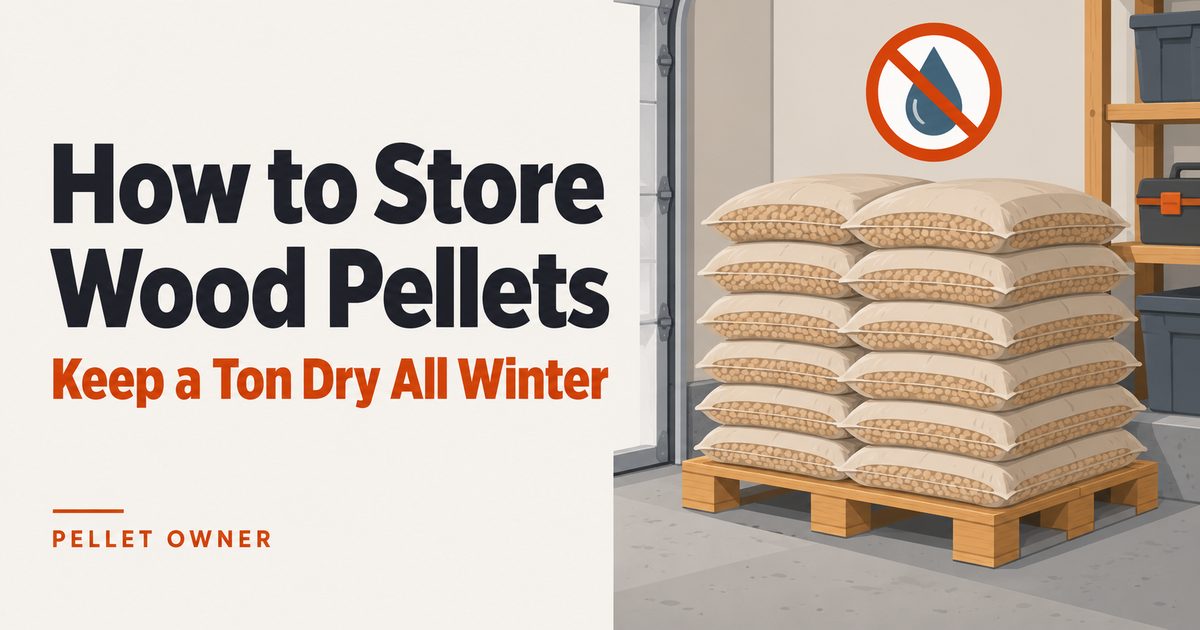
Store wood pellets somewhere dry, in their original sealed bags, and outside your stove’s clearances and the space you need for loading and ash removal — between them, the Harman, PelPro and Englander manuals ask for all three. Owners add one rule: get the bags off bare concrete, onto a pallet. A dry garage or basement beats outdoors. Moisture is the enemy: damp pellets can turn back into sawdust that won’t feed.
A ton of pellets in the garage is money in the bank. A damp ton is a jammed auger in January. Much of the storage advice online comes from pellet sellers and grill brands, and little of it tells you what your stove’s manual asks for, or what bad storage does once the fuel reaches the auger.
What do pellet stove manuals say about storing pellets?
Every storage and moisture rule in the five owner’s manuals this site works from (the two Englander generations are separate manuals):
| Manual | Storage rule | What damp fuel does | Pages |
|---|---|---|---|
| Harman P43 | Pellets stay “in their original sealed bag until ready to use, to prevent moisture.” No fuel within the clearances, “the space required for charging and ash removal,” or where it gets in the way of cleaning. Moisture max 8%. | “Could turn back into sawdust which does not flow properly through the feed system.” Cools the stove; low heat output. | 27, 30 |
| Harman P61 | No storage section. Moisture “must not exceed 8%.” | “Will rob BTU’s and may not burn properly.” Low heat output. | 18 |
| PelPro PP130 | “Store fuel in dry location not within clearances to combustibles of your Stove.” | “Damp pellet fuel can clog the feed system.” Cools the stove. | 14, 23 |
| Englander 25-PDVC (2023) | “Always store wood pellet fuel in a dry location.” Keep it at a safe distance: “close proximity to the stove can result in a fire.” | Burn pot fills with ash faster; shorter maintenance intervals; squealing bottom auger; lazy fire. | 7, 17, 27, 35 |
| Englander 25-PDV (2013) | Pellets “not damp or wet”; pellets and combustibles “a safe distance from the unit.” | Squealing bottom auger; lazy fire (“Keep pellets inside”). | 6, 17, 27 |
The manuals care about two things: keeping fuel dry and keeping it away from the fire. None picks a room for you, none gives pellets a shelf life, and none sets a separate storage distance — they send you back to your model’s clearance-to-combustibles figures. (The P43’s fuel-storage note on page 27 literally ends with “See Page 7,” its clearance page.)
The 8% is a fuel spec, not something you’re expected to test at home. In an addendum on burning a corn-and-pellet mix, the P43 notes that wood pellets “average around 6% moisture content or less.” Your job is simply to keep dry fuel dry.
Where should you store pellets: garage, basement or outside?
The manuals only say “dry” and “not near the stove,” so picking the spot is owner practice, not manufacturer instruction:
| Location | Main risk | How owners handle it |
|---|---|---|
| Dry garage | Bags on or against concrete | Pallet under the stack, off the walls, away from heat |
| Dry basement | Humidity; stacking too close to the stove | Only if truly dry; dehumidifier; pallet; outside the clearances |
| Outside | Rain, standing water, torn bags | Last resort: high ground, intact bags, weighted tarp, monthly checks |
Can you store pellets in the garage?
It’s a common answer, and a good one if the garage stays dry. Owners and dealers consistently advise stacking on a pallet rather than the slab (many add a layer of cardboard), keeping the stack off the walls — especially concrete ones — and away from heat sources. Keep the bags sealed until you need them; that one is straight from the Harman P43.
Can you store pellets in the basement?
Only if it’s genuinely dry. If your basement smells damp in August, your pellets will know it. A dehumidifier is the usual owner fix, and the off-the-concrete rule still applies. The mistake the manuals address head-on is stacking the season’s supply beside the stove: Harman’s P43 says fuel should not be stored within the installation clearances “or within the space required for charging and ash removal.” The handy spot is the wrong spot.
Can wood pellets be stored outside?
It’s a last resort, not an equal third option. PelPro and Englander both say dry location, Harman says sealed bags to keep moisture out, and in my view a tarp over a pallet isn’t a dry location — it’s a bet. Englander’s troubleshooting chart lists “excessive pellet moisture” as a cause of a lazy fire, and the fix it prints is “Keep pellets inside.”
If you truly have no other choice, owners who make it work describe the same routine: a pallet on high ground where water can’t pool, bags with the original plastic intact (tape any tear right away), a tarp weighted or tied down, and a check at least once a month.
How much room does a ton of pellets take?
Harman’s P43 counts a ton as 50 bags — it says to clean the stove “after each ton of pellets (50 bags).” A US ton is 2,000 lb, so the arithmetic points to the common 40-lb bag, and owners commonly report a ton arriving as a single 50-bag pallet. I won’t print a footprint, because pallet sizes and stacking vary by supplier; measure your first delivery and plan from that.
What matters more is how many pallets. Owners commonly report burning 2 to 5 tons a season, depending on the house and the winter — the bags-per-day guide walks through the math so you can size your order, and your floor space, before the truck shows up. Leave room to walk around the stack so you can actually check the bags.
How do you know if pellets are wet or damp?
Check bags when they arrive and again through the season. The signs owners rely on, strongest first:
- Swollen, split or crumbling pellets. The clearest tell.
- A swollen bag, or one gone hard as a brick.
- A musty or moldy smell, or visible mold.
One weak sign is easy to over-read: sawdust at the bottom of the bag. Every bag has some — Harman’s P43 defines fines as “small pieces of broken pellets (sawdust),” and they turn up in perfectly dry fuel. Dust alone doesn’t prove a bag got wet; dust plus swelling or a musty smell does.
Owners agree that swollen pellets don’t go in the hopper. Dry-but-dusty fuel is a smaller problem: the P43 says fines “do not flow easily” and build up on the hopper’s funnel angles, and you can push them into the feeder opening to burn off or clean them out before filling. The P61 adds that the “muffler,” the fitting its draft pressure switch uses to sense hopper pressure, may need periodic cleaning depending on how many fines are in your fuel. Some owners screen the dust out of the last of a bag.
What do damp pellets do to your stove?
This is the part storage guides skip. What the manuals say moisture does:
- Feeding problems. Damp fuel “could turn back into sawdust which does not flow properly through the feed system” (Harman P43); “Damp pellet fuel can clog the feed system” (PelPro PP130). If the auger turns but nothing drops, the auger troubleshooting guide covers bridging and fines.
- Less heat. High-moisture fuel “takes energy to dry and tends to cool the appliance” (P43; the PP130 says nearly the same). Both Harman manuals list “poor quality or damp pellets” under low heat output.
- A squealing auger. Both Englander generations say moisture and the build-up it causes where the bottom auger feeds the burn pot “can cause the bottom auger to ‘squeal’ or squeak.”
- A lazy fire and more cleaning. Englander lists excessive pellet moisture as a lazy-fire cause, and its 2023 manual says high-moisture pellets fill the burn pot with ash faster and make maintenance intervals “significantly shorter.”
Owners add clinkers: wet fuel is a common suspect when the burn pot crusts over, though the P43 traces clinkers to minerals and other non-combustibles in the fuel, and owners rank moisture behind airflow and fuel quality — the clinkers guide ranks the causes.
Do wood pellets go bad?
No manual in our set gives pellets a shelf life, and I’m not going to invent one. The figures you’ll see online — “6 months,” “1 to 3 months” — mostly come from grill sites and cite nothing. What can honestly be said:
- Dry and sealed, they keep. No manual documents this, but owners are consistent that pellets stored dry carry over fine from one season to the next.
- Once swollen, they’re done. Owners are just as consistent that wet pellets don’t come back. Forge & Flame, the Hearth & Home Technologies site that sells Harman and PelPro stoves, puts it plainly: “Once your wood pellets get wet, they can rot, destroying their integrity.”
- Quality varies more than age. The P43 says pellet quality “can fluctuate from manufacturer to manufacturer, and even from bag to bag,” which is why Harman and PelPro both recommend buying in multi-ton lots only after trying different brands. Burn a couple of bags first; the softwood vs hardwood guide explains what to watch for.
Should I empty my pellet stove hopper for the summer?
The manuals and the forums don’t line up neatly, so here are both sides.
The manuals. PelPro’s PP130 is the clearest: its maintenance chart says to empty the hopper of any pellets and vacuum any remaining pellets and debris, “monthly or as needed,” with the stove turned off and unplugged. Englander calls for a complete cleaning of the stove and flue at the end of the heating season but doesn’t spell out a separate hopper step, and neither do the Harman owner’s manuals in our set.
The manufacturer’s website. Forge & Flame goes further: “Do not leave the pellets in the stove over the summer, as this can lead to moisture absorption and degradation of the wood pellets.”
The owners. Split, mostly by climate. On hearth.com you’ll find a long-time owner who hasn’t emptied the hopper in 14 years, and another, in a humid area, warning that pellets left there swell and lock down the auger. On a PP130, neither story overrides the manual’s monthly-or-as-needed emptying.
My call: empty it at the end of the season, and don’t skip it if your stove lives in a basement or anywhere humid. The downside of skipping it is exactly the swollen-pellet jam this article is about. Do it with the stove off, cold and unplugged, and make sure the fire is completely out before any vacuum goes near it — Harman’s P43 warns that live pellets can set a vacuum on fire.
FAQ
How far from the stove should pellets be stored? Outside your model’s clearances to combustibles and out of the space you need to load the hopper, remove ash and do routine cleaning — the rule in the Harman P43 and PelPro PP130 manuals. Englander says “a safe distance” and warns that close proximity “can result in a fire.” A few bags in the same room can be fine on those terms; the spot right beside the stove isn’t. Many guides online quote a flat 3 feet — that’s a general fire-safety rule of thumb, not a number from these manuals. It never replaces your model’s clearances or that working space: use whichever keeps the fuel farther away.
Can wet pellets be dried out and burned? None of the manuals in our set says what to do with fuel that’s already wet. Owners are consistent that swollen or crumbled pellets don’t recover, and pouring them in invites the feed problems above. I’d write that bag off.
Should I keep leftover pellets in an airtight bin? For an opened bag, yes. It’s common owner practice, and Forge & Flame recommends an airtight container for leftovers from an opened bag in the warmer months. Unopened bags stay sealed until you use them, per the Harman P43.
What about mice? No stove manual in our set covers pests in stored wood pellets; the only pest line I found is Harman’s note that shelled corn goes in a tightly sealed container “to deter pests” — and that’s about corn, and only a few stoves can burn corn at all; see what you can burn in a pellet stove. If mice are a problem where you keep fuel, a lidded bin for opened bags is the sensible first step.

Walt Hensley — Walt Hensley is the pen name of Pellet Owner’s editor. I’m not an NFI-certified technician, and I don’t sell stoves, pellets, or parts. Every guide here starts from the manufacturers’ owner’s and service manuals, is cross-checked against what owners consistently report, and says which is which — including what you can safely check yourself and when it’s time to call a certified technician.