What Can You Burn in a Pellet Stove? Grill Pellets & Corn
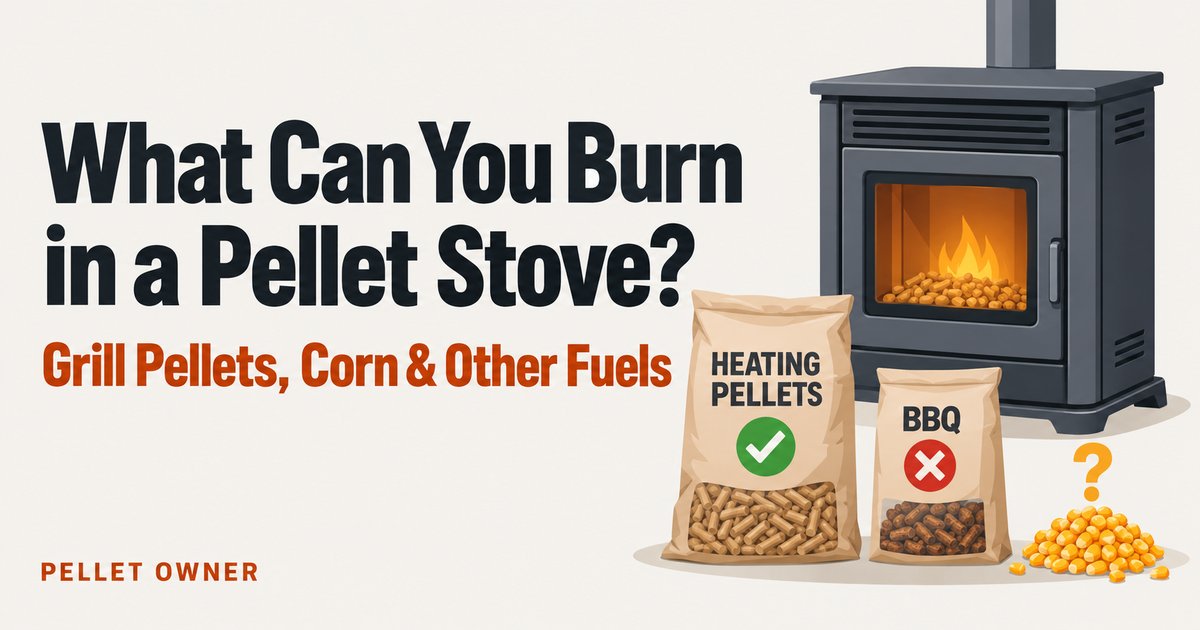
Burn the wood pellets your stove’s manual specifies, from a bag with a heating-fuel grade (PFI or equivalent), and nothing the manual doesn’t name. The one exception in the manuals I work from is corn: Harman’s classic P43 allows up to a 50% corn-and-pellet mix, while the -C models, Englander and PelPro say wood pellets only. Grill and bedding pellets are a no from me. Never charcoal, garbage or treated wood.
I went through the fuel pages of every manual this site works from. Here’s the short version, then the detail.
| Fuel | Verdict | What decides it |
|---|---|---|
| Grill (BBQ) pellets | No (my call) | The ingredient list (Harman bans fuel with additives: “May cause hopper fire”), the grade on the bag, the price |
| Corn | Only if your manual names it | Harman P43 (classic): up to 50%, mixed with pellets. -C, Englander, PelPro: wood pellets only |
| Horse-bedding or cat-litter pellets | No | No manual approves them; used ones count as manure |
| Cherry pits, grain, other biomass | Only in stoves built and approved for them | Englander: “pea coal, cherry pits” void the warranty |
| Firewood, logs, chips | No | Englander SBI: factory burn pot only, no added grates |
| Charcoal or coal | Never | Harman: charcoal can generate carbon monoxide “which is DEADLY” |
| Garbage, treated wood, cardboard, plastic | Never | Englander SBI’s banned list; the federal rule for certified stoves |
| Liquids to start or “freshen” a fire | Never | Every manual here; PelPro bans gels too |
Check two labels before you burn anything
The stove’s safety label decides first. The classic P43’s reads “FOR USE WITH WOOD PELLET FUEL OR UP TO 50% CORN / PELLET MIXTURE ONLY. The Use of Other Fuels May Create an Unsafe Condition.” The -C generation’s: “FOR USE WITH PELLETIZED WOOD FUEL ONLY.” And the P43 manual adds: “Never burn fuels other than those listed on the appliance safety label.”
Then the bag. Hearth & Home Technologies (Harman) “recommends using only fuel that is certified by the Pellet Fuels Institute (PFI),” and PelPro says “We recommend the use of Pellet Fuels Institute certified pellet fuel with this product.” The grades themselves are in softwood vs hardwood pellets.
If your stove is EPA-certified, there’s also a federal rule. Under 40 CFR 60.532(e) (checked October 2026), operators of wood heaters certified for pellet fuel “may burn only pellets that have been specified in the owner’s manual and graded under a licensing agreement with a third-party organization approved by the EPA” (PFI, ENplus and CANplus are approved). The -C, PelPro PP130-C and Englander 25-PDVC manuals are for certified stoves and print “It is against federal regulations to operate this wood heater in a manner inconsistent with operating instructions in this manual.” The classic P43 and P61 labels say they are exempt from EPA certification; for those, the label and the warranty govern. That’s the rule as written, not legal advice.
What fuel does each pellet stove manual allow?
| Stove | Allows | Names as banned or warranty-voiding | Size and moisture |
|---|---|---|---|
| Harman P43 (classic, R18) | Wood pellets, or a mix with up to 50% shelled field corn | Any other fuel voids the warranty; fuel with an additive “(such as soybean oil)”; treated seed corn; charcoal; garbage and flammable fluids | 1/4” or 5/16” across, no longer than 1-1/2”; corn at 15% moisture or less |
| Harman P61 (classic, R10) | “Fuel: Wood Pellets” | Liquids to start the fire | Pellets at 8% moisture or less |
| Harman -C (P43-C, P61-C, P68-C) | “Tested and approved for use with wood pellets ONLY” | Any other fuel voids the warranty; additives; garbage and “improper fuels,” which “COULD RESULT IN A HOUSE FIRE” | 1/4” or 5/16”, no longer than 1-1/2” |
| Englander 25-PDV and 25-PDVC | “Designed to burn Wood Pellets only” | “Burning pea coal, cherry pits, or anything other than wood pellets will void your warranty”; the SBI manual adds a full banned list | 1/4” diameter; longer than 2” “can bind the auger” |
| PelPro PP130-C | “Use only wood pellets in your Stove” | Its red 8 alarm lists “Non-approved fuel used” | Premium, low-ash (<1%), shorter than 1.5” |
Two manuals contradict themselves, and you should see it rather than have it tidied up. Harman’s -C manual says wood pellets only on its label and fuel page, but its troubleshooting hints, on the same page as the table it reserves for qualified technicians, say the stove “is approved for burning any grade of pelletized bio-mass fuel.” This site follows the label, the fuel page and the warranty until Harman clears it up. And the classic P61 manual prints a reference copy of an older P61-2 label reading “PELLETIZED OR BIOMASS,” while its spec says wood pellets: check the label on your own stove, or ask your dealer.
Other brands differ. The EPA’s pellet stove fact sheet (2011) notes that “Some pellet stoves (called multi‐fuel units) can burn various forms of pellet fuels, such as corn, hulled wheat, cherry pits, waste paper pellets and grass pellets. To prevent damage be sure to use only the fuel specified for your stove.” If yours isn’t in the table, its manual decides.
Can you burn grill (BBQ) pellets in a pellet stove?
My answer is no. It rests on what’s in the bag, not on a blanket claim about every grill pellet:
- Read the ingredients. Harman: “Do not burn fuel that contains an additive; (such as soybean oil),” because it “May cause hopper fire,” and “Read the list of ingredients on the packaging.” If a grill bag lists oil, flavoring or anything but wood, that’s the case. Bear Mountain BBQ, a grill pellet maker, says vegetable-based oil is “sometimes used during the extrusion process,” and barbecuefaq.com (2026) cites a Traeger patent describing “wood particles, lubricant, and wood oil.” A bag doesn’t always say, so you can’t rule it out.
- Look for a heating-fuel grade. Harman and PelPro recommend PFI-certified fuel, and on a certified stove the federal rule wants graded pellets your manual specifies. No PFI, ENplus or CANplus mark on the bag, no go.
- Do the math. Grill pellets run about $10 to $13 per 20-lb bag (barbecuefaq.com, 2026), roughly 50 to 65 cents a pound. National cost guides (Angi, HomeGuide, September 2026) list 40-lb heating bags at $5 to $10, roughly 13 to 25 cents a pound.
If the grill bag is hardwood, note that the manuals list “Hardwoods with high mineral content” among the higher-ash materials. More ash means more cleaning, and minerals are what form clinkers.
Some grill-pellet sites claim heating pellets are full of fillers, charcoal or plywood. The PFI standard (2022) requires woody biomass with no chemically treated material, and the federal rule requires graded pellets to be certified free of prohibited fuels, plywood included. PFI does allow up to 2% of declared additives, one more reason to read the bag.
Can you burn corn in a pellet stove?
Only if your manual names it. In this set, that’s the classic Harman P43 alone: “Tested and approved for use with wood pellets and a mixture of shelled field corn and wood pellets ONLY,” and “The listing approves up to a 50% corn and 50% pellet mixture” (tested to ASTM E1509). The same manual’s start-up pages say “ONly use wood pellet fuel”; it doesn’t say which text prevails, and this site reads the specific approval (label plus corn addendum) as the one that counts. None of it carries over to the -C models, the P61, Englander or PelPro.
Before the first bag of corn (P43 classic):
- “Check with your venting manufacturer regarding possible exclusions when a mixture of corn and pellets is burned.”
- “WARNING! Risk of Chemical Poisoning! Do NOT burn treated seed corn.”
- “If you are buying field corn, the only ingredient listed should be field corn.”
- Corn “Must be 15% moisture content or less,” clean, and mixed with pellets (up to 50%); stalks, fines and cob remnants “may cause feed system jams.”
What changes, per its addendum: a lower Feed Adjuster setting (#3 in Stove Temp, #2 or #3 in Room Temp), watching that the fuel doesn’t push “the red glowing fuel bed off of the burn pot grate,” and a lower percentage of corn if it struggles. In Room Temp, the manual suggests turning the stove off, letting it cool, and watching it restart. Maintenance tightens: burn pot scraping “may need to be done once per day,” the ash pan emptied weekly, and the burn pot cleanout cover removed weekly, because “Excessive buildup on the igniter may lead to shortened igniter life.” Corn is stored in a tightly sealed container.
For context, Penn State Extension (2026) puts shelled corn at about 6,970 BTU per pound at 15.5% moisture, and the Alliance for Green Heat warns that “It is not a good idea to burn corn in a pellet stove, and can void the warranty, unless the stove is designed specifically to handle corn.”
Horse bedding, cat litter and other “almost pellets”
No manual in this set approves them, and if the bag carries no heating-fuel grade, a certified stove is outside the federal rule. Tri-County Hearth & Patio, a dealer, puts it simply: “The utility and equine (horse bedding) pellets are not intended for use in your standard home heating appliances.” Owners who burned bedding pellets during shortages report more and darker ash, a fire that wanted more air and sometimes less heat; others noticed no problems (hearth.com, 2012 to 2015).
Used bedding or litter is a never: manure and animal remains are on Englander’s SBI banned list and the federal one. Unused pine litter gets the same no as bedding, and it may carry additives or scent, which brings back Harman’s ingredient rule.
Cherry pits, grain, logs and chips
Englander names them: “Burning pea coal, cherry pits, or anything other than wood pellets will void your warranty.” Multi-fuel stoves that take pits or grain exist, per the EPA, but only their manuals can approve them.
Logs and wood chips: no. Englander’s SBI manual says “Pellets must only be burned in the factory burn pot; no modifications should be made to this burn pot and no additional grates or other fire elevators should be used,” and lists unseasoned wood among the banned fuels. A pellet stove is never run with the door open.
Firestarter is not fuel. Wax-coated wood chips, pellet starter gel or igniter blocks belong only in the manual-lighting procedure your manual allows: Harman’s -C, in an emergency and on a cold stove; Englander, only if the igniter isn’t working, never near the igniter or on a hot surface. PelPro has no manual lighting and bans “liquids or gels.”
What should you never burn in a pellet stove?
Carbon monoxide first. Harman’s P43 manual: “Attempting to burn fuels such as charcoal has the potential of generating Carbon Monoxide which is DEADLY.” Englander’s SBI manual warns that fuel other than wood pellets “can create an unsafe situation and can also generate excess carbon monoxide.” A CO alarm, heavy smoke or anyone feeling unwell: everyone outside, and call 911 from there (this site’s rule; the manuals recommend CO detectors).
- Charcoal and coal, including pea coal (Harman P43; Englander).
- Garbage and flammable fluids “such as gasoline, naphtha, or engine oil” (Harman P43 and -C).
- Any liquid to start or “freshen” a fire: gasoline, kerosene, lighter fluid (every manual here; PelPro adds gels).
- Fuel with additives (Harman) and treated seed corn (P43).
- Treated wood, railroad ties, plywood, particleboard, paper and cardboard, plastic, rubber and tires, yard waste, salt-water driftwood, manure, unseasoned wood (Englander SBI’s list, which warns that burning them “MAY RESULT IN RELEASE OF TOXIC FUMES OR RENDER THE HEATER INEFFECTIVE AND CAUSE SMOKE”).
- Pallets (the federal list for certified stoves; they’re not on Englander’s).
Smoke coming from the hopper is its own emergency. Harman’s -C installation manual: “Evacuate the house immediately. Notify fire department.”
What happens if you burn the wrong fuel?
| Consequence | Where the manuals say so |
|---|---|
| Warranty void | Harman P43 and -C (“Burning of any other fuel will void your warranty”); Englander (pea coal, cherry pits); PelPro offers no performance warranty, in part because of “type of fuel burned” |
| Hopper fire | Harman: fuel with an additive “May cause hopper fire” |
| Carbon monoxide | Harman P43 (charcoal); Englander SBI (anything but wood pellets) |
| Over-temperature alarm | PelPro red 8, “Non-approved fuel used”: “Review the fuel being used” (PP130 codes) |
| E-1 shutdown | Englander: “dirty burning” from improper fuel is among the vacuum-loss situations |
| Ash, clinkers, less heat | Harman: minerals “turn into a hard glass-like substance when heated”; Englander links low-quality pellets to a lazy fire and high pellet consumption |
If any of these rows match what your stove is doing right now, the symptom-by-symptom troubleshooting guide starts from the code or the behavior, not the fuel.
How to check a bag of pellets before you buy
- Find the grade: PFI, ENplus or CANplus on the bag.
- Read the ingredients. Anything besides wood (or field corn, for a classic P43’s mix) means no.
- Check the size against your manual: Harman 1/4” or 5/16” and no longer than 1-1/2”; PelPro under 1.5”; Englander 1/4”, never over 2”.
- Test before you buy a ton. Harman and PelPro both recommend trying different brands before buying multi-ton lots; to size the order, see how many bags of pellets per day.
FAQ
Can I mix grill pellets with regular pellets? Same answer as burning them straight: the ingredient and grade checks don’t change with the ratio. The only mix any manual here approves is corn in a classic P43.
Is it illegal to burn the wrong fuel in a pellet stove? For EPA-certified stoves, the federal rule allows only graded pellets the manual specifies, and those manuals say so in print. Exempt classics like the P43 and P61 are bound by their label and warranty. This isn’t legal advice.
Can you burn wood in a pellet stove? No. The burn pot is built for pellets, and Englander forbids extra grates or modifications.
What about starter gel or lighter fluid? Liquids, never, in any of these stoves. Gel or solid firestarter only where your manual’s manual-lighting procedure allows it, and PelPro allows neither.

Walt Hensley — Walt Hensley is the pen name of Pellet Owner’s editor. I’m not an NFI-certified technician, and I don’t sell stoves, pellets, or parts. Every guide here starts from the manufacturers’ owner’s and service manuals, is cross-checked against what owners consistently report, and says which is which — including what you can safely check yourself and when it’s time to call a certified technician.