Can a Pellet Stove Cause a Chimney Fire? Signs & What to Do
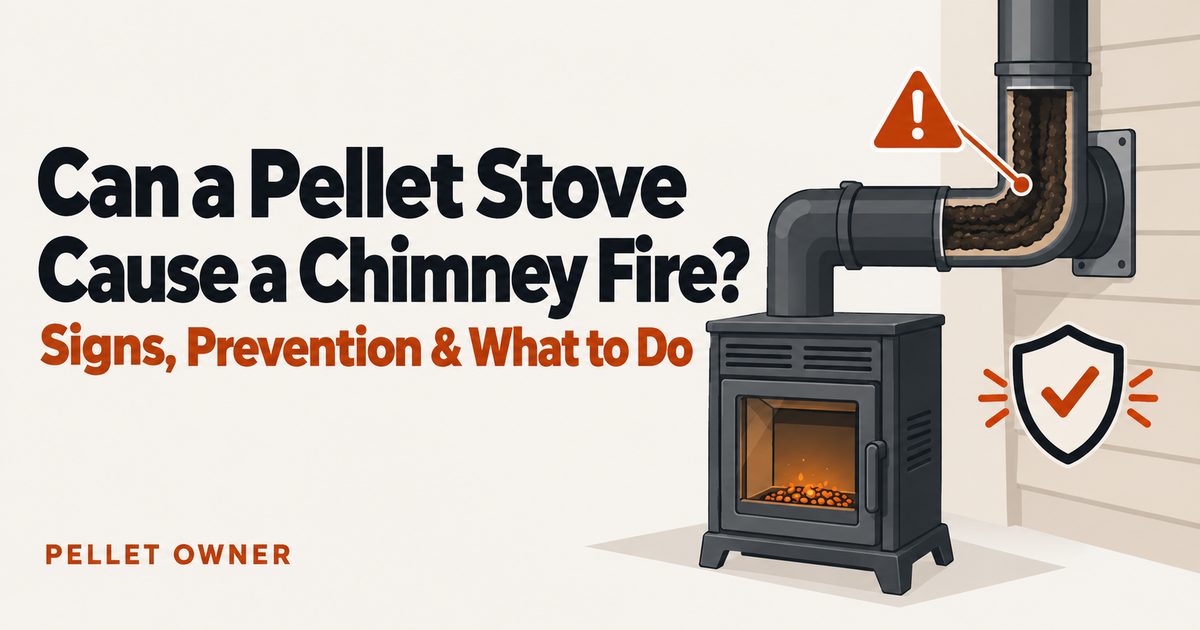
Yes. Owners and sweeps generally see it as less common than with a wood stove, but the manufacturers’ manuals explain how it happens: a low or incomplete burn leaves creosote and soot in the vent — fastest in horizontal runs and elbows — and when the stove later calls for more heat, that residue can ignite. You prevent it by inspecting and cleaning the vent, not burning hot. If you suspect one: stove OFF (don’t unplug), everyone out, call 911.
I’m not an NFI technician or a firefighter, so where this touches emergency response, I’m quoting the manuals and fire-safety sources, not improvising.
Do pellet stoves produce creosote?
Although plenty of owners — and some sweeps — will tell you a well-maintained pellet stove doesn’t make creosote, the manufacturers don’t say that. They say it can, under specific conditions:
- PelPro PP130-C: when wood pellets burn at a low temperature, they give off organic vapors that combine with moisture to form creosote vapors, which “condense in the relatively cool chimney flue of a newly-started or a low-temperature fire. As a result, creosote residue accumulates on the flue lining.”
- Harman P43: “Whenever wood is burned slowly, the potential exists for creosote to form in the venting.”
- Harman P43 and P61, Englander (both generations): incomplete combustion during start-up, shutdown or incorrect operation leads to “some soot formation which will collect in the exhaust venting system.”
The manuals name three things that collect in a pellet vent: fly ash, soot and creosote. Owners and sweeps report that fly ash, the fine powder, is the bulk of what they brush out; the manuals’ complaint about it is that it restricts the flow of flue gases. Creosote is the one PelPro describes igniting. So: less common than with wood, not impossible — and more likely on a stove that runs low, lazy or dirty.
What makes creosote build up in a pellet vent?
Pulling the manuals together, these are the conditions to watch:
- Long, low, slow burns. The PelPro and Harman passages above both point at low-temperature, slow burning and a cool flue.
- Incomplete combustion. Start-up, shutdown and “incorrect operation” are when the manuals say soot forms. A tall, lazy, dark-tipped flame is the visible sign owners learn to watch for — see how to read your pellet stove’s flame.
- Ignoring a Harman 6-blink. The P43 manual says the board shuts the stove down as a safety feature when it calculates poor or incomplete combustion, and that “poor or incomplete combustion is a contributor of creosote which may cause a chimney fire.” Here’s what the 6-blink code means and how to clear it.
- Horizontal runs and elbows. PelPro says soot, creosote and fly ash build up “more quickly in horizontal sections and elbows.”
- A dirty burn pot and air path. Plugged burn pot holes, a fines-packed chamber under the pot and a blocked air inlet are all on the P43’s list of causes of poor combustion — the same poor combustion it links to creosote.
- Damp fuel. PelPro says burning fuel with high moisture content tends to cool the stove. My read: that pushes you toward exactly the cooler, sluggish burn the manuals describe above.
There’s a second, separate route to a fire: over-firing. Englander’s manuals put it bluntly: “If the unit or chimney connector pipe ‘glows’ red (or white), the stove is over-fired. This condition could cause a house or chimney fire.” Harman’s P-Series -C installation manual gives the same warning sign — if any external part starts to glow, you’re overfiring; reduce the feed rate. (The classic Harman P43 and P61 manuals note that their ESP control prevents the stove from being over-fired.)
“Just burn it hot to clean it out” — why that’s backwards
This one circulates on forums and in at least one stove retailer’s blog: run the stove hot now and then to “cook off” creosote. Some owners make a habit of running it higher in the evening for the same reason.
Although the belief is common, PelPro’s manual describes that exact moment as how a chimney fire starts. Right after explaining how creosote condenses in a cool flue, it says: “When more heat is called for, this residue can be ignited, which creates an extremely hot fire in the chimney flue; this may damage the chimney or even destroy your home.”
| Preventing creosote | “Burning it off” | |
|---|---|---|
| What you do | Run the stove as its manual intends, keep the burn pot and air path clean, inspect the vent | Fire the stove hot on purpose to ignite deposits already in the vent |
| What the manuals say | Harman’s P43 recommends the normal Feed Adjuster range (#4) when you don’t need maximum heat | PelPro: residue in the flue “can be ignited” when more heat is called for |
| What you get | Less new creosote forming | That is a chimney fire |
So where does that leave the “run it hot now and then” habit? Running your stove at the higher settings it’s designed for is normal operation — but it isn’t a cleaning cycle. It doesn’t remove creosote that’s already there, and if there is buildup, extra heat is exactly what PelPro says can ignite it. Inspect and clean first; never use heat as the cleaning method. Deposits come out with a brush: Harman’s P43 says a layer of 3 mm or more “should be removed to reduce the risk of a chimney fire,” and adds that “a professional chimney sweep is recommended, since they would normally have the correct equipment to ensure proper creosote removal.”
And don’t try to engineer your way out of low burns by modifying the stove. PelPro and Harman both state that the stove has a manufacturer-set minimum low burn rate that must not be altered — doing so is against federal regulations.
What are the signs of a chimney fire?
The best-known lists come from fire-safety sources writing about chimneys in general, mostly wood-burning ones — a guide, not a pellet-specific checklist:
- The Chimney Safety Institute of America (CSIA) describes loud cracking and popping, a lot of dense smoke, and an intense, hot smell; flames or dense smoke shooting from the top of the chimney; and a low rumble homeowners compare to a freight train or a low-flying airplane (csia.org, “Preventing Chimney Fires,” accessed September 2026).
- Portland Fire & Rescue lists a loud roar, sucking sounds, shaking pipes, hot spots on the wall or chimney, or smoke in the house (portland.gov, accessed September 2026).
- On a pellet stove specifically, the manual sign to know is Englander’s: a stove or connector pipe glowing red or white means over-firing, which “could cause a house or chimney fire.”
The unsettling part also comes from CSIA: “The majority of chimney fires go undetected.” Slow-burning ones don’t get enough air or fuel to be dramatic, and often turn up only at a later inspection — with damage that can match the dramatic kind. CSIA’s after-the-fact clues include “puffy” or “honeycombed” creosote, creosote flakes and pieces on the roof or ground, and a discolored or distorted rain cap. One more reason the yearly inspection matters.
What to do if you think your pellet vent is on fire
The only manual in my set that spells out a vent-fire procedure is Harman’s P43. The PelPro and Englander manuals I work from don’t include one, so for those stoves I’d follow the same core — controls off, everyone out, fire department — alongside your own manual’s shutdown rules:
- Turn the stove OFF with its controls — don’t unplug it. The P43 says to turn the stove to “OFF” to allow the unit to shut down. Harman’s P43 and Englander’s manuals both forbid shutting a stove down by pulling the plug; the P43 explains that it stops the combustion blower and lets smoke escape into the room. It takes a second; do it on your way out, not instead of leaving.
- Get everyone out of the house. P43: “be sure everyone is out of the residence.” Portland Fire & Rescue: “get everyone out of the house quickly.”
- Call 911 from outside. P43: “Call the fire department.” Portland Fire & Rescue says to call 911 “from a cell phone or neighbor’s phone.”
- Don’t use the stove again until it’s been inspected. P43: “Before re-using the appliance, have it, and the venting system thoroughly inspected and replace any damaged components.”
What not to do:
- Don’t unplug the stove. See step 1.
- Don’t open the stove door or the hopper. Englander’s smoke-back instructions are emphatic about keeping both closed; I’d apply the same caution to a vent fire.
- Don’t borrow wood-stove advice about the damper or the air supply. Portland’s list includes “shut off the fire’s air supply” — that’s written for wood stoves and fireplaces. Pellet manuals prohibit installing a flue damper in the exhaust venting at all (Harman P43 and P61, PelPro, Englander, and Harman’s -C installation manual), and none of the manuals I work from tells you to adjust the air during a vent fire.
- Don’t stay to fight a fire inside the vent. That’s what the fire department is for.
Hopper fire or smoke in the hopper: a different emergency
A fire or smoke in the hopper is not the same event as a vent fire, and the manuals handle it separately:
- Harman P-Series -C installation manual: “In the event of a hopper fire: Evacuate the house immediately. Notify fire department.”
- Englander (both generations): if you see “any evidence of smoke in the hopper (smoke back),” close and latch the hopper lid and the door, open the nearest windows and outside door, press OFF, and let the unit cool for at least 3 hours without opening the door or hopper lid. Then call technical support — the manual calls it “a maintenance problem.”
Englander’s procedure is for smoke. If you see flames, or the smoke keeps building, treat it as a fire: get out and call 911.
After a chimney fire
Whatever brand you own, I’d apply the P43’s last step: before using the stove again, have it and the whole venting system thoroughly inspected, and any damaged components replaced. That’s a job for a certified professional — a CSIA-certified sweep or an NFI-certified technician — not a DIY look with a flashlight.
How to prevent a pellet stove chimney fire
Inspection intervals differ by manual, and your own manual sets the minimum:
| Manual | What it says about the vent |
|---|---|
| PelPro PP130-C | Inspect the chimney “once every few months during the heating season” and remove creosote or soot if it has accumulated; venting service annually or as needed |
| Harman P43 | Inspect “periodically throughout the heating season”; remove creosote at 3 mm or more; venting inspected at least once every year; stove inspected before use and at least annually by a qualified service person |
| Harman P61 | Venting inspected at least once every year |
| Englander 25-PDV and 25-PDVC | Venting inspected at least once every year; stove and flue system get a complete cleaning at the end of the heating season |
Those aren’t contradictions — they’re different minimums for different stoves. CSIA’s general advice lines up with the yearly baseline: have your chimney checked annually by a CSIA Certified Chimney Sweep.
Then the habits that keep creosote from forming in the first place:
- Clean the vent on schedule. What you can do yourself and what needs a pro is in pellet stove chimney cleaning: DIY vs pro.
- Keep the firebox side clean — burn pot holes, the chamber under the pot, the air inlet. The deep clean checklist walks through it.
- Burn dry, good-quality pellets. PelPro recommends Pellet Fuels Institute certified fuel, and the manuals want fuel stored dry.
- Watch the flame and the status light. A lazy flame or a Harman 6-blink is combustion telling you something.
- Don’t over-fire, and don’t alter the stove’s burn settings.
- Detectors and an extinguisher. Harman’s -C installation manual calls for at least one smoke detector and one CO detector on each floor and a Class A fire extinguisher within easy reach for small fires; PelPro also calls for a CO detector on each floor.
- Handle ashes like they’re live. Put them in a metal container with a tight-fitting lid and set it on a noncombustible floor or on the ground, well away from anything that burns (P43, PelPro, Englander) — see how to dispose of pellet stove ash safely; Harman’s P43 adds that the container goes outdoors immediately, and the -C chart says outside too. Owners and stove-safety sites often point to hot ashes in the wrong container as one of the most common ways pellet stoves start house fires — even though it has nothing to do with the chimney.
FAQ
Do pellet stoves make less creosote than wood stoves? Owners and sweeps generally say yes. But “less” isn’t “none”: PelPro and Harman both describe creosote forming in pellet venting during low, slow or incomplete burns.
How often should a pellet stove vent be inspected? At least once a year under every manual I work from, and every few months during the heating season on the PelPro. Follow your own manual.
Do creosote-removing logs or sprays work on a pellet stove? None of the pellet stove manuals I work from mention them, so I can’t tell you they’re safe or effective for your stove. The manuals’ answer to creosote is inspection and mechanical removal — a brush, and a professional sweep for real buildup.
What does over-firing a pellet stove mean? Running it hotter than it’s designed for. Englander’s sign is the stove or connector pipe glowing red or white, and it warns this “could cause a house or chimney fire.” Harman’s -C installation manual says that if any external part starts to glow, you’re overfiring — reduce the feed rate.

Walt Hensley — Walt Hensley is the pen name of Pellet Owner’s editor. I’m not an NFI-certified technician, and I don’t sell stoves, pellets, or parts. Every guide here starts from the manufacturers’ owner’s and service manuals, is cross-checked against what owners consistently report, and says which is which — including what you can safely check yourself and when it’s time to call a certified technician.